Why Your Brain Can Feel Slower With Age—Even When Your Thinking Is Still Sharp

Processing speed and aging are closely connected. As we get older, it’s normal for some mental tasks to take a little longer—even when our knowledge, judgment, and overall thinking remain strong.

Maybe you’ve noticed it in small moments.

Someone asks you a question and you know the answer—but it takes an extra second to form the response.

You open several tabs to compare information and realize it takes more effort than it once did to keep everything straight.

Or you’re reading something complicated and catch yourself going back over a sentence you would have absorbed immediately ten years ago.

The strange part is that you don’t necessarily feel less intelligent.

In many areas, you may actually be better than you were when you were younger. You have more experience. Better judgment. A larger knowledge base. You recognize patterns faster because you’ve seen them before.

So why can the brain occasionally feel slower?

One possible piece of the puzzle is processing speed.

And processing speed is not the same thing as intelligence.

What Is Processing Speed?

Processing speed describes, broadly, how quickly your brain can take in information, make sense of it, and respond.

Processing speed and aging are often discussed in the context of fluid cognition—mental abilities involved in dealing with new information, solving unfamiliar problems, shifting attention, and responding quickly.—mental abilities involved in dealing with new information, solving unfamiliar problems, shifting attention, and responding quickly.

Research on normal cognitive aging has consistently found that processing speed is among the cognitive abilities that can gradually change across adulthood. At the same time, knowledge-based abilities such as vocabulary and accumulated general knowledge tend to remain much more resilient.

That distinction matters.

Being slower at processing something does not necessarily mean you understand it less well.

Imagine two computers containing the same enormous library of information.

One pulls up the answer instantly.

The other takes another second.

The information hasn’t disappeared.

The retrieval and processing simply take a little longer.

The human brain is obviously far more complicated than a computer, but the analogy helps explain why mental speed and mental ability shouldn’t automatically be treated as the same thing.

You Can Get Slower at Some Things—and Better at Others

This is one of the most misunderstood parts of cognitive aging.

We tend to imagine brain performance as one number:

Sharp or not sharp.

But cognition isn’t one ability.

It’s a collection of different systems.

Processing speed may change while knowledge remains extremely strong. Vocabulary can remain stable. Pattern recognition built through decades of experience may become excellent. Judgment may improve because you’ve encountered similar situations hundreds of times.

Researchers distinguish between fluid abilities and crystallized abilities.

Fluid abilities help us solve unfamiliar problems and manipulate new information quickly.

Crystallized abilities represent accumulated knowledge and experience.

Processing speed is generally considered a fluid ability, while vocabulary and general knowledge are classic crystallized abilities. Studies of normal aging show that these don’t necessarily follow the same trajectory.

This may explain something many experienced professionals recognize intuitively:

A 55-year-old may not process every new detail as rapidly as a 25-year-old.

But give both people a complicated real-world problem and speed alone may tell you very little about who reaches the better decision.

Why Slower Processing Can Feel Like a Memory Problem

Here’s where things get interesting about processing speed and aging.

Sometimes what feels like a memory problem may actually involve the amount of information your brain is trying to process at once.

Imagine someone gives you four pieces of information in quick succession.

If your brain processes them rapidly, the first piece is still readily available when you’re dealing with the fourth.

If processing requires a little more time, the earlier information may be harder to keep active while later information arrives.

One influential theory of cognitive aging proposes that slowing can affect higher-level thinking because mental operations have limited time to be completed and earlier information may become less accessible before later processing is finished.

In everyday life, this may show up as:

  • needing someone to repeat complicated instructions,
  • losing part of a conversation when several people speak,
  • rereading dense material,
  • needing longer to compare several options,
  • finding rapid task-switching more tiring,
  • or knowing something but needing an extra moment to retrieve it.

None of those experiences automatically mean that the information itself is gone.

Sometimes the problem is simply traffic.

Too much information is trying to move through the intersection at once.

Modern Life Makes the Difference More Noticeable

There’s another reason people may notice processing speed more today.

Our environments demand speed constantly.

Think about a normal workday:

An email arrives.

A text appears.

You return to the spreadsheet.

Your phone rings.

You answer a question.

You go back to the spreadsheet and try to remember exactly what you were doing.

Even a very capable brain can feel slow when it is repeatedly forced to stop, reorient, and reload context.

That means there’s an important distinction between:

“My brain is slower.”

and

“I’m asking my brain to process too many competing streams of information.”

The subjective experience can feel remarkably similar.

This is one reason reducing unnecessary cognitive load can make such a noticeable difference.

You haven’t suddenly increased your IQ.

You’ve simply given your existing cognitive resources a cleaner environment in which to work.

Speed Isn’t Always the Goal

There’s another assumption worth challenging:

Faster is always better.

Sometimes it is.

Quick reaction matters when driving. Rapid processing is useful during complicated conversations. Speed helps when learning unfamiliar software or managing several changing variables.

But many of life’s most important decisions reward something different:

  • Perspective.
  • Experience.
  • Pattern recognition.
  • Patience.
  • Judgment.
  • The ability to distinguish what matters from what doesn’t.

Those abilities aren’t captured simply by how many milliseconds it takes you to respond.

That may be especially reassuring to adults who notice they are no longer as mentally fast as they were at 25.

The goal doesn’t have to be recreating your 25-year-old brain.

A much more useful goal is helping your current brain perform at its best.

What Can You Do to Support Mental Processing?

There is no single switch for improving processing speed and aging-related changes in cognition.

But several practical habits can make the brain’s workload easier to manage.

1. Stop Creating Unnecessary Competition for Attention

If something matters, try doing it without simultaneously checking messages, listening to a podcast, and keeping three conversations open.

This sounds almost too simple.

But every additional stream of information gives your brain something else to select, suppress, remember, or return to.

Protecting attention can make thinking feel faster simply because less cognitive energy is being spent deciding what deserves attention.

2. Give Complicated Information an Extra Beat

Speed pressure can itself make cognitive tasks harder.

When someone explains several things quickly, pause before responding.

For complicated information, allow yourself another pass before responding.

If a decision involves several variables, write them down instead of demanding that your working memory hold everything simultaneously.

The goal isn’t proving how quickly you can think.

The goal is thinking well.

3. Move Your Body

Physical activity has repeatedly been associated with brain-health benefits, and research has found potential benefits across some areas of cognition, including attention, processing speed, executive function, and memory.

The CDC notes that regular physical activity can help keep thinking, learning, and judgment skills sharp as we age.

It doesn’t mean one walk transforms your processing speed.

It does mean movement belongs in the larger picture of supporting a brain you expect to perform for decades.

Related: Why a Short Walk Can Help You Think More Clearly

4. Use Your Environment as External Memory

Write things down.

Keep important information visible.

Use reminders.

Create repeatable systems.

These aren’t signs of cognitive weakness.

They’re intelligent ways of reducing unnecessary mental load so your attention can be used for the work that actually requires thinking.

5. Keep Demanding Something From Your Brain

A comfortable brain isn’t necessarily an engaged brain.

Read unfamiliar material.

Learn something complicated.

Have conversations with people who make you think.

Solve problems without immediately reaching for an answer.

As we discussed in Why Trying to Remember Before Looking It Up Can Make Memory Stronger, actively retrieving information requires more mental engagement than simply rereading it.

And when you’re learning something you want to retain, spacing your learning over time can be more effective than repeatedly reviewing it in one sitting.

The larger principle is simple:

Don’t just consume information.

Interact with it.

Mental Sharpness Is More Than Mental Speed

We often judge our brains by their quickest moments.

How fast did I remember the name?

How quickly did I understand the instructions?

Why did that answer take me five seconds instead of one?

But mental performance is bigger than speed.

A sharp mind can be thoughtful.

Focused.

Experienced.

Accurate.

Creative.

Persistent.

And sometimes deliberately slow.

At Lumultra, we’re interested in supporting the conditions that help people stay mentally engaged—focus, memory, clarity, and the ability to stay with demanding cognitive work.

Because the objective isn’t simply to think faster.

It’s to be able to use your mind well when it matters.

So if you occasionally find yourself taking an extra second, don’t judge your brain by the stopwatch.

Pay attention to what happens next.

You may discover that the answer arriving a little later is still a very good one.

Understanding processing speed and aging can make those occasional moments of slower thinking feel less alarming.

Give Your Brain Better Conditions to Perform

Lumultra is formulated for adults who want support for focus, memory, mental clarity, and productive mental performance during demanding days.

Explore Lumultra →

These statements have not been evaluated by the Food and Drug Administration. This product is not intended to diagnose, treat, cure, or prevent any disease.

Why Is It Harder to Follow Conversations in Noisy Rooms After 50?

If you find it harder to follow conversations in noisy rooms after 50, you may notice it most while sitting at dinner with friends. You can hear everyone talking and you are not completely missing the words—but something has changed.

When several people speak at once, you have to concentrate harder than you used to. Someone across the table tells a story and halfway through it, you realize you missed an important detail. You ask them to repeat themselves.

Then someone else starts talking.

By the end of dinner, you have followed most of the conversation—but it felt strangely exhausting.

If this has become more noticeable after 50, there is an important point to understand:

Following a conversation is not purely a hearing task.

Your ears receive sound, but your brain still has to separate one voice from another, ignore irrelevant noise, process language, hold earlier parts of a sentence in working memory, connect ideas, and prepare your own response.

When the environment becomes noisy, all of those jobs become harder.

And that may explain why conversations that once felt effortless can sometimes require noticeably more mental energy.

Why It’s Harder to Follow Conversations in Noisy Rooms

Imagine talking with someone in a quiet room.

There is one dominant voice.

Your brain has relatively little competing information to filter.

Now move that same conversation into a crowded restaurant.

Music is playing.

Plates are clattering.

Someone at the next table is talking loudly.

Two people at your table begin speaking at once.

A server asks a question behind you.

Your brain has to determine:

Which sound matters right now?

Researchers often study this as speech perception in noise.

Research involving older adults has found that understanding speech against competing background sound becomes more difficult with age, and hearing ability alone does not completely explain the difference. Working memory, processing speed, and attention can contribute as well.

That distinction matters.

Sometimes the challenge is not simply:

“I cannot hear.”

It is:

“I can hear—but I have to work much harder to understand.”

Hearing Changes Can Still Be Part of the Picture

Hearing should not be ignored.

The National Institute on Deafness and Other Communication Disorders notes that age-related hearing loss often develops gradually, sometimes so gradually that people do not immediately recognize the change.

Certain speech sounds can become harder to distinguish, particularly when there is background noise.

Another factor is processing speed, which can gradually change with age and make rapidly arriving information harder to sort through when several things are competing for attention.

That means someone might function perfectly well during a quiet conversation but struggle considerably more in a restaurant, conference, party, or family gathering.

This is why persistent difficulty understanding speech in noisy environments is worth discussing with a healthcare professional or hearing specialist.

But hearing is only one part of what makes conversation work.

Your brain still has to interpret what your ears deliver.

Conversation Uses Working Memory

Working memory is the temporary mental workspace that keeps information available while you are actively using it.

Think about a long sentence.

By the time someone reaches the end, you need to remember what they said at the beginning.

Or imagine someone telling you:

“I spoke with John on Monday, but Susan said the meeting is actually moving to Thursday.”

Your brain has to temporarily hold:

  • John
  • Monday
  • Susan
  • the meeting
  • Thursday
  • the relationship between all of those details

And you have to do it while the speaker continues talking.

Research on speech comprehension has found that working-memory ability can contribute to how successfully older adults understand speech in challenging listening environments.

This means that a noisy conversation is placing demands on more than your ears.

Your brain is continually reconstructing meaning from an imperfect signal.

The same process can also affect how well you remember new information after 50. When attention is divided, important details may not be encoded as clearly in the first place.

Background Noise Creates Competition for Attention

Attention plays another major role.

At dinner, your brain may be hearing four conversations.

But you only want one.

The ability to suppress irrelevant information while staying locked onto the person speaking is a form of attentional control.

When the environment becomes more complicated, the brain has more competing information to manage.

This connects closely with why your brain feels slower after 50.

You may still understand everything perfectly when you have sufficient time and a clean environment.

But when information arrives quickly from several directions, the processing demands rise.

The problem is not necessarily that the knowledge disappeared.

The brain simply has more filtering to do before it can use the information.

This Can Also Explain Why Names Disappear

There is an interesting connection to why names become harder to remember after 50.

Imagine being introduced to someone at a quiet desk.

“Hi, I’m Michael.”

You hear the name clearly.

You have time to register the face.

You repeat it:

“Nice to meet you, Michael.”

Now imagine the exact same introduction at a wedding reception with 100 people talking.

Your attention is divided.

The name competes with background conversations.

Someone interrupts.

You are thinking about what to say next.

Ten minutes later, the name is gone.

That may feel like a memory problem.

But part of the failure may have happened before memory was ever tested.

You cannot reliably remember information that your attention never encoded clearly.

This is why improving memory often begins with improving the conditions under which information enters the brain.

Why Noisy Conversations Can Feel Exhausting

Listening effort is another important concept.

Researchers use the term to describe the mental resources required to understand speech when listening becomes difficult.

Studies have found that older adults may need to devote greater cognitive resources to understand speech in background noise.

A 2026 study involving older adults with hearing loss also found that background noise can increase listening effort and fatigue during demanding tasks.

This explains an experience many people find confusing:

You attend dinner.

You barely move physically.

Yet two hours later, you feel mentally exhausted.

Your brain may have spent much of the evening performing continuous filtering:

Listen. Separate. Interpret. Remember. Predict. Respond. Repeat.

The conversation was social.

The cognitive workload was real.

This is also why brain fog and mental fatigue can sometimes overlap.

Your brain may still be capable of understanding everything, but maintaining that level of cognitive effort for several hours can leave thinking feeling less clear afterward.

Context Helps Your Brain Fill in Missing Pieces

Fortunately, your brain does not process every word independently.

It uses context.

If someone says:

“I went to the grocery store to buy a loaf of…”

Your brain already predicts likely possibilities.

Bread is much easier to recognize than an unrelated word because the sentence created an expectation.

Research has found that meaningful sentence context can reduce listening effort in older adults.

This is one reason familiar people are sometimes easier to understand than strangers.

You know their voice.

You know how they speak.

You know the subjects they discuss.

You can predict more of what is coming.

The brain does not have to reconstruct every piece from scratch.

How to Follow Conversations in Noisy Rooms More Easily

You cannot make every restaurant quiet.

But you can reduce unnecessary cognitive load.

1. Choose your position strategically

If possible, sit where you can clearly see the people you are speaking with rather than placing yourself in the middle of several competing sound sources.

Visual information from a speaker’s face can provide additional cues during conversation.

2. Reduce competing stimulation

If you are trying to follow an important conversation, avoid simultaneously checking messages, scanning the room, or handling another task.

One stream of attention gives the brain more resources for listening.

3. Ask for the important part again

Instead of pretending you heard everything, ask:

“Did you say Thursday?”

That is often easier than asking someone to repeat an entire paragraph.

4. Protect cognitive energy

A noisy dinner after a day of meetings, decisions, emails, and travel may be much harder than the identical dinner when you are fresh.

Your listening environment did not change.

Your available mental resources did.

Sleep, recovery, breaks, and overall mental fatigue matter.

5. Have your hearing checked when appropriate

Difficulty understanding speech in noisy settings can be associated with hearing changes, and hearing loss often develops gradually. Professional evaluation may be appropriate when hearing difficulties become noticeable.

Cognitive support should never be used as a substitute for investigating a possible hearing problem.

Where Lumultra Fits

This distinction is important.

Lumultra does not treat hearing loss.

If the problem is reduced hearing ability, that deserves appropriate evaluation.

But conversation also depends on cognitive functions including:

  • sustained attention
  • working memory
  • mental clarity
  • information processing
  • recall
  • cognitive stamina

Those are the areas where Lumultra belongs in this conversation.

Lumultra is positioned as daily cognitive support for focus, memory, and mental clarity, alongside overall cognitive performance.

For someone whose bigger complaint is:

“My mind feels less reliable when too much is happening at once,”

the goal should not simply be more stimulation.

The goal is creating better conditions for cognitive performance.

That includes sleep.

Fewer unnecessary distractions.

Physical activity.

Appropriate hearing care.

Recovery.

And, for adults who want additional daily cognitive support, a nootropic routine such as Lumultra can fit alongside those fundamentals.

The point is not to make a crowded restaurant silent.

It is to support the cognitive resources your brain uses when the world is not.

The Bottom Line

If conversations in noisy rooms feel harder to follow after 50, do not automatically assume your memory is failing.

And do not automatically assume it is purely a focus problem either.

Successful conversation requires several systems to work together.

Your ears have to detect speech.

Your brain has to separate the voice from competing sounds.

Attention has to remain on the speaker.

Working memory has to hold the beginning of the thought while the rest arrives.

Your brain then has to connect everything quickly enough to understand and respond.

When one part becomes more demanding, the others have to work harder.

That is why a conversation you can follow effortlessly in a quiet room may feel surprisingly difficult in a crowded restaurant.

Sometimes the smartest response is to improve the environment.

Sometimes it is to check your hearing.

And sometimes it is a reminder that maintaining focus, mental clarity, working memory, and cognitive stamina matters more than we realize.

Because clear thinking is not only about what you know.

It is also about how effectively your brain can find the signal inside all the noise.

Explore Lumultra for daily support with focus, memory, mental clarity, and cognitive performance.

This article is for educational purposes and is not a substitute for medical advice, diagnosis, hearing evaluation, or treatment.

Can Your Brain Still Change After 50?

You try to learn a new program and feel as though every button disappears the moment you look away.

Someone explains a new process, and you understand it—but need to hear it again before it truly sticks.

You take a different route, begin a new hobby, or attempt to change a familiar routine, and your brain seems to resist the adjustment.

That can lead to an uncomfortable question:

Can your brain change after 50, or has it become too set in its ways?

The reassuring answer is yes. Your brain can continue learning, adapting, and reorganizing itself throughout your life.

The process may not feel as effortless as it did when you were younger. You may need more repetition, fewer distractions, better recovery, and stronger reasons to stay engaged. But slower adaptation is not the same as losing the ability to adapt.

Your brain is not finished.

As you build new routines, well-placed notes and reminders can help you remember to carry out the actions you have planned.

Your Brain Is Designed to Change

The brain’s ability to change in response to experience is called neuroplasticity.

Neuroplasticity allows connections between brain cells to strengthen, weaken, reorganize, and respond to what you repeatedly do. It is involved whenever you learn a skill, form a memory, adjust to an unfamiliar environment, or develop a more efficient way to complete a task.

For years, people assumed that this flexibility belonged mainly to children and younger adults.

We now know that the brain remains adaptable throughout adulthood. Research on cognitive aging has found that older adults can continue showing neural and cognitive changes in response to sustained training and experience.

The National Institute on Aging also emphasizes that physical activity, intellectual engagement, sleep, cardiovascular health, and social connection can all contribute to cognitive health as people get older.

That does not mean every age-related change can be prevented or reversed.

It means that age does not turn your brain into a fixed object.

So, Can Your Brain Change After 50?

Yes—but change may become less automatic.

A younger brain is constantly encountering first experiences. New schools, new relationships, new environments, new responsibilities, and unfamiliar problems give it repeated reasons to build and adjust its internal pathways.

By the time you reach your 50s, much of daily life has become familiar.

You may have performed the same professional tasks for decades. You follow similar routines, drive familiar roads, use the same vocabulary, and rely on well-established ways of solving problems.

That experience is valuable. It is one reason older adults often have stronger judgment, broader knowledge, and a better ability to recognize patterns.

But familiarity also means the brain receives fewer demands to reorganize itself.

The issue is not always that your brain has lost its ability to change. It may simply be receiving fewer meaningful reasons to change.

What Actually Changes With Age?

Certain cognitive functions can become less efficient with age.

Processing speed may slow. It may take longer to switch between tasks. Working memory can feel less spacious when several pieces of information arrive at once. Names and precise words may require more time to retrieve.

This helps explain why your brain can feel slower after 50, even when your intelligence, experience, and long-term knowledge remain strong.

A younger person may learn a new device by rapidly tapping through every menu.

An older adult may prefer to understand the logic first, connect the new system to something familiar, and repeat the process several times.

The second method is not necessarily worse.

It is simply more deliberate.

The aging brain often becomes more dependent on context, meaning, and established knowledge. Once new information becomes connected to something you already understand, it may become much easier to retain.

That reliance on meaning can also help explain why you sometimes remember the overall experience while the precise details are harder to retrieve

Difficulty Does Not Mean Your Brain Is Failing

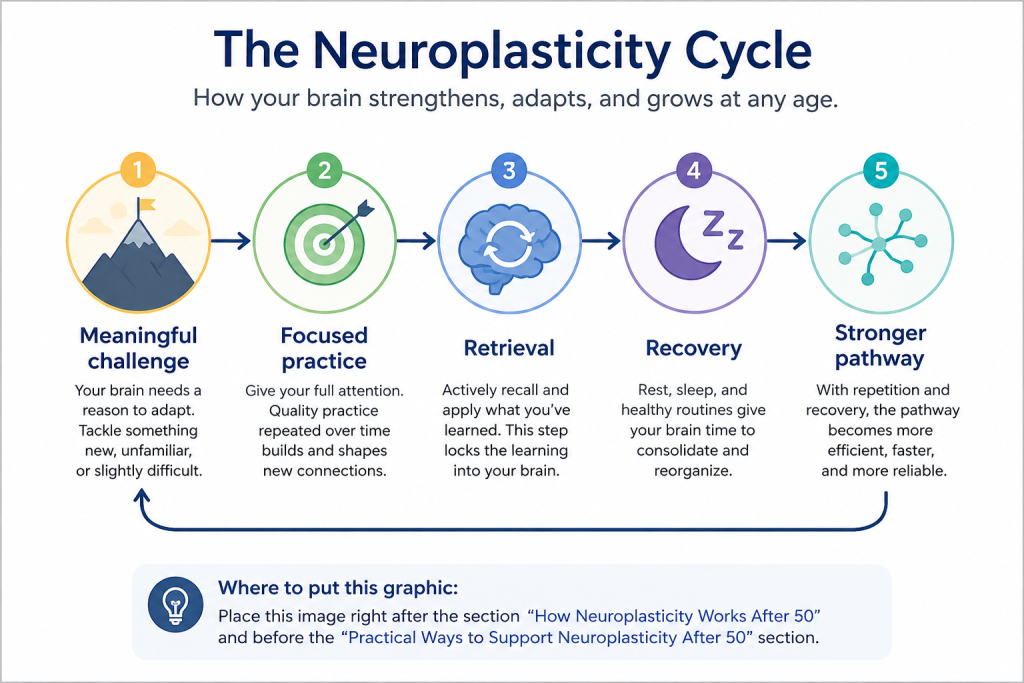
Diagram showing how challenge, focus, repetition, retrieval, and recovery support neuroplasticity

One of the biggest obstacles to learning after 50 is not necessarily biology.

It is interpretation.

When something feels harder than it used to, people often assume the difficulty means they are no longer capable of doing it.

They say:

  • “I am too old to learn this.”
  • “Technology changes too quickly for me.”
  • “My memory is not good enough anymore.”
  • “I used to pick things up immediately.”
  • “My brain just does not work that way now.”

Those conclusions can cause people to stop just when the brain is beginning to adapt.

Learning is supposed to create some friction.

The moment when you have to pause, retrieve the next step, correct an error, or try again is not evidence that nothing is happening. It is often the exact moment your brain is being asked to build a stronger pathway.

If everything feels completely automatic, your brain may be performing—but it is not necessarily adapting.

Four Conditions That Help the Aging Brain Adapt

Neuroplasticity is not created by simply wanting your brain to remain sharp.

It responds to conditions.

1. Meaningful Challenge

The activity needs to demand something your brain does not already do automatically.

That could mean:

  • Learning conversational phrases in another language
  • Practicing a new golf technique
  • Using unfamiliar software
  • Learning an instrument
  • Taking a class outside your professional expertise
  • Navigating a new city
  • Learning the rules of an unfamiliar game

The challenge should feel difficult enough to require attention but not so overwhelming that you immediately disengage.

Doing the same crossword puzzle format every morning may feel mentally active. But once the pattern becomes completely familiar, it may no longer provide the same adaptive demand.

Novelty helps, but meaningful difficulty matters more.

2. Focused Repetition

Your brain needs repeated opportunities to strengthen a new pathway.

However, repetition only works when your attention is present.

Repeating something ten times while checking messages, thinking about another task, or moving between tabs may create less learning than three focused attempts.

This is because memory starts with attention.

As discussed in why you forget what you just read, information cannot be recalled reliably if it was never clearly encoded in the first place.

Focused repetition tells your brain:

This information matters. Keep this pathway available.

Distracted repetition sends a weaker signal.

3. Recovery

The work of learning does not end when practice stops.

Sleep and recovery help the brain consolidate information, strengthen memory, and prepare for future learning.

Recovery does not happen only during sleep; research also suggests that brief wakeful rest after learning may help create favorable conditions for newly learned information to consolidate.

This is why forcing yourself through hours of frustrated practice is not always the most effective approach.

A shorter period of concentrated effort followed by proper recovery may create better results than a longer period of mentally depleted repetition.

Poor sleep also makes attention and working memory less dependable. When those systems are weakened, learning can feel unnecessarily difficult—even when the brain remains capable of adapting.

4. Physical Activity

The brain is not separate from the rest of the body.

Research on physical activity and aging has found that the brain can retain meaningful plasticity in later adulthood, and exercise is associated with changes relevant to memory and cognitive function.

Movement supports circulation, cardiovascular health, stress regulation, sleep, and other systems that affect how well the brain can learn and perform.

You do not need to become an elite athlete.

Walking, resistance training, golf, swimming, dancing, cycling, and other sustainable forms of movement can all be part of a brain-supportive lifestyle.

Harvard Health also notes that continued learning, regular movement, and mentally engaging activities help support cognitive fitness throughout adulthood.

The best activity is often the one you will continue doing consistently.

Your Brain Learns Better When the Information Matters

Adults sometimes compare themselves unfairly with children.

A child may memorize something quickly, but adults possess an advantage children do not: decades of context.

You already have a large network of experiences, concepts, relationships, and knowledge. New information can become easier to retain when you deliberately attach it to that network.

For example, instead of trying to memorize a person’s name as an isolated sound, connect it with:

  • Someone else you know with the same name
  • The person’s profession
  • Where you met
  • A detail from your conversation
  • A visual feature or meaningful association

This can help with the same retrieval problems discussed in why you cannot remember names and why words get stuck on the tip of your tongue.

The brain remembers relationships better than disconnected information.

Meaning gives a new memory somewhere to belong.

One simple strategy worth exploring is drawing to improve memory, which researchers have tested as a learning technique in both younger and older adults.

Retrieval Is More Powerful Than Recognition

Many people try to learn by repeatedly looking at the answer.

They reread the instructions, rewatch the demonstration, or keep the steps visible while performing the task.

This creates familiarity. But familiarity is not always the same as learning.

A more powerful approach is retrieval.

After reviewing the information, look away and try to reproduce it from memory.

Ask yourself:

  • What were the three steps?
  • How would I explain this without looking?
  • What comes next?
  • What did I get wrong last time?
  • How does this connect to something I already know?

Learning may also become more meaningful when you deliberately connect a new idea to knowledge or experience you already understand.

The effort required to retrieve the information helps reinforce the pathway leading back to it.

That effort may feel uncomfortable.

But comfortable recognition can create the illusion that you know something, while active retrieval reveals whether the information has actually become accessible.

Stop Making Your Brain Learn While It Is Switching

Modern life makes neuroplasticity more difficult for a simple reason: we rarely give the brain enough uninterrupted time to engage deeply.

You begin learning something.

A message arrives.

You answer it.

You return to the lesson.

Then you remember an email, open another tab, check a notification, and attempt to resume where you stopped.

Every switch forces the brain to reconstruct context.

The same instability can cause you to forget what you were about to do.

Learning requires continuity.

Your brain needs enough uninterrupted time to understand the information, make mistakes, correct those mistakes, and repeat the process while the context is still available.

Before assuming your brain can no longer learn, ask whether it is being given a fair opportunity to learn.

What Cognitive Support Can—and Cannot—Do

No supplement can perform the work of neuroplasticity for you.

A capsule cannot learn the language, practice the skill, protect your sleep, take the walk, or provide the repetition required to make a new ability more automatic.

But cognitive support can serve a different purpose.

Learning and adaptation depend on your ability to:

  • Pay attention
  • Hold information in working memory
  • Process what you are seeing
  • Remain mentally connected to the task
  • Retrieve the next step
  • Continue long enough for repetition to occur

When those systems feel inconsistent, the problem may not be your willingness to learn. It may be the amount of cognitive friction you experience while trying.

Where Lumultra Fits

Lumultra is formulated to support focus, working memory, mental clarity, and processing speed—the cognitive functions involved in learning, retaining, and using information.

Its role is not to claim that aging can be reversed.

Its role is to support the mental conditions that allow you to stay engaged with challenging information instead of repeatedly losing your place.

Noopept sits at the center of the Lumultra formula, alongside ingredients selected to support complementary areas of cognitive performance.

The relevant benefit is not simply feeling more stimulated.

It is being able to remain mentally present long enough to understand the task, hold the information, repeat it deliberately, and return to it with greater continuity.

That is the practical bridge between cognitive support and lifelong learning.

Neuroplasticity still requires your participation.

Lumultra is designed to help support the brain you are asking to participate.

Support the Mental Work Behind Lifelong Learning

Your brain is still capable of learning, adapting, and building stronger mental pathways.

Support the focus, working memory, mental clarity, and processing speed that help you stay engaged with the process.

Explore Lumultra

New subscribers can receive 30% off their first subscription with code NEWU26.

When Cognitive Changes Deserve Medical Attention

Occasional difficulty learning a new system, remembering a name, or adjusting to an unfamiliar routine can occur with normal aging.

However, noticeable or worsening changes that interfere with everyday functioning should not simply be dismissed as age.

Speak with a qualified healthcare professional when cognitive changes begin affecting areas such as:

  • Managing finances
  • Following familiar instructions
  • Navigating known places
  • Taking medications safely
  • Completing normal responsibilities
  • Communicating clearly
  • Maintaining personal independence

Supporting cognitive health includes recognizing when professional evaluation is appropriate.

Final Thought

Can your brain change after 50?

Yes.

It may require more intentional challenge.

More focused repetition.

Better recovery.

Fewer interruptions.

And more patience during the uncomfortable period when something new has not yet become familiar.

But difficulty is not the same as incapacity.

Age may change the speed at which a new pathway forms. It does not erase your ability to form one.

Your brain is still responding to what you repeatedly ask it to do.

Give it meaningful work. Then provide enough focused attention for that work to take hold, along with the recovery needed to retain what it learns.

And support the cognitive functions that help you remain present for the process.

Your brain is not finished changing.

Neither are you.

This article is for educational purposes and is not a substitute for medical advice, diagnosis, or treatment.

Why Your Brain Feels Slower After 50

Feeling that your brain is slower after 50 can be frustrating because the change often does not feel like “memory loss” in the dramatic sense.

This is one of the most common complaints people notice as they get older: “I still feel like myself, but my brain does not feel as quick as it used to.”

The important thing to understand is that a slower-feeling brain does not always mean something is seriously wrong. In many cases, it reflects changes in processing speed, attention, mental recovery, and how much cognitive load your brain is carrying at once. According to the National Institute on Aging explains that the aging brain can change in ways that affect learning, memory, and other cognitive functions, while also noting that older adults may often perform well when given enough time to learn or process new information.

So the real question is not simply, “Am I losing my memory?” A better question is: “What is making my brain work harder than it used to?”

Feeling Slower Is Often About Processing Speed

When people say their brain feels slower after 50, they are often describing a change in processing speed. Processing speed is the rate at which your brain takes in information, organizes it, responds to it, and moves to the next thought.

This is why the issue may show up in subtle ways:

  • It may take a few extra seconds to remember names.
  • Reading the same sentence twice becomes more common.
  • Walking into a room only to forget why you went there happens occasionally.
  • Mental fatigue can set in after errands, emails, or conversations.
  • Solving problems is still possible, but getting started often requires more effort.
  • Conversations involving several people may feel harder to keep up with.

When several people are talking at once, the brain also has to separate competing sounds while processing speech, which helps explain why conversations in noisy rooms can become harder to follow after 50.

This does not mean intelligence disappears. In fact, life experience, judgment, vocabulary, emotional intelligence, and pattern recognition can stay strong or even improve with age. But the “speed” of accessing and organizing information may feel different.

Harvard Health notes that as people age, the brain’s processing speed can slow, which means recall may not happen as quickly as it used to. That is why you may remember the name five minutes later, after the pressure is gone. The information was not lost. Your brain simply needed more time and less interference to retrieve it.This is similar to why the brain blanks under pressure, when stress temporarily makes recall feel harder than it actually is.

Why the Brain Can Feel Mentally Heavier

A slower brain is not always caused by aging alone. Many people over 50 are also carrying more mental load than they realize.

By this stage of life, you may be managing business decisions, family responsibilities, finances, aging parents, health issues, travel, technology, and constant communication. Your brain is not just “thinking.” Instead, your brain is filtering, switching, remembering, planning, responding, and recovering all day long.

The brain is not designed to run at full speed without recovery. When your attention is repeatedly interrupted, your working memory becomes crowded. As your working memory becomes crowded, recall naturally slows. The result is that you feel less mentally sharp.

This is why mental slowness often feels worse during busy periods. You may notice it more after poor sleep, too much screen time, stressful conversations, travel, alcohol, or a demanding workday. The issue is not always that your brain has lost ability. Sometimes your brain is operating with too many tabs open. If your brain feels busy throughout the day, reducing cognitive overload can often improve focus and recall.

Normal Aging vs. Something Worth Checking

It is also important to be honest: not every cognitive change should be brushed off. Some changes are normal and manageable, while others deserve medical attention.

Normal age-related changes may include occasionally forgetting where you put your keys, struggling to find a word but remembering it later, or forgetting the name of an acquaintance. The CDC notes that these kinds of subtle changes can be frustrating, but should not interfere with daily life.

More concerning signs include memory problems that are getting worse, interfering with daily functioning, causing you to miss important responsibilities, or making familiar tasks difficult. Harvard Health similarly recommends seeking medical advice when memory loss becomes persistent, worsening, or starts affecting daily routines.

A good way to think about it is this: occasional forgetfulness (like misplacing keys or struggling to find a word) is normal, while frequent memory lapses involving appointments or familiar routes should be evaluated. Feeling slower but still functioning well may simply mean your brain needs better support, whereas noticeable changes observed by family or friends are worth discussing with a doctor.

Lumultra content should never replace medical evaluation. But for many people, the everyday feeling of “my brain is not as quick as before” is not necessarily a diagnosis. More often, this is a sign that attention, recovery, mental stamina, and brain-supportive habits need more care.

Some people also notice difficulty comparing several options at once. This does not necessarily indicate cognitive decline, but it can reflect increased cognitive load or normal age-related changes in attention.

The Role of Attention in Memory and Recall

Memory is not just about storage. Everything begins with attention.

If you are distracted when someone tells you their name, your brain may not encode the name clearly in the first place. Later, it feels like you “forgot,” but the real problem may be that the information never entered your memory strongly enough.

This becomes more noticeable with age because the brain may need more focused attention to form a strong memory. You may no longer be able to half-listen, check your phone, think about your schedule, and remember every detail effortlessly.

“Sometimes I can remember things when I really focus.”
“When I’m rushed, I forget things.”
“Writing it down helps me remember better.”
“The answer is there—I just need a second.”

These are not signs that your brain is useless. They are signs that your attention system may need more structure.

The modern world makes this worse. Notifications, short videos, multiple browser tabs, and constant switching train the brain to skim instead of encode. When your brain is always shifting, it becomes harder to create clean memories and retrieve them quickly.

If your brain feels slower after 50, one of the first things to improve is not memory. Attention should come first.

Mental Stamina Matters More Than People Realize

Another reason your brain feels slower after 50 is reduced mental stamina.

Mental stamina is your ability to think clearly over time. It goes beyond focusing for five minutes. Instead, it reflects your ability to stay mentally clear through a full morning, a long meeting, a complicated project, or a demanding day.

When mental stamina drops, the brain may start strong but fade quickly. You might feel sharp in the morning but foggy by afternoon. Handling one task well may still feel manageable, but multiple demands can quickly become overwhelming. Even with strong intelligence, your brain may feel less resilient than it once did.

This is one reason people become more interested in daily brain support as they age. Most people aren’t looking for stimulation. Instead, they’re looking for steadiness: better focus, cleaner recall, less mental drag, and more confidence in everyday thinking.

That is exactly where Lumultra fits into the broader conversation. Lumultra is not positioned as a cure for cognitive aging or a treatment for memory disorders. It is positioned as daily nootropic support for focus, mental energy, memory recall, and sharper thinking—especially for adults who want to feel more mentally capable during real life.

What Helps Support a Faster-Feeling Brain?

There is no single magic habit that fixes mental slowness. Your brain responds best to a stack of supportive behaviors done consistently.

Improve sleep quality

Sleep is when the brain restores, organizes, and clears mental clutter. Anyone who has experienced brain fog after poor sleep knows how much harder concentration and recall can become the next day. A decline in recall after a bad night’s sleep is not surprising. Your brain is simply running with less recovery.

Reduce attention switching

Multitasking feels productive, but it often makes thinking slower. Try doing one mentally demanding task at a time. Close extra tabs. Turn off nonessential notifications. Give your brain fewer things to filter.

Move your body

Physical activity supports blood flow, mood, metabolism, and overall brain health. Harvard Health lists regular exercise, healthy diet, and social interaction among practical ways to preserve mental function with age.

Use memory supports without shame

Writing things down, using reminders, keeping a consistent place for keys, and repeating names out loud are not signs of weakness. They are smart systems. High-functioning people use systems because they do not waste mental energy on things a tool can handle.

Support daily mental energy

For people who already prioritize sleep, movement, and healthy routines, nutritional nootropic support may be another layer. Lumultra is designed for people who want to support clearer focus, recall, and mental stamina as part of a daily routine.

Rather than forcing the brain into overdrive. The goal is to help the brain feel more available, more steady, and less overloaded.

Why Experience Still Matters

One of the most reassuring things about cognitive aging is that speed is not the only form of intelligence.

A younger brain may respond faster, but an experienced brain often sees patterns better. An older mind tends to judge risk more accurately, understand people more deeply, and know what truly matters. Experience also brings less impulsivity and more strategic thinking.

So if your brain feels slower after 50, do not reduce your entire mental ability to speed alone. Speed is useful, but wisdom, judgment, discipline, emotional intelligence, and pattern recognition matter too.

No one needs to become 25 again. Instead, the goal is to protect the parts of your thinking that make you effective now—and support the areas that feel less automatic than before.

When to Take Action

If you are noticing occasional slowness, start with the basics: sleep, stress, exercise, hydration, fewer distractions, and better daily routines. Track whether your brain feels worse after poor sleep, heavy stress, alcohol, travel, or too much screen time.

If your symptoms are worsening, interfering with your life, or being noticed by people close to you, speak with a qualified healthcare provider. MedlinePlus notes that dementia and severe memory loss are not a normal part of aging, and some sudden confusion or memory changes may be related to other medical issues or medications.

But if what you are experiencing is that your brain feels a little slower, less focused, or less mentally resilient than before, that is also a meaningful signal. It may be time to support your brain more intentionally.

The Bottom Line

If your brain feels slower after 50, it does not automatically mean you are losing your edge. Often, it means your processing speed, attention, recovery, and mental stamina need more support.

Retrieving names may simply take a little longer. Fewer distractions can make it easier to encode information. Better sleep often leads to clearer thinking. Simple systems can reduce unnecessary cognitive load. A daily brain-support routine may also help you feel sharper and more consistent.

A slower-feeling brain is not the end of sharp thinking. It is a reminder that your brain deserves support, structure, and recovery—especially if you still have a lot you want to do.

For daily support with focus, recall, and mental energy, Lumultra is designed to help you feel clearer, sharper, and more mentally ready for the day ahead.