Why a Short Walk Can Help You Think More Clearly

You have been staring at the same problem for forty minutes. Sometimes, taking a short walk for mental clarity can be a simple way to step away, change your environment, and approach the problem from a different perspective.

You have read the same paragraph three times.

You know what you want to say in an email, but the words refuse to come together.

You try harder.

You open another tab.

You look up another piece of information.

You drink more coffee.

Nothing changes.

Then you leave your desk and take a walk.

Five minutes later, a new idea comes to mind. By the time you return, the problem looks a little different.

Why does that happen?

The answer isn’t that walking magically makes you smarter. The relationship between movement and thinking is more interesting than that.

Research suggests that walking can help with certain kinds of creative thinking. Regular physical activity also contributes to brain health over time.

And on a practical level, stepping away gives you an opportunity to interrupt an unproductive work pattern.

Sometimes the most useful thing you can do for your thinking is stop staring at the problem.

Why Does Your Thinking Sometimes Get Stuck?

Mental work does not always improve simply because you spend more time doing it.

Imagine writing an important proposal.

You have a point you want to communicate, but the right opening sentence will not come.

You write something.

Delete it.

Rewrite it.

Delete it again.

Eventually, you are no longer exploring the subject. You are repeatedly trying variations of the same approach.

This is a common experience during mentally demanding work.

You become committed to one interpretation of a problem, one structure for your writing, or one possible solution.

Continuing to concentrate can be helpful when you are making progress.

But when you keep repeating the same unsuccessful approach, a change in activity may give you an opportunity to reconsider it.

That is one reason a short walk can be an appealing alternative to simply forcing another twenty minutes of effort.

You are not abandoning the problem.

You are changing the conditions under which you approach it.

This distinction is particularly important if you regularly experience mental clutter that makes your mind feel full but not focused.

Sometimes your next useful step isn’t more information.

It is a different way of engaging with the information you already have.

What Research Says About Walking and Creative Thinking

Researchers at Stanford University investigated the relationship between walking and creativity in a series of experiments.

Participants performed different thinking tasks while sitting or walking.

The researchers found that walking improved performance on a task requiring participants to generate creative uses for familiar objects.

The effect appeared during walking and could continue briefly afterward. Walking indoors and outdoors both showed benefits for creative idea generation.

Research on walking and creativity helps explain why a short walk for mental clarity may be useful when you are trying to generate new ideas.

However, the study also found an important limitation.

Walking did not improve every kind of thinking. In one experiment, performance was slightly worse on a task requiring participants to find a single correct answer.

In other words, walking appeared particularly useful for generating possibilities—not necessarily for solving every type of problem.

You can read more in Stanford’s explanation of the walking and creativity research.

That difference matters.

Generating ideas for a presentation and checking the accuracy of a financial report are not identical cognitive tasks.

Walking may be a useful time for exploring ideas, developing alternatives, or considering a problem from another direction.

Careful verification may still be better handled when you return to a stable workspace.

The lesson is not that walking improves all mental performance.

It is that different environments and activities can be useful for different kinds of thinking.

Walking Gives You a Different Kind of Work Break

Think about your typical break.

You finish a demanding task.

You pick up your phone.

You check messages.

You read the news.

You scroll through social media.

Then you return to work.

Technically, you stopped doing your original task.

But you replaced it with another stream of information.

A walking break can be different.

You stand up.

Move away from the screen.

Let your eyes focus on something farther away.

For a few minutes, you are no longer required to interpret emails, respond to notifications, or make decisions on demand.

The movement itself may be beneficial, and stepping away from competing demands can provide a practical opportunity to change your work pattern.

A short walk for mental clarity can also give you a practical alternative to another screen-based break.

We should not assume that every short walk resets the brain or that its effects are identical for everyone.

But choosing a break that does not simply introduce more work-related information is a reasonable experiment.

If your usual breaks involve switching between screens, try replacing one of them with a short walk.

Pay attention to how you feel when you return.

Are you ready to begin again?

Do you see another possible approach?

Is the problem still difficult, but less frustrating?

You may find that the nature of the break matters as much as the fact that you took one.

Mental sharpness isn’t only about memory or focus—the speed at which we process new information can also influence how mentally effortless a task feels.

Physical Activity Supports Brain Health Beyond the Immediate Break

Walking has benefits beyond the possibility of producing a new idea.

Regular physical activity is an important part of maintaining cognitive and physical health as we age.

The Centers for Disease Control and Prevention explains how physical activity supports brain health, including potential benefits for thinking, learning, and problem-solving.

The CDC also notes that some benefits of physical activity can occur shortly after exercise, while others depend on consistent activity over time.

These are two different questions.

One is:

“Can moving today help me feel better or approach my work differently?”

The other is:

“What habits support my brain over the coming years?”

Regular movement belongs in the second conversation.

The National Institute on Aging’s guidance on cognitive health identifies physical activity as one of several lifestyle factors that may help people maintain cognitive health.

Walking is accessible to many people because it does not necessarily require specialized equipment, an athletic background, or an expensive membership.

For adults who spend most of their workdays sitting, building movement into the day can be a practical starting point.

However, a short walk should not be treated as a substitute for an overall physical activity routine.

Nor should anyone assume that a single exercise habit can prevent cognitive decline or reverse existing cognitive problems.

Brain health involves multiple factors, including sleep, cardiovascular health, physical activity, and appropriate medical care.

The value of walking is that it is one manageable part of a much larger picture.

Why You Might Get Better Ideas Away From Your Desk

Have you ever solved a problem in the shower?

Thought of the right sentence while walking to lunch?

Remembered an overlooked possibility while doing something ordinary?

There is a recognizable pattern here.

You stop actively forcing the solution, and a useful thought arrives later.

One explanation worth considering is that changing activities can interrupt an unproductive approach and create an opportunity for different ideas to emerge.

Walking also gives you a practical opportunity to change what you are looking at and what you are doing.

At your desk, your attention may be dominated by the same document, the same screen, and the same sequence of attempted solutions.

During a walk, you are interacting with a different environment.

You may still think about the problem, but you are no longer required to work on it in exactly the same way.

The Stanford findings are consistent with the idea that walking can be useful for generating alternatives.

They do not prove that every spontaneous insight during a walk results from a particular brain mechanism.

Still, the practical application is straightforward.

When the challenge requires new possibilities, consider changing your activity before deciding that you have exhausted your ideas.

For some people, a short walk for mental clarity provides enough of a change in activity to approach a difficult problem differently.

This can be especially useful if you are a professional, entrepreneur, writer, or manager whose work requires both creativity and careful analysis.

You might use your walk to generate options.

Then return to your desk to evaluate them.

One activity helps you explore.

The other helps you decide.

Both matter.

A Simple 10-Minute Walking Routine for Mentally Demanding Days

You do not need to turn your workday into an elaborate productivity experiment.
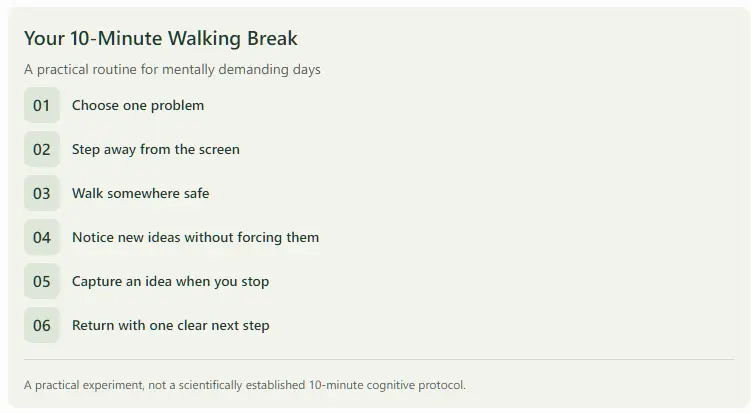
Six steps for a ten-minute walking break, from identifying a problem to returning with a clear next action.

Try a small routine that is easy to repeat.

This simple routine can turn a short walk for mental clarity into a repeatable part of your workday.

The ten-minute duration below is a practical starting point, not a clinically established dose for improving cognition.

Step 1: Identify the problem before leaving

Ask yourself one question:

“What exactly am I trying to figure out?”

Perhaps you need a better headline, a solution to a customer problem, or a different way to explain an important idea.

Keep the question simple.

Step 2: Leave your usual workspace

Take a walk somewhere safe and convenient.

This might be outside, through your office building, or along an indoor corridor.

You do not need a beautiful park to begin.

Step 3: Avoid turning the walk into another information session

You can choose to leave your phone in your pocket.

Skip the email.

Skip the work notifications.

If you usually listen to a podcast, experiment with a few minutes without one.

This is not because research proves silent walking is universally superior.

It is simply a way to make the break different from the information-heavy activity you just left.

Step 4: Allow ideas to come without demanding them

You do not have to solve the problem while walking.

Notice what occurs to you.

Perhaps a new angle appears.

Perhaps nothing does.

Either result is fine.

Step 5: Capture one useful idea when you stop

If you think of something worth pursuing, record it once you are safely stopped.

A brief note is enough.

This connects with our guide on why writing things down helps you remember to act.

An idea is easier to use when you can find it again.

Step 6: Return with a clear next action

Do not immediately reopen every browser tab.

Choose the next meaningful step.

Write the opening paragraph.

Test the alternative solution.

Review the proposal with fresh attention.

The aim is to make the transition back to work deliberate.

A useful break is not just about leaving your desk.

It is also about knowing what to do when you return.

If returning to work is harder than taking the break itself, our guide to refocusing after an interruption offers additional ways to make that transition more deliberate.

When Should You Take a Walking Break?

Timing matters more than following a rigid schedule.

You might consider a short walk for mental clarity when you notice one of these patterns:

  • You keep rewriting the same sentence without improving it.
  • You have several possible ideas but cannot find another direction.
  • You have completed a long stretch of demanding work.
  • You are transitioning between two complex projects.
  • You feel tempted to keep working simply because you have already spent so much time on the problem.

Walking is not necessarily the right response to every difficulty.

If you are making steady progress, you may prefer to finish the thought.

If you are exhausted because you slept poorly, a short walk does not replace adequate sleep.

And if you are experiencing persistent mental fatigue, it can be useful to distinguish between feeling mentally drained and experiencing broader cognitive symptoms.

Our article on brain fog versus mental fatigue explores that difference in greater detail.

When the real obstacle is choosing between too many options, understanding why small decisions can feel disproportionately difficult may help you decide what needs your attention first.

Think of a walking break as one option in your cognitive routine.

Not an emergency repair.

Not a productivity guarantee.

And certainly not a reason to ignore persistent symptoms.

It is a simple way to introduce movement and potentially change your approach to a demanding day.

Where Lumultra Fits Into a Daily Cognitive Routine

A more effective cognitive routine is rarely built around one intervention.

You need adequate sleep.

You need appropriate physical activity.

You need time to concentrate without unnecessary interruptions.

You also need strategies that help you manage information, remember important details, and organize your work.

These habits create a foundation for everyday cognitive performance.

A short walk for mental clarity can be one small part of that broader daily routine.

Lumultra is formulated as a daily supplement for adults interested in cognitive support, with a focus on areas such as attention, memory, and mental clarity.

It can be considered as an optional part of a broader routine, alongside healthy habits—not as a replacement for them.

An important distinction: the walking research discussed in this article did not study Lumultra. It does not establish that Lumultra enhances the cognitive effects of walking, and it should not be presented as evidence that the supplement produces similar results.

If you are considering a supplement, review its ingredients and use instructions, and discuss it with a healthcare professional if you have medical conditions or take medications.

The goal is to build a routine that makes sense for you rather than assuming that any one product or activity provides the complete answer.

Explore Lumultra Original

Interested in learning more about our approach to daily cognitive support?

Explore Lumultra Original, including its ingredients and product details.

New subscribers can use code NEWU26 for 30% off their first subscription, subject to the current offer terms.

This statement has not been evaluated by the Food and Drug Administration. This product is not intended to diagnose, treat, cure, or prevent any disease.

Frequently Asked Questions

Does walking actually help you think better?

Research has found benefits for certain creative-thinking tasks, particularly generating different possible ideas. However, results vary by task, and walking does not necessarily improve every aspect of cognition.

How long should I take a short walk for mental clarity?

There is no universal walking duration proven to produce immediate mental clarity for everyone. A short walk for mental clarity, such as five to ten minutes, can be a practical starting point. Observe whether it helps you return to your work and adjust the duration to your needs and physical abilities.

Is walking outside better than walking indoors?

Stanford’s research found that walking indoors and outdoors could both benefit creative idea generation. The study does not establish that one environment is universally superior for all cognitive tasks.

Should I walk when I am mentally exhausted?

Gentle movement may be a useful break if you feel physically well enough. However, persistent exhaustion may require sleep, workload changes, medical assessment, or other support rather than more activity.

Can walking replace cognitive supplements?

Walking and supplements are different interventions. Physical activity has established health benefits, while claims about any supplement require evidence relevant to that specific product. Neither should be presented as a universal solution for cognitive difficulties.

The Takeaway: Sometimes Progress Begins by Stepping Away

The next time you find yourself staring at a problem without making progress, consider another option.

Close the laptop.

Stand up.

Take a walk.

Give yourself permission to change activities for a few minutes.

You may return with a new idea.

You may simply feel ready to approach the problem differently.

Or you may realize that the task needs more time and a better plan.

Whatever happens, you have introduced movement into a day that might otherwise have involved hours of sitting.

Better thinking is not always about doing more of the same thing.

Sometimes it begins with knowing when to change what you are doing.

Decision Fatigue: Why Small Choices Feel So Hard

You are not facing a life-changing decision.

You are deciding which email to answer first.

What to make for dinner.

Whether to schedule the appointment today or deal with it tomorrow.

Which of three nearly identical options to buy.

Yet instead of making the choice and moving on, you hesitate.

You compare.

You reopen the same tabs.

You ask someone else what they think.

Then, strangely, you feel tired before you have actually done anything.

This experience is often called decision fatigue—the feeling that making one more choice requires far more mental effort than it should.

It can leave capable, intelligent people wondering why they have become so indecisive.

But the problem may not be that you have lost your judgment.

Your brain may simply be trying to make decisions while carrying too much else at the same time.

What Is Decision Fatigue?

Decision fatigue describes the decline in mental clarity, patience, or consistency that can appear after prolonged thinking and repeated decision-making.

It is not a formal medical diagnosis. It is also more complicated than the popular idea that every choice removes a fixed amount of “willpower” from your brain.

Researchers increasingly describe decision fatigue as the result of several overlapping pressures, including cognitive load, emotional strain, time on task, poor recovery, stress, and the complexity of the decisions being made. Reviews of decision fatigue have also noted that the concept is measured inconsistently, which means it should not be treated as one simple biological switch that turns off after too many choices. Research examining decision fatigue continues to develop.

The everyday experience, however, is familiar.

After spending hours answering questions, comparing options, solving problems, and reacting to interruptions, you may notice that you:

  • postpone simple choices
  • choose the easiest option rather than the best one
  • become unusually irritated when someone asks another question
  • repeatedly reconsider decisions you have already made
  • avoid beginning tasks that require planning
  • default to scrolling, snacking, or checking messages
  • ask other people to decide for you

This does not necessarily mean your decision-making ability is disappearing.

It may mean the mental systems supporting good decisions are already occupied.

Every Decision Uses More Than Judgment

A decision is rarely just a choice between A and B.

To choose well, your brain may need to:

  1. remember what you are trying to accomplish
  2. hold several options in working memory
  3. compare the advantages and disadvantages
  4. ignore irrelevant information
  5. predict possible outcomes
  6. manage your emotional reaction
  7. commit without continuing to second-guess yourself

That is a considerable amount of cognitive work.

Working memory is especially important because it allows you to temporarily hold and manipulate information while solving a problem. It supports planning, reasoning, reading comprehension, and decision-making.

If working memory is overloaded, you may also notice that information does not seem to stick. You might finish a paragraph only to realize you cannot remember what you just read. If that sounds familiar, read our guide on why you forget what you just read.

But working memory is limited.

When it is already holding an unfinished conversation, tomorrow’s schedule, three work problems, a financial concern, and the reminder that someone is waiting for your reply, a small additional decision may feel disproportionately difficult.

The choice is not necessarily hard.

The mental workspace required to make it is already crowded.

Why Small Choices Can Feel Harder Than Big Ones

Large decisions usually announce themselves.

You know they matter, so you create time for them. You gather information. You speak with someone you trust. You expect the process to require effort.

Small decisions arrive without warning.

They appear between other tasks:

“Can you approve this?”

“What time works for you?”

“Which version should we use?”

“Do you want to renew this?”

“Should we order it now?”

Each question may seem insignificant. But every one asks your brain to stop, load a new set of information, evaluate it, respond, and then reconstruct whatever you were thinking about before.

This is closely connected to the mental cost of task switching.

You are not only making the decision. You are repeatedly changing cognitive context.

That is why a day filled with small questions can feel more mentally exhausting than several hours spent on one meaningful project.

You may have completed dozens of things, yet still feel as though your mind never fully settled into any of them.

Back-to-back calls can create similar demands on attention; our guide to video meeting fatigue  explains why the drain can add up even when you barely move.

Related: Why You Keep Making Small Mistakes at Work

Cognitive Load Makes Decisions Feel Heavier

Cognitive load is the amount of information your brain is trying to process at one time.

Some of that load is visible:

  • the document in front of you
  • the numbers you are comparing
  • the conversation you are having
  • the instructions you are following

Some of it remains in the background:

  • unfinished work
  • unanswered messages
  • concerns about family
  • appointments you need to schedule
  • things you are afraid of forgetting
  • decisions you have postponed

For responsibilities you keep trying to remember, our guide to using external reminders shows how to give each task a clear action and a useful cue.

These open mental loops do not always occupy your full attention. But they can continue competing for access to it.

This helps explain why unfinished tasks can keep returning to mind even when you are trying to concentrate on something completely different.

That means your brain may be trying to evaluate a new choice while simultaneously preventing several unrelated concerns from disappearing.

This is why decision fatigue often appears alongside mental clutter.

Related research on cognitive fatigue also shows how sustained mental effort can reduce cognitive performance over time.

You know the information.

You understand the choices.

But you cannot seem to create enough clean mental space to compare them calmly.

Related: Mental Clutter: Why Your Mind Feels Full but Not Focused

Stress Quietly Reduces Your Decision-Making Capacity

Stress does not have to feel dramatic to affect thinking.

You may not feel panicked. You may simply feel slightly rushed, watchful, impatient, or mentally preoccupied.

Part of your attention is then directed toward managing that state.

Research on stress and cognition suggests that stress can compete with working memory and attention, particularly when the cognitive demand of a task is already high. In other words, stress creates another stream of information your brain must manage while it is trying to think.

This helps explain why the same decision can feel easy one day and impossible the next.

The options did not change.

Your available cognitive capacity did.

When your mind is calm and relatively clear, you may evaluate the information and decide within minutes.

When you are carrying unresolved stress, you may read the same information repeatedly without feeling ready to commit.

Poor Sleep Changes How You Choose

Sleep affects more than whether you feel awake.

It also influences attention, cognitive flexibility, judgment, feedback processing, and the effort you are willing to invest in a decision.

A recent scoping review examining 25 studies and more than 2,200 participants found that sleep deprivation commonly impaired aspects of decision-making, although the strength and type of impairment varied across tasks and individuals. Some studies found greater risk-taking, while others found smaller or inconsistent effects. The review is available through PubMed.

That nuance matters.

Poor sleep does not automatically make every decision bad. But it can make effortful thinking more difficult and make simpler, faster, or more immediately rewarding choices more appealing.

Interestingly, some people notice the opposite effect later in the evening, when distractions are lower and their thoughts seem to flow more easily. If you’ve ever wondered why your mind feels clearer after dark, our article on why some people think better at night explains the science behind it.

This is why the late-night version of you may:

  • buy something you would normally compare more carefully
  • avoid an important conversation
  • agree to something just to end the discussion
  • abandon a task that felt manageable earlier
  • decide that tomorrow’s problem belongs to tomorrow’s brain

Sometimes postponing a decision is wise.

But repeatedly postponing decisions because your brain cannot create enough clarity is different.

Is Decision Fatigue a Sign of Cognitive Decline?

Not necessarily.

Normal aging can bring mild changes in processing speed, attention, multitasking, and how quickly information is retrieved. At the same time, experience, knowledge, pattern recognition, and judgment can remain strong or even become more useful with age. How the aging brain affects thinking, according to the National Institute on Aging, includes mild slowing in processing speed and multitasking while many reasoning abilities remain intact.

Many people interpret any increase in mental effort as evidence that they are “losing it.”

But needing more time to process several competing variables is not the same as losing the ability to reason.

Often, the problem is environmental.

There are more messages.

More accounts.

More subscriptions.

More information.

More responsibilities.

More people asking for immediate answers.

The modern brain is expected to make a continuous stream of low-level decisions while remaining available for high-level thinking.

That is an unreasonable cognitive arrangement.

Related: Why Your Brain Feels Slower After 50

How to Reduce Decision Fatigue

The goal is not to eliminate decisions.

It is to stop spending valuable cognitive energy on choices that do not deserve it.

1. Create Defaults for Repetitive Decisions

Decide once wherever possible.

Create a default breakfast, workout time, grocery list, meeting structure, or weekly planning routine.

Defaults do not remove freedom. They preserve your mental resources for decisions where judgment genuinely matters.

2. Write the Variables Down

Do not force working memory to hold everything.

When comparing options, write down:

  • the actual objective
  • the three most important criteria
  • the available choices
  • the consequences that matter
  • the deadline for deciding

Externalizing information reduces the number of variables your brain must continuously maintain.

3. Separate Decisions From Notifications

A decision made immediately after an interruption is often made from a fragmented mental state.

When possible, collect nonurgent decisions and address them during one or two designated windows.

This prevents your entire day from becoming a sequence of cognitive restarts.

4. Use a “Good Enough” Threshold

Not every decision deserves optimization.

Ask:

“Will the difference between these options still matter in six months?”

When the answer is no, choose an option that meets your essential requirements and move forward.

The cost of endlessly searching for the perfect answer may be greater than the difference between the available choices.

5. Make Important Decisions Earlier

Pay attention to when your mind is naturally clearest.

For many people, that is earlier in the day, before meetings, messages, and unresolved tasks accumulate.

Protect that window for decisions that require comparison, judgment, and long-term thinking.

6. Recover Before Adding More Stimulation

When your thinking becomes slow, the instinct is often to push harder or consume more caffeine.

Sometimes that works temporarily.

But mental fatigue is not always a stimulation problem.

A short walk, food, hydration, quiet, sleep, or ten minutes without new information may restore more clarity than another stream of input.

When you need a practical way to step away from a difficult decision, our article on why a short walk can help you think more clearly  explains what the research shows and how to try a movement break.

Clear Thinking Requires More Than Mental Energy

Many people describe decision fatigue as needing “more energy.”

But energy without clarity can simply make a scattered mind move faster.

Good decision-making requires several abilities working together:

  • enough attention to identify what matters
  • enough working memory to compare the options
  • enough mental stamina to stay with the problem
  • enough calm to avoid reacting impulsively
  • enough clarity to commit and move forward

This distinction matters when considering cognitive support.

You do not merely want to feel activated.

You want your attention, memory, and mental energy to work together.

Where Lumultra Fits

The experience customers often describe is not a lack of intelligence.

They know what needs to be done.

They understand the options.

But accessing that knowledge feels less smooth than it once did.

Lumultra was formulated around that gap—the distance between having the ability to think clearly and being able to access that clarity consistently when the day becomes demanding.

Its formula is spearheaded by Noopept and combines focus, memory, and energy ingredients intended to support working memory, sustained attention, and overall cognitive performance. The formula also includes ingredients such as phosphatidylserine, acetyl-L-carnitine, L-tyrosine, Panax ginseng, and guarana.

Lumultra is not a substitute for sleep, recovery, or better decision systems.

It is designed to complement them.

Because once unnecessary decisions are removed and mental clutter is reduced, the next goal is helping your brain remain clear, engaged, and available for the decisions that still matter.

For especially demanding mornings or extended periods of mental and physical output, Nova can be paired with Lumultra as an optional energy and mood-support companion. Nova combines caffeine, L-theanine, and N-acetyl-L-tyrosine and should not be taken late in the day because its stimulating ingredients may interfere with sleep.

Explore Lumultra for clearer, more consistent thinking

Explore Lumultra + Nova for higher-demand days

You May Not Be Indecisive

You may be mentally overloaded.

There is an important difference.

Indecisiveness sounds like a personality flaw.

Cognitive overload is a condition you can change.

Reduce the number of low-value choices.

Move important thinking into your clearest hours.

Get information out of working memory and onto paper.

Protect your brain from constant context switching.

Support the mental systems that help you hold information, maintain focus, and follow a thought through to its conclusion.

The goal is not to make every decision instantly.

It is to stop allowing small decisions to consume the clarity you need for the important ones.

Frequently Asked Questions

What does decision fatigue feel like?

Decision fatigue can feel like hesitation, irritability, avoidance, repeated second-guessing, impulsive choices, or mental exhaustion after making numerous decisions. It may also make simple questions feel disproportionately demanding.

Why do I struggle to make decisions when I am tired?

Decision-making uses attention, working memory, cognitive flexibility, and judgment. When you are tired, stressed, or sleep deprived, those processes may require more effort, making the easiest or most immediate option more appealing.

How can I recover from decision fatigue quickly?

Step away from new information, write down the variables you are considering, eat or hydrate if needed, take a short walk, and postpone nonurgent decisions until a clearer time. Longer-term improvements come from creating defaults, reducing interruptions, protecting sleep, and grouping low-priority decisions together.

Why Does Everything Take More Effort Than It Used To?

Have you ever wondered:

“Why does everything take more effort than it used to?”

The tasks haven’t changed.

The work isn’t necessarily more difficult.

Yet somehow everything feels heavier.

You sit down to answer emails.

A report needs your attention.

Before long, you’re trying to finish a project.

And within minutes your brain is looking for an exit.


And within minutes your brain is looking for an exit.

It’s not because you’re lazy.

Nor is it because you’re weak.

And it’s not necessarily because you’re getting older.

Many people are experiencing something different:

The mental cost of staying focused has increased.

This Shows Up If…

You may recognize some of these signs:

  • Procrastinating tasks you once handled easily

  • Rereading the same paragraph multiple times

  • Losing your train of thought more often

  • Feeling mentally tired even after a low-activity day

  • Needing more breaks than you used to

Most people blame motivation.

But motivation may not be the real issue.

The Hidden Cost Of Attention

Every task requires mental energy.

But there’s another resource many people overlook:

attention stability.

When attention is stable, your brain stays connected to the task.

Your thinking remains connected to the task.

Progress feels smoother and more efficient.

When attention becomes unstable, your brain repeatedly disconnects and reconnects.

Each restart creates friction.

Each interruption requires effort.

Over time these small costs accumulate into significant mental fatigue.

This is why a task that once took 20 minutes may now feel like it takes an hour.

This pattern helps explain why many people feel mentally occupied all day yet make less meaningful progress than expected. Learn more in Why Your Brain Feels Busy But Gets Less Done.


Your Brain May Be Restarting More Often

Think about how often your attention gets interrupted during a typical day.

Notifications, emails, text messages, social media, multiple browser tabs, and background conversations all compete for attention.

Constant switching trains the brain to operate in shorter attention cycles.

Research suggests that task switching carries measurable cognitive costs because the brain must reorient itself each time attention changes.

External Authority Links:

  1. National Institutes of Health:
    https://pmc.ncbi.nlm.nih.gov/articles/PMC7075496/
  2. American Psychological Association:
    https://www.apa.org/topics/technology/multitasking

Over time this can create the feeling that everything requires more effort.

Because your brain is repeatedly rebuilding context.

Those repeated attention resets do not just make work feel harder. They can also increase the chances of overlooking details, skipping familiar steps, and making small but frustrating errors. Learn why making small mistakes at work is often linked to cognitive overload rather than carelessness.

Why Hard Work Doesn’t Always Fix The Problem

Many people respond by trying harder—adding more coffee, longer hours, more discipline, and more pressure.

Unfortunately, effort doesn’t always solve a stamina problem.

Imagine driving with the parking brake partially engaged.

Pressing the accelerator harder doesn’t remove the drag.

It simply increases strain.

The same principle can apply mentally.

When cognitive resources are constantly being redirected, additional effort may only create additional fatigue.

Age Isn’t Always The Explanation

Many adults assume:

“I’m getting older. This is probably normal.”

Age can influence cognitive performance.

But many people begin noticing these changes long before significant age-related decline would be expected.

Lifestyle factors often play a major role:

  • Poor sleep
  • Chronic stress
  • Information overload
  • Reduced recovery
  • Constant digital stimulation

These factors may affect attention and mental stamina regardless of age.

The Difference Between Being Busy And Being Effective

A surprising number of people spend their entire day working yet accomplish less than expected.

Why?

Because activity and effectiveness are not the same thing.

Many people spend entire days checking messages, responding to notifications, switching tasks, and attending meetings without much sustained concentration.

The result is a feeling of constant activity.

Productivity, however, may still feel elusive.

This often creates a strange combination of:

The result is a strange combination of:

  • Mental exhaustion
  • Low output
  • Frustration

You feel busy.

Yet you don’t feel productive.

If this sounds familiar, you may also relate to Why You’re Busy All Day But Feel Like You Accomplished Nothing, which explores the gap between activity and meaningful progress.

Cognitive Stamina Matters More Than Most People Realize

Physical stamina determines how long your body can perform.

Cognitive stamina determines how long your brain can perform.

When cognitive stamina declines:

  • Focus fades faster
  • Distractions become stronger
  • Mental effort feels heavier
  • Recovery takes longer

These effects are often most noticeable in the afternoon when concentration suddenly drops.  Why Your Focus Crashes Halfway Through The Day explores several factors that may contribute to this pattern.

Many people focus exclusively on energy.

But cognitive stamina may be equally important.

The goal isn’t simply feeling awake.

Instead, the objective is maintaining effective thinking over time.

What Helps Support Cognitive Stamina?

The fundamentals remain important:

Sleep

Consistent, high-quality sleep supports attention, memory, and executive function.

Physical Activity

Regular exercise has been associated with improved cognitive performance.

Stress Management

Chronic stress can consume mental resources and impair focus.

Building stronger cognitive resilience may help support mental performance during periods of ongoing stress. Read more about Cognitive Resilience & Stress Defense.

Reducing Cognitive Clutter

Limiting unnecessary interruptions helps preserve attention.

External Authority Link:

https://www.cdc.gov/sleep/about/index.html

Why Some People Stay Sharp Longer

If you know someone who seems mentally sharp all day, it may not be because they have more intelligence.

Often they simply protect their attention better.

They create environments that support:

  • Deep work
  • Reduced distraction
  • Consistent routines
  • Mental recovery

The result is less friction and more sustained performance.

The Real Question

Instead of asking:

“Why am I less motivated?”

Try asking:

“Why is maintaining focus requiring more effort?”

That subtle shift changes everything.

Because it moves the conversation away from willpower and toward cognitive function.

A Different Approach To Mental Performance

Most solutions focus on stimulation through additional caffeine, greater intensity, or short-term energy boosts.

But long-term mental performance depends on something deeper:

Your ability to stay engaged, maintain context, and continue processing effectively throughout the day.

For people looking to support focus, cognitive processing, and mental stamina, Lumultra was designed around that broader goal.

Not simply helping you feel energized.

But helping you stay mentally present when sustained performance matters most.

Feeling Like Everything Takes More Effort?

If your attention feels less stable than it once did, it may be time to support the systems behind sustained cognitive performance.


Explore Lumultra →

Why Your Brain Feels Foggy After Poor Sleep — Even If You “Slept Enough”

Brain fog after poor sleep can be surprisingly frustrating. You went to bed at a reasonable time. You technically got enough hours. You did not pull an all-nighter or stay out late.

So why does your brain still feel slow?

You open your laptop, look at your task list, and somehow everything takes longer than it should. Reading feels heavier. Decisions feel annoying. You reread the same sentence twice. You forget why you opened a tab. You know what you need to do, but your brain does not seem ready to fully come online.

That is the frustrating thing about brain fog after poor sleep.

It does not always feel like exhaustion. Sometimes it feels like a weak signal. Your body is awake, but your focus is delayed. Your mind is present, but not sharp. You can function, but you are not operating at the level you expect from yourself.

And often, the issue is not just how many hours you spent in bed. It is the quality of the recovery your brain actually got.

Brain Fog After Poor Sleep Is Not Just “Being Tired”

Most people think sleep affects energy first.

That is true, but incomplete.

Sleep also affects attention, memory, reaction time, emotional regulation, decision-making, and the ability to hold information in your mind long enough to use it.

That is why poor sleep can show up as:

  • Trouble focusing on one task
  • Slower word recall
  • Forgetting small details
  • Feeling mentally scattered
  • Taking longer to make simple decisions
  • More mistakes in routine work
  • Less patience with interruptions
  • A strange sense of “I know I can do this, but my brain is not cooperating”

This is why the phrase “I’m tired” does not always capture what is happening.

You may not feel sleepy enough to go back to bed. You may even feel physically okay. But cognitively, your brain may be working with a reduced level of mental efficiency.

Research has repeatedly linked sleep loss with changes in cognitive performance, especially attention and working memory. One review published through NIH notes that total sleep deprivation impairs attention and working memory, while partial sleep deprivation can especially affect vigilance.

Multiple studies have shown that sleep deprivation can impair attention and working memory, which explains why even simple tasks can feel harder after a night of poor sleep.

That matters because attention and working memory are the foundation of your productive day.

Attention lets you stay with the task.

Working memory lets you hold the task in your mind.

When both are weaker, everything feels more effortful.

You Can Get Enough Hours and Still Get Poor Recovery

This is where many people get confused.

They say, “But I slept seven or eight hours.”

That may be true. But sleep is not just a time block. It is a recovery process.

You can spend enough time in bed and still wake up feeling mentally flat if your sleep was fragmented, shallow, inconsistent, or poorly timed.

Common reasons include:

  • Waking up multiple times during the night
  • Drinking alcohol too close to bedtime
  • Too much caffeine too late in the day
  • Late-night screen exposure
  • Stress or racing thoughts
  • Inconsistent sleep and wake times
  • Eating too heavily before bed
  • Poor sleep environment
  • Sleep apnea or breathing issues
  • Travel, time zone shifts, or irregular schedules

The CDC explains that good sleep is not only about duration. Good sleep quality is also essential for healthy sleep.

According to the CDC, good sleep quality is essential for healthy sleep, not just the number of hours spent in bed.

That distinction is important.

You may have “slept,” but your brain may not have fully recovered.

The First Thing to Go Is Often Focus

When sleep quality is poor, focus often becomes fragile.

You may still be able to do easy tasks. You may still answer messages, attend meetings, or handle routine work. But anything requiring deep concentration feels harder.

This is because focus is not just willpower. It is a cognitive resource.

When your brain is well-rested, you can lock onto a task, filter out distractions, and stay mentally engaged long enough to make progress.

After poor sleep, that filter weakens.

Suddenly, everything competes for attention:

The notification.

The email.

The open browser tab.

The small noise in the background.

The random thought about something unrelated.

The task you were supposed to do next.

This is why sleep-deprived focus often feels jumpy. You are not lazy. Your brain is simply having a harder time protecting the task from competing signals.

And once you get interrupted, it may take longer to return to the original task. That connects directly with the problem we covered in the article on how long it takes to refocus after an interruption.

Poor sleep does not just make you distracted. It makes distraction more expensive.

Poor Sleep Also Weakens Working Memory

Working memory is your brain’s mental workspace.

It is what allows you to hold a few pieces of information in mind while doing something with them.

For example:

  • Remembering what someone just said while forming a reply
  • Holding a number in mind long enough to use it
  • Comparing two options
  • Following a multi-step instruction
  • Reading a paragraph and connecting the ideas
  • Writing clearly without losing your point

When working memory is strong, thinking feels smooth.

When it is weak, everything feels slippery.

You lose your place. You forget the middle of the sentence. You walk into a room and forget why. You open an email and forget what you were about to write.

This is one reason brain fog after poor sleep can feel so frustrating. You are not losing intelligence. You are losing temporary mental holding power.

The ideas may still be there, but they are harder to keep organized.

Poor sleep can also reduce mental endurance the next day, which is one reason brain fog and mental fatigue can become difficult to separate.

Recall Gets Slower Too

Poor sleep can also affect recall.

That does not always mean you cannot remember something. Sometimes it means the memory is harder to access on demand.

You know the name, but it does not come quickly.

You know the word, but you cannot grab it.

You know the answer, but it takes a few extra seconds.

You remember what you meant to do — after you have already moved on to something else.

This kind of slow recall is subtle, but it can make the whole day feel inefficient.

For high-performing adults, this is often more irritating than being physically tired. You are used to your brain responding quickly. When it does not, you feel like you are dragging yourself through the day.

This is also why people often describe brain fog as feeling “off” rather than feeling sick.

Nothing is dramatically wrong.

But everything is slightly harder.

Decision Fatigue Shows Up Faster

Another overlooked effect of poor sleep is decision fatigue.

After a good night of rest, choosing between tasks may feel normal. After poor sleep, even simple choices can feel heavier.

What should I work on first?

Should I reply now or later?

Do I need to rewrite this?

Should I take the call?

What was I supposed to prioritize?

Your brain has to spend energy organizing choices before it can even begin the work. When sleep recovery is poor, that organizing function becomes less efficient.

This is one reason people often feel tired before they even start working. The fatigue is not always from the task itself. Sometimes it comes from the mental load of preparing to engage. That is the same pattern discussed in why you feel tired before starting work.

Poor sleep makes the starting line feel farther away.

Why Coffee Does Not Fully Fix It

Coffee can help you feel more awake.

But caffeine does not fully replace sleep recovery.

That is why you can drink coffee and still feel mentally foggy.

Caffeine may increase alertness, but it does not automatically restore working memory, emotional balance, or deep focus. It can help you push through the day, but if the underlying problem is poor sleep quality, the brain may still feel under-recovered.

This is especially true when people keep adding more caffeine to compensate.

One cup becomes two. Two becomes three. Then the extra caffeine affects the next night’s sleep, and the cycle repeats.

The goal is not to demonize caffeine. Many people use it effectively. The point is that caffeine works best when it supports an already-recovered brain, not when it is used as a daily substitute for recovery.

The “Foggy Morning” Can Turn Into a Foggy Whole Day

A poor sleep night does not always stay contained to the morning.

It can shape the entire day.

You start slower. You fall behind. You switch tasks more often. You make more small errors. Those errors create more cleanup. The cleanup creates more stress. By the afternoon, you feel even more depleted.

That is how brain fog becomes a productivity spiral.

The original problem may have been poor recovery, but the downstream effect is a day that feels harder than it should.

This is why protecting sleep quality is not just a wellness habit. It is a cognitive performance habit.

What Helps Your Brain Recover Better

The first step is to stop judging the fog as a character flaw.

Brain fog after poor sleep is information. It tells you your brain did not get the recovery it needed.

Here are practical ways to support better cognitive performance after a rough night:

  1. Start With Light, Not Your Phone

Morning light helps signal wakefulness to your brain and body. Before diving into messages, try getting natural light exposure, even briefly.

This helps create a stronger transition from sleep mode to daytime alertness.

  1. Do Your Most Important Thinking Earlier

After poor sleep, do not waste your best available focus on inbox cleanup.

Choose one meaningful task and make it the first priority. Even if your focus is not perfect, your morning may still be better than your late afternoon.

  1. Reduce Task Switching

A tired brain pays a higher price for switching.

Instead of bouncing between email, tabs, messages, and projects, create a smaller focus window. Pick one task. Remove obvious distractions. Give your brain fewer things to manage.

  1. Hydrate Before More Caffeine

Many people go straight from poor sleep to coffee. But dehydration can make fogginess feel worse.

Drink water first. Then use caffeine strategically instead of desperately.

  1. Take a Short Movement Break

Light movement can help increase alertness and reduce the feeling of mental stagnation.

This does not need to be a hard workout. A walk, stretching, or a few minutes of movement can help shift your state.

  1. Protect the Next Night

The best fix for brain fog after poor sleep is not always more stimulation today. It is better recovery tonight.

Keep caffeine earlier. Reduce late-night screens. Avoid heavy meals too close to bedtime. Keep your sleep schedule as consistent as possible.

The goal is to stop one bad night from becoming a pattern.

Where Lumultra Fits In

Lumultra is not a sleep product, and it should not be used as a replacement for good sleep.

But for people who care about focus, memory, mental clarity, and productive momentum, daytime cognitive support can be part of a smarter routine.

The key is to think in layers.

Sleep is the foundation.

Nutrition, hydration, movement, and stress management support that foundation.

And a focused nootropic routine can help support the mental performance you want during the day.

Lumultra was designed for people who want to support focus, memory, and mental clarity — especially when modern life makes cognitive performance feel harder than it should.

Not because you want to push your brain harder forever.

But because you want your brain to show up when the day demands it.

Support Clearer Focus During the Day

Poor sleep can make focus, memory, and mental stamina feel harder than they should.
Lumultra is designed to support cognitive performance, mental clarity, and productive
momentum as part of a smart daily routine.


Shop Lumultra

Final Thought

Brain fog after poor sleep is not just about feeling tired.

It is about attention that breaks more easily.

Working memory that holds less.

Recall that takes longer.

Decisions that feel heavier.

And a day that requires more effort to produce the same result.

The solution is not to shame yourself into focusing harder. The better approach is to understand what your brain is asking for: better recovery, fewer distractions, smarter routines, and the right kind of support.

Because when your brain is well-recovered and properly supported, focus feels less forced.

And the day feels less like something you have to drag yourself through.