Why Unfinished Tasks Keep Popping Into Your Head

You close the laptop.

Dinner starts.

You are talking to someone about something completely unrelated.

And then, suddenly:

I still need to answer that email.

Or:

I never finished that proposal.

Nothing reminded you.

You were not even trying to think about work.

The unfinished task simply returned.

This is one of the strange things about mental load: a task does not always stop taking up attention just because you stopped working on it.

Sometimes the thing you have not finished becomes more mentally persistent than the things you completed.

And that may explain why your brain can feel busy even when you are technically doing nothing.

An Unfinished Task Can Stay Mentally Active

When you decide that something needs to happen, your brain creates a goal.

  • Reply to Daniel.
  • Finish the presentation.
  • Book the appointment.
  • Resolve the billing problem.
  • Figure out what to do about the insurance renewal.

Until that goal is completed—or at least given a dependable next step—it can remain mentally accessible.

This is often discussed in connection with the Zeigarnik effect, the long-standing idea that unfinished or interrupted tasks can remain more memorable than completed ones.

The popular version of the Zeigarnik effect is sometimes oversimplified.

A 2025 meta-analysis of the Zeigarnik and Ovsiankina effects found that the classic claim that unfinished tasks are always remembered better is not consistently supported. The researchers found no general memory advantage for unfinished tasks, although people did show a broader tendency to resume interrupted tasks.

But that does not mean unfinished tasks are mentally irrelevant.

More recent evidence points to something particularly useful for everyday life: unfinished responsibilities are associated with continuing thoughts about work even after the workday ends.

A 2026 meta-analysis of unfinished work and work-related thoughts during off-job time found that unfinished work tasks were positively associated with work-related thoughts during personal time, with the strongest associations involving affective rumination.

That may sound very familiar.

The task is no longer in front of you.

But part of your attention still seems to be checking on it.

This Is What an “Open Loop” Feels Like

People often use the phrase open loop to describe an unresolved responsibility the mind keeps returning to.

It might be something large:

  • A financial decision you have not made
  • A difficult conversation you need to have
  • A work project without a clear solution

But it can also be tiny:

  • An email you have not answered
  • A package you need to return
  • A form you need to complete
  • Something you promised to look up
  • An appointment you keep meaning to schedule

None of these tasks has to occupy your full attention.

That is what makes the effect easy to miss.

You can work on something completely different while the unfinished item periodically reappears:

Don’t forget that.

What are you going to do about that?

You still haven’t handled it.

One unfinished task may not matter much.

Twenty of them can create a very different mental environment.

This connects closely with mental clutter and too many open loops. Your mind can feel full even when you are not consciously thinking about every responsibility you are carrying.

Research on psychological detachment from work also helps explain why this matters. A large meta-analysis of recovery from work found that psychological detachment is associated with better well-being, less exhaustion, better sleep, and other recovery-related outcomes.

Your Brain May Be Trying to Protect the Goal

Why would the brain keep bringing an unfinished responsibility back?

One useful way to think about it is that forgetting an important unfinished goal could be costly.

If you have not completed something—and have not created a dependable system for completing it later—the brain has a reason to keep that goal accessible.

Imagine telling yourself:

“I need to deal with the insurance renewal.”

That is not really a plan.

There is no time.

No next action.

No place.

No clear trigger telling you when the task can safely become active again.

So the responsibility remains unresolved.

Your brain cannot necessarily assume somebody else is handling it.

And because there is no reliable future cue, periodically reminding you may serve a purpose.

The problem is that the reminder often appears when you cannot do anything about it.

While driving.

During dinner.

In another meeting.

At midnight.

That is when an unfinished responsibility stops feeling useful and starts feeling like background mental noise.

Studies of work recovery have similarly found that unfinished tasks can be associated with lower psychological detachment from work during non-work time.

In one diary study, for example, unfinished tasks at the end of the work week were associated with lower detachment, while progress toward completing those tasks appeared to lessen some of the negative recovery effects.

You can read the study on unfinished work, goal progress, and recovery for more detail.

Open Loops Can Compete With the Task in Front of You

Imagine trying to write an important document while several unrelated responsibilities keep surfacing.

You remember a payment.

Then a message.

Then tomorrow’s appointment.

Then something you forgot to order.

You are still capable of writing.

But your attention keeps being forced to reorient.

Each interruption may last only a few seconds.

Yet the task in front of you now has to compete with everything your brain believes still requires attention.

This helps explain why unresolved responsibilities often show up alongside decision fatigue.

You are not only making today’s decision.

Part of your mind may also be tracking several decisions you have not made yet.

The mental problem is not simply having a lot to do.

It is having too many things without a clear place to go.

Writing the Task Down Is Helpful—but There Is an Important Difference

Suppose the thought is:

“Need to figure out taxes.”

You write:

Taxes

That may prevent you from completely forgetting the issue.

But it has not resolved much.

Tomorrow you still have to ask:

  • What about taxes?
  • What exactly needs to happen?
  • What information do I need?
  • Who do I need to contact?
  • When am I going to do this?

The task may remain mentally noisy because the uncertainty is still there.

Compare that with:

Wednesday at 10 a.m.: email the accountant and ask whether the vehicle depreciation carries into this year’s return.

Now the task has somewhere to go.

There is a next action.

There is a time.

There is enough context to restart.

That difference matters.

A Specific Plan Can Help Quiet an Unfinished Goal

One of the most interesting findings in this area comes from research examining what happens when people make plans for unfinished goals.

Participants who were thinking about unfinished goals experienced more intrusive thoughts while doing an unrelated activity.

But when they created specific plans describing how, when, and where they would complete those goals, those interference effects were reduced.

Importantly, they had not actually finished the tasks yet.

They had simply given the tasks a dependable future path.

Research on making specific plans for unfinished goals found that creating a specific plan could eliminate several of the cognitive effects associated with unfulfilled goals, including intrusive thoughts during unrelated activities.

That creates a useful distinction:

Writing something down says:

Don’t forget this.

Planning it says:

You don’t have to deal with this now. Here is when you will deal with it.

That second message may be much easier for your attention to release.

Try Turning Open Loops Into Closed Plans

The next time something keeps coming back into your head, do not simply add the name of the task to a long list.

Give it four pieces of information.

1. Name the actual outcome

Instead of:

“Insurance”

Try:

“Confirm whether we are renewing the policy.”

2. Identify the next physical action

What can you actually do?

  • “Email Kris.”
  • “Call the insurer.”
  • “Download the statement.”
  • “Open the contract.”

A task becomes less vague when the next movement is visible.

3. Decide when or where you will restart

  • “Tuesday after lunch.”
  • “When I get to the office tomorrow.”
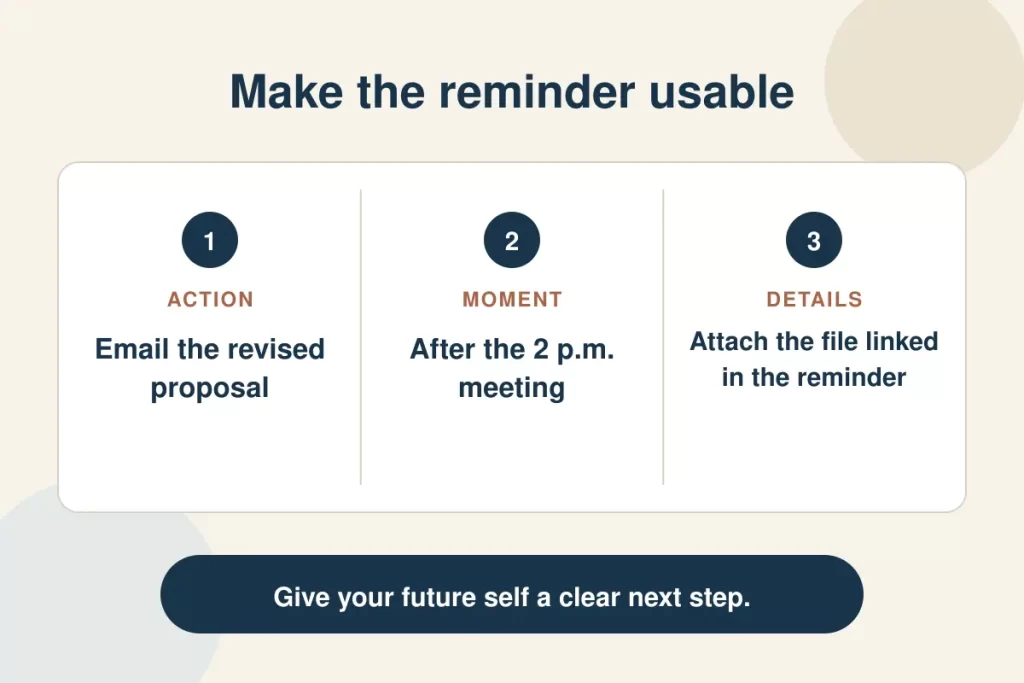
  • “After the 2 p.m. meeting.”
  • “When Michael sends the document.”

Now the responsibility has a trigger.

4. Leave enough context for your future self

Do not make yourself reconstruct the entire problem tomorrow.

  • Leave the policy number.
  • Attach the document.
  • Save the relevant email.
  • Write down the exact question.

Your future self should be able to look at the task and begin without recreating today’s thinking.

The Goal Is Not to Finish Everything Today

There is an important trap here.

Once people realize unfinished tasks create mental noise, they sometimes conclude:

“I just need to finish everything.”

That is impossible.

There will always be another email.

Another project.

Another decision.

Another responsibility.

The goal is not to have no unfinished tasks.

The goal is to have fewer undefined unfinished tasks.

There is an enormous psychological difference between:

“I still need to deal with that.”

And:

“I know exactly what the next action is, and I know when I will see it again.”

One is an open question.

The other is a plan.

This May Also Explain Why Your Brain Feels Better at Night

There is a reason some people suddenly experience clearer thinking late in the evening.

The responsibilities may not have disappeared.

But many of them have temporarily stopped demanding an answer.

The business day is over.

People are less likely to contact you.

Meetings are finished.

Appointments have passed.

You have psychologically postponed certain responsibilities until tomorrow.

That reduces the number of things your mind believes require an immediate response.

Our article on why you think better at night explores this pattern in more detail.

Sometimes what feels like a more powerful nighttime brain is simply a brain facing fewer open loops.

That does not necessarily mean your brain suddenly becomes more capable at night. It may simply be that fewer demands are competing for attention.

Where Lumultra Fits

Planning can reduce unnecessary cognitive competition.

But you still need to think once you return to the task.

You need to hold relevant information in mind.

Maintain attention.

Filter competing information.

Retrieve what matters.

And move through the task without repeatedly losing your place.

Those are different problems from simply having an unfinished to-do list.

Lumultra is formulated to support cognitive functions involved in focus, working memory, mental clarity, memory, and processing.

It is not intended to eliminate unfinished responsibilities or treat intrusive thoughts or rumination.

The more practical way to think about it is this:

Use systems to reduce unnecessary mental load.

Then support the cognitive functions you rely on for the work that remains.

You do not need your brain to remember everything at every moment.

You need it available for the thing that matters now.

Give the Task Somewhere to Go

The next time the same unfinished responsibility appears for the fourth time in one afternoon, stop repeating:

“I need to remember that.”

Ask:

  • “What is the next action?”
  • “When will I do it?”
  • “What will remind me?”
  • “What information will I need when I return?”

Then put those answers somewhere you trust.

The task may still be unfinished.

But it no longer has to remain undefined.

And sometimes that is enough to give your attention permission to move on.

Support Your Everyday Cognitive Performance

Learn more about Lumultra and how it fits into your daily approach to focus, memory, and mental clarity.

Explore Lumultra

This article is for educational purposes and is not a substitute for medical advice, diagnosis, or treatment.

“`
Why Writing Things Down Helps You Remember to Act

Why writing things down helps you remember becomes clearer when you notice when forgotten tasks return. The package comes to mind when you pull into your driveway, the meeting question returns five minutes too late, and the unanswered message surfaces as you turn out the light.

This helps explain why writing things down helps you remember: the note moves part of the memory task outside your head and creates a cue you can encounter later.

Writing is not the only way to make information more distinctive—saying selected information out loud can also make it easier to remember later.

The difference between “Insurance” and a complete instruction shows why writing things down helps you remember. A specific note gives your future self a recognizable action instead of another decision to make.

Understanding why writing things down helps you remember can help you build better reminders. Write the action clearly, connect it to the right time or place, and make sure the details you need are easy to find.

If this sounds familiar, it helps to look at the timing of your reminders. Writing things down helps you remember to act when the note becomes a cue you encounter at the right moment.

“Mail the package” on a page you never reopen cannot do much for you. The same note attached to your keys has a chance to catch you before you leave.

Remembering an Intention Is Its Own Kind of Memory Task

Remembering to carry out a future action is called prospective memory. It includes remembering to make a call, bring a document, or do something at a particular time.

One way people support this process is by placing part of the job outside their heads: in a calendar, a written note, or an alert. Researchers call this intention offloading.

In experiments involving delayed intentions, participants performed better when they could create external reminders. They also used reminders more often when the memory load or likelihood of distraction increased.

These findings support reminders as a practical aid; they do not show that making lists increases your underlying memory capacity.

External authority link:
Read the original research on external reminders.

For a related everyday experience, see why you forget what you were about to do.

Give the Reminder a Job

Think about the last task you remembered too late.

Where were you when you first decided to do it?

Where would you have needed to see the reminder?

Those may be two different places.

A note made during breakfast might need to reach you at your desk. A document you prepare at your desk might need to leave the house with you tomorrow.

Try treating each reminder as a short instruction for your future self.

It should answer three questions:

  • What exactly do I need to do?
  • When or where can I do it?
  • What do I need in front of me?

This gives you something concrete to build, especially on days when every unfinished responsibility feels like another thing you must keep track of.

Our article on  explores that related experience.


Turn a Vague Note Into an Action

“Insurance.”

You knew what that meant when you wrote it.

Tomorrow, you might have to work it out again.

Was there a bill to pay?

A form to find?

A question to ask?

Try:

“Call the insurer Tuesday at 10 a.m. to ask about the renewal; policy number is in the saved email.”

That is longer, but it leaves fewer decisions for later.

Here are a few practical examples:

Vague Note More Usable Reminder
Send file After the 2 p.m. meeting, email the revised proposal to Alex.
Return package Put the sealed return beside the work bag tonight; take it when leaving tomorrow.
Book appointment At lunch Tuesday, call the clinic using the number saved in this reminder.
Ask about invoice Add “confirm invoice due date” to the agenda for Thursday’s supplier call.


A useful reminder specifies the action, the moment to act, and the details needed

You are leaving yourself a next step you can recognize quickly.

This is especially useful when someone gives you several directions at once, since forgetting verbal instructions can happen even when you understood the explanation perfectly.

Put the Cue Where the Action Can Happen

A reminder at 9 a.m. is awkward if you are driving and cannot act until noon.

For that situation, set it for a time when you expect to be available.

If plans change, reschedule it deliberately before dismissing it.

For something you need to take with you, place it safely beside an item you already collect before leaving.

For a question you need to ask, put it on the agenda you will open during the conversation.

An alert, an agenda item, and a package beside your bag serve different purposes.

Choose the one that matches the task.

The goal is simple:

Make the reminder available where you need it.

Make the System Easy Enough to Keep Using

You could build an elaborate collection of lists, labels, and reminders.

You could also spend more time organizing it than using it.

Start smaller.

Choose one place for loose tasks and keep appointments in the calendar you already check.

Give yourself a regular moment to review the task list, such as when you first sit down at your desk.

Research on reminder-setting offers a useful reason to care about convenience: in two experiments, people set fewer reminders when doing so required more physical effort.

Making a reminder easy to create can matter to whether you use it.

External authority link:
Read the study on reminder-setting effort.

For tomorrow, choose just one responsibility you keep remembering at inconvenient moments.

Write the action clearly.

Give it a time or a visible cue.

Then notice whether you encounter it when you can do something about it.

Using Support Does Not Have to Become a Judgment About Yourself

A shopping list is an ordinary tool.

So is a meeting agenda.

You can choose to use a reminder because a task matters to you, without treating the choice as a verdict on your abilities.

If you are exploring how to keep learning as you get older, our article Can Your Brain Still Change After 50? offers a related starting point.

Memory changes that worsen or interfere with everyday responsibilities deserve a conversation with a healthcare professional.

The National Institute on Aging explains the distinction between everyday forgetfulness and memory problems that need attention.

Writing something down can help you remember what needs to be done, while reviewing important information again after a delay can help strengthen your ability to recall the information itself.


Make Room for the Part of the Day You Want to Engage With

Tomorrow morning, you may still have the same responsibilities.

But one well-placed reminder can give a recurring task a clear place and time.

That is a useful starting point for a more deliberate approach to your day.

If that same interest in everyday focus and memory brought you to Lumultra, you can explore the formula and product details as you consider your routine.

The reminder studies discussed here did not test Lumultra or establish a supplement benefit for remembering intentions.

Explore Lumultra

Why Does My Brain Work Better at Night?

If you’ve ever wondered, “Why does my brain work better at night?” you’re not alone. It happens to a lot of people.

All day, your brain feels crowded.

You answer emails.
Jump between tasks.
Handle conversations.
Remember appointments.
Check your phone.
Make decisions.

You sit down to do something that actually requires thought—and somehow everything feels harder than it should.

Then 10:00 p.m. arrives.

The messages slow down.

Nobody needs anything.

The house gets quiet.

And suddenly…

you can think.

The idea you’ve been struggling with all afternoon becomes obvious.

Writing gets easier.

Thoughts connect.

You can stay with one thing without constantly pulling yourself back.

And you start wondering:

Why does my brain work better at night?

It may be tempting to assume you’re simply a night person.

And for some people, biological timing absolutely matters.

But there may be another explanation hiding in plain sight:

Your brain didn’t suddenly become more powerful.

The competition for your attention disappeared.

This Shows Up More Than You Think

You may recognize the pattern:

  • You struggle to write during the workday but can write effortlessly late at night.
  • You spend hours avoiding a complicated task and suddenly solve it after dinner.
  • Your best ideas appear when everyone else has gone to bed.
  • You can read for an hour at night but struggle to finish three pages during the day.
  • You feel mentally scattered at 2:00 p.m. and strangely focused at 10:00 p.m.

That doesn’t necessarily mean something magical happens to your brain after sunset.

Two things may be changing simultaneously:

your internal biological rhythm

and

your external cognitive environment.

Understanding both helps explain why nighttime thinking can feel so different.

Your Brain Does Have a Daily Rhythm

The human brain doesn’t operate at exactly the same level of alertness throughout the entire day.

Your circadian rhythm helps regulate cycles of wakefulness and sleepiness over roughly 24 hours.

And those rhythms aren’t identical for everyone.

Some people naturally prefer waking and working earlier.

Others naturally shift later.

So yes—part of your nighttime clarity may reflect when your particular brain feels most alert.

But that’s only part of the story.

Because something else happens at night that has nothing to do with your internal clock.

The world gets quieter.

And cognitively, that matters.

During the Day, Your Brain Is Constantly Being Asked to Switch

Think about a normal afternoon.

You’re working on something.

An email appears.

You check it.

You return to your work.

Then your phone vibrates.

You answer a message.

You return again.

Someone asks a question.

Then you remember something you need to do later.

You add it to a list.

Then another notification appears.

None of these interruptions feels particularly significant.

But your brain pays for every one.

Research on task switching shows that the brain doesn’t seamlessly perform multiple demanding tasks at once. It repeatedly shifts its goals and rules as attention moves from one activity to another.

And when you return to the original task, you need to reconstruct where you were.

If this happens repeatedly during your day, it also helps to understand how long it can take to refocus after an interruption.

That’s why an interruption lasting 30 seconds can disrupt you for much longer than 30 seconds.

You’re not merely returning to your desk.

You’re returning to a mental state.

At Night, That Constant Reconstruction Often Stops

Now compare that with 10:30 p.m.

No meetings.

Fewer emails.

Fewer phone calls.

No coworkers asking questions.

No appointments waiting later in the day.

No constant expectation that something new might demand your attention.

You finally stay inside one thought long enough for it to develop.

And that creates an interesting sensation:

Your brain feels faster.

But perhaps it isn’t faster.

Perhaps it simply isn’t restarting every few minutes.

That distinction matters.

Because if you believe your brain only works at night, you may conclude that your biology is the problem.

If you recognize that your environment is contributing to the problem, you suddenly have much more control over it.

You’re Not Getting More Brainpower. You’re Losing Less of It.

This is one of the most useful ways to think about nighttime focus.

Throughout the day, your attention is constantly being divided among:

  • what you’re doing
  • what you were doing
  • what you need to do next
  • what someone just asked you
  • what you don’t want to forget
  • what’s happening on your phone
  • what might happen later

Each individual demand can be small.

Together, they create cognitive congestion.

That accumulating load may also help explain why your focus crashes halfway through the day, even when you still have plenty left to accomplish.

At night, much of that disappears.

You don’t necessarily gain additional mental capacity.

You stop spending so much of the capacity you already have.

That’s why complicated work can suddenly feel surprisingly easy.

The difference isn’t always motivation.

Sometimes it’s available mental bandwidth.

Why This Can Feel Like You’re “Finally Yourself” Again

The emotional part of this experience is easy to overlook.

When you’ve spent an entire day struggling to concentrate, it can create an uncomfortable question:

Am I getting slower?

Then nighttime comes and suddenly your old mental sharpness seems to reappear.

That’s reassuring—but also confusing.

Which version is the real you?

The answer may be both.

Your cognitive abilities don’t exist independently of the environment around you.

Attention is affected by interruptions, mental workload, stress, sleep, biological rhythms, and the number of competing demands you’re trying to hold at once.

That’s why your performance can feel dramatically different from one part of the day to another.

The capacity may still be there.

Access to it is inconsistent.

That’s also why understanding why your focus can feel inconsistent can be more useful than simply blaming yourself for having an “off” day.

But There’s an Important Catch: Don’t Sacrifice Sleep for Nighttime Clarity

Once people discover that they work well late at night, there’s a temptation to keep extending those hours.

That’s where this strategy can backfire.

Sleep deprivation has repeatedly been associated with poorer sustained attention and changes in working-memory and executive-function performance.

So if you’re routinely trading sleep for several hours of quiet work, you may eventually make your daytime cognition worse.

Which creates a vicious cycle:

You struggle during the day.

So you work at night.

You sleep less.

Then you struggle even more the next day.

So you depend even more on the quiet hours at night.

The goal shouldn’t be to become nocturnal.

It should be to understand what nighttime is giving your brain that daytime isn’t.

Then recreate more of that during the day.

Repeated context rebuilding is also one reason why your brain can feel slow at work, even when the work itself hasn’t become more difficult.

How to Recreate “Night Brain” During the Day

You probably can’t eliminate every interruption.

But you can create periods when your brain stops expecting them.

Try protecting one block of time for a cognitively demanding task.

During that period:

  • Silence notifications.
  • Close the inbox.
  • Put the phone somewhere you can’t see it.
  • Work on one clearly defined objective.

And perhaps most importantly:

Don’t use every moment of discomfort as a reason to switch tasks.

There is often a short period when your brain is settling into difficult work.

If you interrupt that process every time concentration feels slightly uncomfortable, you repeatedly prevent yourself from reaching the mental state you’re trying to create.

Nighttime sometimes solves this accidentally.

There simply isn’t as much else to switch to.

The Real Goal Is Mental Continuity

Most conversations about productivity revolve around energy.

More coffee.

More stimulation.

More motivation.

More urgency.

But if your best thinking happens when everything finally becomes quiet, energy may not be your primary limitation.

The missing ingredient may be continuity.

The ability to:

  • hold information in mind
  • remain inside the same thought
  • resist unnecessary switching
  • move from one mental step into the next
  • maintain clarity long enough to build momentum

Once continuity improves, thinking often feels different.

Not more intense.

Just smoother.

Where Lumultra Fits

This is where Lumultra makes the most natural connection.

The goal isn’t to artificially recreate the feeling of being awake at midnight.

And Lumultra isn’t a replacement for adequate sleep or good work habits.

The goal is to support the cognitive functions you rely on when you need to think clearly—focus, working memory, mental clarity, and the ability to stay engaged with what you’re doing.

Because the best mental-performance strategy isn’t forcing yourself to work only during the few hours when the world leaves you alone.

It’s building conditions that make clear, sustained thinking easier to access when you actually need it.

Your nighttime brain may already be showing you something important.

You’re probably capable of more focus than you think.

The challenge is giving that focus enough stability to show up consistently.

The Bottom Line

If your brain seems to work better at night, don’t immediately assume you were simply born to work after midnight.

Your natural circadian rhythm may play a role.

But so can something far simpler:

There is finally less competing for your attention.

Less switching.

Less incoming information.

Less anticipation of the next interruption.

Less mental reconstruction.

And when those things disappear, the difference can feel dramatic.

Your brain didn’t necessarily become sharper.

It finally got the chance to stay sharp.

And that’s the lesson worth taking into the rest of your day.


Want to Support Clearer, More Consistent Focus?

Explore Lumultra and discover support for clearer, more consistent focus throughout your day.

Explore Lumultra

Why Do I Think Better at Night?

Have you ever reached the end of a mentally frustrating day and suddenly wondered, “Why do I think better at night?”

All day, your mind felt scattered.

You reread emails. You struggled to organize your thoughts. You knew what needed to be done, but getting your brain to settle into the work felt unnecessarily difficult.

Then evening arrives.

The messages slow down. The meetings are over. Nobody is waiting for an immediate response.

And somehow, your brain wakes up.

Ideas begin connecting. Writing feels easier. Problems that seemed complicated at three in the afternoon suddenly look manageable. You can sit with one thought without feeling pulled toward five others.

It may seem as though you have finally found your productive hours.

But your brain may not have suddenly become sharper.

The world may simply have stopped competing for it.

This May Sound Familiar

You may think better at night if:

  • You struggle to begin important work during normal business hours
  • You feel mentally crowded throughout the day
  • Your best ideas appear after everyone else has gone to bed
  • You can focus for hours at night but barely concentrate for 20 minutes during the day
  • You feel more creative when nobody expects anything from you
  • You frequently tell yourself that you are “just not a morning person”
  • You stay up later than intended because nighttime is the only period when your mind feels like your own

This does not automatically mean you should reorganize your entire life around late-night work.

But it does provide an important clue.

Your ability to think clearly may still be there. It may simply be hidden beneath interruptions, open loops, social demands, poor timing, and too much incoming information.

Why Do I Think Better at Night? The Day Finally Stops Interrupting You

During the day, your attention rarely belongs entirely to one task.

Even when you are technically working on one thing, part of your brain may be monitoring:

  • Incoming email
  • Messages and notifications
  • Upcoming meetings
  • Other people’s requests
  • Household responsibilities
  • Unfinished tasks
  • The time
  • What needs to happen next

Every interruption creates a transition.

Your brain must disengage from one mental context, respond to something else, and then reconstruct what you were doing before.

The American Psychological Association explains that what people often call multitasking is really rapid task-switching—and that these switches create measurable costs in time and mental efficiency.

You can read more about the research on multitasking and switching costs.

At night, much of that switching disappears.

The inbox may still exist, but you no longer feel obligated to monitor it. Other people are less likely to contact you. The calendar stops advancing toward another appointment.

For the first time all day, your brain is permitted to remain in one place.

Many people discover they think more clearly because there are fewer incoming decisions and interruptions competing for their attention.

You are not suddenly gaining more intelligence.

You are losing fewer pieces of your attention.

That is an important distinction.

Your Brain May Be Quieter Because Your Environment Is Quieter

Many people describe nighttime as peaceful.

But the benefit is not only the lower noise level.

Night also reduces what we might call anticipatory attention.

During the day, you are often waiting for something:

A reply.

A call.

A delivery.

A meeting.

A question.

A child who needs help.

A customer who may contact you.

A decision someone else still needs to make.

Even when nothing is happening, part of your attention remains prepared to respond.

That creates a subtle state of cognitive readiness. You cannot fully settle because your brain knows it may need to change direction at any moment.

At night, that readiness begins to release.

You are no longer thinking while simultaneously monitoring the environment for the next demand.

You can simply think.

If your daytime mind often feels full but not focused, this connects closely with the problem of mental clutter and too many open loops.

The daytime brain is frequently performing two jobs:

  1. Doing the task in front of you
  2. Keeping track of everything that could interrupt it

At night, the second job becomes smaller.

One reason quiet environments can feel mentally easier is that your brain has less competing sound to filter; learn more about why background noise can make it harder to concentrate.

That leaves more mental space for the first.

Fewer Open Loops Create More Working Space

Throughout the day, your brain accumulates unfinished business.

A message you need to answer.

A decision you have not made.

Something you need to remember.

A conversation you need to revisit.

A task you started but did not finish.

Each item may be small. Together, they occupy mental space.

That is one reason your brain can feel busy while getting less done.

Your brain is active, but much of that activity is being spent tracking, filtering, and prioritizing rather than creating meaningful progress.

By late evening, many of these obligations are psychologically postponed until tomorrow.

They have not disappeared.

But your brain no longer believes they must be resolved immediately.

That temporary permission can feel like clarity.

The number of responsibilities did not change.

The number of responsibilities demanding an answer right now did.

“For a closer look at why unresolved responsibilities remain mentally active, read why unfinished tasks stay on your mind—and why making a specific plan can sometimes help quiet the loop

Your Natural Circadian Timing May Be Part of the Explanation

There is also a biological component.

Circadian rhythms are approximately 24-hour patterns that influence physical, mental, and behavioral functioning. Light is one of the strongest signals affecting these rhythms, although activity, food, stress, and social routines can also play a role.

The National Institute of General Medical Sciences provides a helpful overview of how circadian rhythms work.

People also differ in chronotype—their natural preference for earlier or later sleep and activity.

Some people feel mentally alert shortly after waking. Others take longer to reach their strongest cognitive period.

Research comparing earlier and later chronotypes has found that later types can experience poorer alertness and executive performance earlier in the day. You can review the study on chronotype and time-of-day performance.

There can also be an evening increase in wakefulness before the body begins preparing for sleep. The CDC’s occupational sleep materials describe this as an evening peak in alertness or a “wake maintenance zone.”

That does not mean everyone performs best at night.

It means your cognitive performance may not be identical at every hour—and your strongest period may not perfectly match the traditional workday.

Night Removes the Pressure to Perform Immediately

Daytime thinking often comes with an audience.

You may be preparing to present an idea, answer someone, meet a deadline, or prove that you know what you are doing.

That pressure changes the experience of thinking.

Instead of simply exploring an idea, you may also be evaluating it:

Is this good enough?

Am I taking too long?

What will they think?

What if I am wrong?

Should I answer now?

“The opposite becomes especially noticeable when pressure rises, because your mind can go blank under pressure as stress and self-monitoring compete with the working memory you need to think clearly.

At night, there is often less pressure to produce an immediate result.

You can draft without sending.

Think without explaining.

Explore without defending.

The reduction in evaluation can make your thinking feel more fluid.

During the day, you are thinking and monitoring yourself.

At night, you may finally be allowed to think without watching yourself think.

Why More Caffeine Does Not Always Recreate Nighttime Clarity

When daytime focus feels weak, the usual response is to look for more energy.

Another coffee.

A stronger energy drink.

More stimulation.

That can help when the real problem is sleepiness or low physical energy.

But energy and cognitive clarity are not exactly the same thing.

Caffeine may increase alertness, but it does not silence notifications, close mental loops, remove meetings, or decide which task matters most.

You can feel highly awake and still be mentally fragmented.

This is why some people consume more stimulation but continue to feel busy all day without being productive.

They have increased the intensity of their mental activity without improving its direction.

If your brain works well at night, the problem may not be that your brain lacks power.

It may be that too much of that power is being spent switching, filtering, anticipating, and restarting.

Late-Night Clarity Can Become a Trap

Once you discover that you think better at night, it is tempting to stay awake later.

You finally feel productive, so you do not want to stop.

One clear hour becomes two. Then three.

Eventually, you go to bed much later than intended and wake up mentally depleted.

That makes daytime concentration even harder.

The next night, you again wait for the quiet period when your brain feels usable.

A cycle develops:

  1. Daytime thinking feels difficult
  2. Nighttime thinking feels easier
  3. You stay awake to use the clear period
  4. You get less sleep
  5. Daytime thinking becomes even more difficult

This is not a sustainable productivity system.

It is borrowing clarity from tomorrow.

Poor sleep can affect attention, working memory, and the ability to resist distractions. We explored that relationship in why your brain feels foggy after poor sleep.

The goal is not to eliminate your productive evening period.

The goal is to understand what makes it work—and bring more of those conditions into the day.

How to Bring Nighttime Clarity Into Your Day

1. Create a Night-Like Focus Window

Choose a 45- to 90-minute daytime period when you are unavailable for routine communication.

Close email.

Silence nonessential notifications.

Put your phone out of reach.

Work in one window rather than moving between multiple applications.

The objective is not merely to avoid distraction.

It is to give your brain confidence that it will not need to change direction.

2. Decide What the Session Is For

At night, you may naturally choose one meaningful task because nobody else is directing your attention.

Recreate that clarity during the day.

Before beginning, write one sentence:

“When this focus period is over, I want to have completed ______.”

A clear finish line prevents your attention from being divided between deciding and doing.

3. Remove Open Loops From Your Head

Keep a sheet of paper or a simple document nearby.

When an unrelated thought appears, write it down rather than acting on it.

You are not ignoring the thought.

You are assuring your brain that it will not be forgotten.

This reduces the temptation to check, search, reply, or switch tasks immediately.

4. Match Demanding Work to Your Stronger Hours

Pay attention to when your mind naturally feels clearest.

You may discover that you are not truly a nighttime thinker. You may simply be protecting your best hours poorly.

Perhaps your strongest period is late morning, but you spend it answering email.

Perhaps you think well in the afternoon, but meetings consume that window.

Move your most cognitively demanding work into the best realistic period available.

Do not give your strongest mental hours to your lowest-value tasks.

If you notice your concentration consistently fading by early afternoon, understanding why your focus crashes halfway through the day can help you identify whether the cause is mental fatigue, poor sleep, nutrition, or the cumulative effect of constant task switching.

5. Protect Sleep Rather Than Trading It for Productivity

Nighttime clarity is useful information, but sleep is still foundational.

Set a stopping time.

Dim lights as bedtime approaches.

Keep wake and sleep times reasonably consistent.

If you repeatedly stay awake because nighttime is your only uninterrupted period, the deeper issue may be that your daytime environment needs stronger boundaries.

6. Separate an Energy Problem From a Focus Problem

Ask yourself:

Am I genuinely sleepy and physically depleted?

Or am I awake but unable to keep my thoughts organized?

Low energy, poor sleep, fragmented attention, mental clutter, and weak task structure can feel similar. But they do not require exactly the same response.

Understanding the difference helps you choose support more intelligently.

Where Lumultra Fits

The most encouraging part of nighttime clarity is that it shows your ability to think clearly may not be gone.

Under the right conditions, it returns.

That means the goal is not simply to force your brain to work harder. It is to support the processes that help you stay mentally connected:

  • Sustained focus
  • Working memory
  • Mental clarity
  • Information processing
  • Continuity from one step to the next

That is where Lumultra fits naturally.

Lumultra’s formulation combines Noopept, Alpha GPC, guarana, and traditional botanical nootropics. The formulation philosophy is broader than creating a temporary burst of stimulation. It is designed to support focus, memory, mental clarity, and productive cognitive performance as part of a consistent daytime routine.

When you are awake but your thoughts keep scattering, Lumultra is the foundational choice.

When low daytime energy and drive are also part of the problem, Nova can be paired with Lumultra for additional energy support.

The distinction matters.

More energy is not always the entire answer.

But when clear cognitive support and appropriate energy are combined with fewer interruptions, stronger boundaries, and better sleep, you create a much better environment for productive thinking.

Bring Your Best Thinking Into the Day

If your brain becomes clear only after the world quiets down, do not assume your best thinking must always begin at 10 p.m.

Protect your attention.

Respect your natural timing.

Reduce unnecessary switching.

Support your brain consistently.

And create more daytime periods in which your mind is allowed to remain with one meaningful thing.

Explore Lumultra and receive 30% off your first subscription with code NEWU26.

Frequently Asked Questions

Is It Normal to Think Better at Night?

Yes. Some people naturally prefer later hours, while others simply experience fewer distractions and demands at night. Thinking better at night does not necessarily mean something is wrong with your daytime cognition.

Does Thinking Better at Night Mean I Am a Night Owl?

Not necessarily. A later chronotype may be part of the explanation, but your environment also matters. You may think better at night because meetings, messages, decisions, and social demands have finally decreased.

How Can I Think More Clearly During the Day?

Create protected focus periods, reduce notifications, choose one clear objective, write down distracting thoughts, schedule demanding work during your stronger hours, and protect your sleep. Cognitive support such as Lumultra can complement these habits, but it should not replace sleep or a well-designed work environment.

Final Thought

The next time you ask, “Why do I think better at night?”, pay attention to what has changed.

It may not be your intelligence.

It may not even be your energy.

It may be the first moment all day when your attention is no longer divided between what you want to think about and what the world may ask from you next.

Your brain did not suddenly become capable.

It finally became uninterrupted.

Explore Lumultra and receive 30% off your first subscription with code NEWU26.