Why Certain Smells Bring Back Memories You Thought You Forgot

Have you ever wondered why smells trigger memories from decades ago, even when you struggle to remember something from yesterday? A familiar scent can suddenly bring back childhood moments, people, places, and emotions you haven’t thought about in years.

You walk into a store and notice a familiar smell.

Maybe it’s freshly cut wood. Maybe it’s a particular aftershave. Or the scent of coffee brewing in a kitchen that reminds you of somewhere you haven’t been in 30 years.

Suddenly, a memory appears.

You remember the room. The people. The atmosphere. Perhaps even the feeling of being there.

You weren’t trying to remember anything. You hadn’t thought about that moment in years.

Yet one ordinary smell brought it back.

Meanwhile, you might struggle to remember the name of someone you met yesterday or a detail from a conversation earlier this morning.

Why can a smell bring back a memory from decades ago when something you actively try to remember remains out of reach?

The answer reveals something fascinating about how memory works.

Remembering isn’t simply about whether information exists somewhere in your brain. Sometimes it’s about finding the right way back to it.

Why Do Smells Trigger Memories?

Your memories aren’t stored like photographs in a neatly organized filing cabinet.

An experience involves many connected elements.

Think about a family gathering from your childhood.

You might remember the people who were there, the room, the music playing, the conversation, and the food being prepared.

But those details don’t necessarily return together.

Sometimes you can remember the people but not what happened.

Sometimes you remember the event but not the exact location.

And sometimes, a smell brings back an experience you haven’t consciously revisited in years.

That’s because sensory information can become part of the context associated with a memory.

When you encounter a similar cue later, it may help you retrieve aspects of the original experience.

The smell doesn’t contain the memory.

It provides another possible route to it.

The Special Connection Between Smell, Emotion, and Memory

Smell has an unusually close relationship with brain systems involved in emotion and memory.

The olfactory system, the network responsible for processing odors, has connections with regions including the amygdala and hippocampus.

The amygdala participates in emotional processing, while the hippocampus plays an important role in forming and retrieving memories of experiences.

A scientific chapter published through the National Library of Medicine explains how these connections may help account for the emotional quality of odor-triggered memories.

You can read the neuroscience overview of smell and memory.

This doesn’t mean every odor produces an emotional response or that smells automatically create stronger memories.

It means our brains have biological pathways through which scent, emotion, and past experiences can become closely associated.

Imagine the smell of rain on warm pavement.

For one person, it’s simply a familiar smell.

For someone else, it evokes summer afternoons at their childhood home.

The chemical odor may be similar.

What differs is the personal history connected to it.

Old family photographs beside a cup of coffee, illustrating how familiar scents can bring back memories.

Familiar smells can provide powerful cues that reconnect us with experiences from the past.

What a New Scientific Review Reveals About Smell and Memory

On October 26, 2026, researchers published a systematic review and meta-analysis in Psychonomic Bulletin & Review examining a question people have wondered about for generations:

Are smells really more powerful memory triggers than sights, sounds, or words?

The researchers analyzed 18 experimental and quasi-experimental studies examining odor-evoked autobiographical memories.

Their findings were interesting, but more nuanced than the popular belief that smell is always the strongest sense for memory.

Compared with other types of cues, odor-triggered autobiographical memories showed advantages in several areas:

  • Emotional intensity: Memories evoked by smells tended to carry stronger emotional reactions.
  • Pleasantness: These memories were, on average, rated as more pleasant.
  • Evocativeness: Smells were more likely to produce the sensation of being transported back into a past experience.
  • Age of memories: Smell-triggered memories tended to come from earlier periods of life.

However, the researchers did not find a consistent advantage for every characteristic of memory.

In particular, the findings did not establish that smell-triggered memories are universally more vivid, more specific, or more accurate.

You can read the October 2026 systematic review on odor-evoked autobiographical memory.

The distinction matters.

A smell may make a memory feel unexpectedly close.

But that feeling isn’t proof that every detail has been preserved exactly as it happened.

Why Can an Old Memory Return So Suddenly?

Consider a familiar situation.

You haven’t visited your childhood neighborhood in 25 years.

You rarely think about the house where you grew up.

Then you walk past a bakery and notice a particular scent.

Without consciously searching your memory, you suddenly picture your childhood kitchen.

Why does that happen?

One explanation involves retrieval cues.

A retrieval cue is information that helps your brain access something previously learned or experienced.

It could be a place, a face, a sound, a phrase, or a smell.

When you try to recall something deliberately, you may search using words and conscious associations.

But a sensory cue can provide a different kind of connection.

Instead of asking yourself, “What did that kitchen look like?”, you encounter something associated with being there.

The surrounding context becomes available again.

This is related to a broader principle called context-dependent memory.

Research has found that information can sometimes be easier to retrieve when elements of the original learning environment are present again.

A 2022 study of odor-based context-dependent memory found benefits for delayed recall of a story under matching odor conditions, although the effects did not extend consistently to every memory test.

In other words, sensory context can sometimes help.

But it isn’t a universal memory-enhancement technique.

Why You Can’t Always Remember Something Just by Trying Harder

Here’s where this becomes relevant to everyday forgetfulness.

Imagine trying to remember where you met someone.

You recognize the person immediately.

You know you’ve spoken before.

But the setting refuses to come to mind.

Then someone mentions a conference, restaurant, or shared acquaintance.

Suddenly, the missing context returns.

The information wasn’t necessarily unavailable.

You may have been searching without the most useful cue.

This is closely related to our article on why you recognize someone but can’t remember where you know them from.

Recognizing something as familiar and retrieving the surrounding details are different memory tasks.

The same principle helps explain why certain smells can unexpectedly bring back old experiences.

Sometimes your brain needs a cue that connects with the way the information was originally encoded.

Repeatedly telling yourself to remember harder doesn’t necessarily provide that connection.

Changing the question, or the context, sometimes can.

Why an Emotional Memory Isn’t Necessarily an Accurate One

One of the most interesting aspects of smell-triggered memory is how real the experience can feel.

A familiar scent may produce an immediate emotional reaction.

You remember feeling happy, excited, nervous, or comforted.

You may even feel momentarily transported into another period of your life.

But there’s an important distinction:

The strength of a memory’s emotional feeling is not the same as the accuracy of its details.

Memory is reconstructive.

When we remember an event, our brains can combine preserved information with interpretations, associations, and details reconstructed during recall.

That doesn’t make every memory unreliable.

It means even vivid recollections shouldn’t automatically be treated as perfect recordings.

We explored a related effect in why embarrassing memories stick but important details fade.

Emotion can influence which experiences remain accessible and how confidently we remember them.

Smell offers another fascinating way to understand the connection between emotion and retrieval.

A memory can feel powerful without being complete.

What Does This Tell Us About Everyday Memory After 40 or 50?

As we get older, many of us become more sensitive to moments when our memory doesn’t cooperate.

Perhaps names take longer to retrieve.

Maybe you remember the general point of a conversation but lose one important detail.

You might feel less confident remembering information after a busy day.

Then a familiar song, photograph, or smell brings back something from your twenties with surprising ease.

It’s tempting to interpret this contrast as evidence that your older memories are functioning well while your recent memory is deteriorating.

But memory doesn’t work as one single ability.

Remembering information you learned decades ago is different from learning something new, keeping it available, and recalling it later.

Older experiences may have many associations and retrieval opportunities.

New information may have received only a few seconds of attention.

Our article on why remembering new information can feel harder after 50 explores how attention, working memory, and encoding contribute to this experience.

Smell-triggered memories add another lesson:

What you can recall at a particular moment depends partly on which cues are available.

That doesn’t mean every forgotten detail is safely stored somewhere waiting to be discovered.

Some information was never encoded well enough to be retrieved later.

And significant memory changes should not automatically be attributed to normal aging.

But an occasional difficulty recalling something doesn’t, by itself, establish that your memory is failing.

Three Practical Ways to Make Important Information Easier to Recall

You can’t recreate every meaningful smell from your past.

And there is no evidence that routinely exposing yourself to particular scents will automatically improve your overall memory.

However, research on memory cues suggests several practical ideas.

1. Connect New Information to Meaningful Context

Suppose you meet someone named Daniel at a conference.

Instead of trying to memorize only his name, connect it to the circumstances of your meeting.

“Daniel — works in engineering — met near the coffee station — mentioned a new project.”

Now you have several possible ways to retrieve the information later.

The name is no longer an isolated fact.

It’s connected to a person, place, conversation, and experience.

2. When Something Won’t Come to Mind, Search for the Surrounding Details

If you’re trying to remember a conversation, don’t necessarily repeat the same question over and over.

Try asking:

  • Where was I?
  • Who else was there?
  • What were we discussing?
  • What happened just before or afterward?
  • What was I trying to accomplish?

These questions create alternative routes toward the missing information.

They won’t guarantee recall, especially if the information was poorly encoded.

But they can be more useful than simply applying more mental effort to the same unsuccessful search.

3. Give Important Information Attention When You First Encounter It

Retrieval cues are useful only when there is something meaningful to retrieve.

If you’re introduced to someone while checking your phone, responding to a message, and thinking about your next meeting, you may not encode their name or the surrounding details very well.

No clever memory cue can reliably recover information that was never adequately learned.

When something matters, give it a moment of focused attention.

Connect it to something meaningful.

Repeat the key point in your own words.

For deadlines and responsibilities, use written reminders rather than relying entirely on memory.

The goal isn’t to remember everything.

It’s to create better conditions for remembering what matters.

Supporting the Cognitive Functions Behind Everyday Recall

The remarkable relationship between smell and memory reminds us that recall is more complicated than simply storing information.

It involves attention, learning, associations, emotional context, and the ability to retrieve information when needed.

Those processes are part of everyday cognitive performance.

Good sleep, regular physical activity, effective stress management, and focused learning habits are important foundations for cognitive health.

For adults who are also exploring nutritional supplements as part of their wellness routine, Lumultra is formulated and marketed to support areas of cognitive performance including focus, working memory, and mental clarity.

It’s important to distinguish that positioning from the research in this article.

The studies on smell-triggered memories did not test Lumultra, and they do not establish that the formula improves odor-related recall or reverses age-related memory problems.

If you’re interested in learning more about the formula and its ingredients, you can explore the product information below.

Explore Lumultra for Everyday Cognitive Support →

Frequently Asked Questions

Why Do Certain Smells Bring Back Childhood Memories?

Smells can become associated with people, places, emotions, and experiences. Encountering a familiar odor years later may provide a retrieval cue that makes an older autobiographical memory easier to access.

Are Smell-Triggered Memories More Accurate?

Not necessarily. Research suggests odor-evoked memories may be more emotionally evocative or associated with earlier life experiences, but that does not establish greater factual accuracy.

Does a Strong Memory From Childhood Mean My Memory Is Healthy?

Not by itself. Recalling a vivid childhood experience and remembering new information involve different cognitive processes. If memory changes become persistent, progressive, or interfere with daily activities, seek medical evaluation.

Can I Use Scents to Improve My Memory?

Some studies suggest matching odor contexts can help certain memory tasks, but results are mixed and context-specific. There is not enough evidence to recommend scents as a reliable general-purpose memory enhancement technique.

The Takeaway: Sometimes Memory Is About Finding the Right Cue

You may struggle to remember a conversation from yesterday.

Then a familiar smell brings back a moment from 30 years ago without any effort.

That contrast is one of the fascinating features of human memory.

What we remember isn’t determined only by how long ago something happened.

Attention, emotion, associations, and retrieval cues all influence which experiences become accessible.

The next time a familiar scent unexpectedly takes you back in time, consider what it reveals about your brain.

You didn’t necessarily discover a memory that had been erased.

You encountered a cue that helped bring part of your past back into awareness.

And sometimes, remembering isn’t about trying harder.

It’s about finding the connection that makes remembering possible.

Educational content only. Dietary supplements are not intended to diagnose, treat, cure, or prevent disease. Persistent, worsening, or significant changes in memory should be evaluated by a qualified healthcare professional.
Why You Forget Instructions Seconds After Hearing Them

Someone explains something to you.

Maybe it’s a colleague describing three changes needed in a report. Maybe your spouse asks you to take care of a few things before leaving the house. Or maybe a technician walks you through the steps needed to fix a problem.

You listen. You understand everything. You even nod and say, “Got it.”

Then, a minute later, you try to follow the instructions. You remember the first step and what the request was generally about. But the second and third steps? Gone.

Didn’t they just tell me?

If you’ve wondered why you forget instructions seconds after hearing them, the explanation may have less to do with long-term memory than you think. The challenge often involves working memory—your brain’s ability to temporarily hold information while you’re using it.

Understanding Something Isn’t the Same as Remembering It

Here’s something many people don’t realize: you can understand information perfectly without successfully retaining it.

Imagine someone tells you: “Open the spreadsheet, update the October numbers, compare them with September, and send the revised version to Michael.”

You understand every instruction. But now you have four separate actions to remember. Your brain must hold those actions in mind, preserve their order, and organize how to complete them. That’s different from simply understanding the words.

The American Psychological Association’s overview of learning and memory distinguishes taking in information from retaining and retrieving it. Hearing is only the beginning. Keeping information available long enough to use it is another matter.

Your Brain Has a Temporary Mental Workspace

Working memory is often compared to a mental notepad. It holds information you need right now, especially when you must do something with that information.

You use it when you:

  • Remember a phone number long enough to enter it.
  • Follow a conversation with several details.
  • Calculate something in your head.
  • Compare two or three options.
  • Keep track of multiple instructions.
  • Remember what you were about to say.

But that mental notepad has limited space. It doesn’t just store information; it also helps you work with it.

Holding four digits for a few seconds may be straightforward. Holding four instructions while deciding which one to do first demands more attention and organization. A research review of working memory, executive function, and aging discusses how attention control and working-memory demands interact, including changes that can accompany aging.

The takeaway is simple: remembering instructions isn’t merely a test of whether you heard them. It’s a task involving several mental processes at once.

Why the Second and Third Steps Disappear

Consider what happens when someone gives you several instructions in a row.

First comes Step 1. Then Step 2. Then Step 3. While the other person is describing Step 3, you may already be thinking about how to complete Step 1.

Where is the document? Is there enough time? Did they mean the old version or the new one?

Now your brain is listening, remembering, planning, and interpreting at nearly the same time. Those demands can compete for limited attention. You might remember the purpose of the request but lose one of the exact actions.

This connects with our earlier article on why you remember the big picture but forget the details. Knowing what a conversation was about doesn’t guarantee that you can reconstruct every instruction in the correct order.

Why Distractions Make Verbal Instructions Harder to Remember

Now imagine receiving those instructions while checking your phone, listening to the television, or rushing to your next meeting.

Even if you believe you’re listening, some of your attention may be occupied elsewhere. The result isn’t always that you fail to hear the words. Sometimes you hear them without keeping all of the steps available afterward.

Our article on why background noise makes thinking harder after 50 explores how competing sounds can add demands during listening and concentration.

The same general problem can happen with competing thoughts. A worried mind, an unfinished task, or a stream of notifications can compete with what someone is trying to tell you.

That is also why mental clutter can make an otherwise simple request feel unexpectedly difficult. Sometimes the instructions aren’t complicated; your mental workspace is simply busy.

Why Following Instructions Can Feel Harder as You Get Older

If spoken instructions feel harder to remember than they did years ago, age-related cognitive changes may be part of the explanation. But healthy aging doesn’t affect every thinking skill in the same way.

Vocabulary, experience, and accumulated knowledge can remain strengths. Meanwhile, some aspects of processing speed, attention, and working memory may become less efficient with age. People also vary widely in how these changes appear.

Research provides a useful example. A 2022 study published in Memory examined younger and older adults following instructions, including the role of performing actions while learning or recalling them. The findings suggest that how instructions are processed can influence performance.

That doesn’t mean everyone over 50 will struggle with verbal instructions, or that every lapse is caused by aging. It does show why the format of instructions and the strategies you use can matter.

Why Seeing an Action Can Help More Than Just Hearing It

Imagine someone explains how to operate an unfamiliar machine. They describe which button to press, which setting to select, and what to check afterward.

You may understand the explanation yet struggle to retain the sequence. Now imagine they demonstrate the steps while talking. You can connect each instruction with something visible or an action you perform.

The 2022 instruction-following study investigated benefits of actions during encoding and retrieval. Its results support exploring action-based approaches for certain kinds of instruction tasks, although they do not guarantee that demonstrations will help in every situation.

When practical, try to connect an instruction with something you can see or do:

  • Follow along as a person demonstrates a computer setting.
  • Perform the first step while the explanation is fresh.
  • Ask for a brief written example when accuracy matters.
  • Turn a spoken sequence into a small checklist.

Instead of keeping a string of disconnected words in mind, you give yourself a concrete sequence to follow.

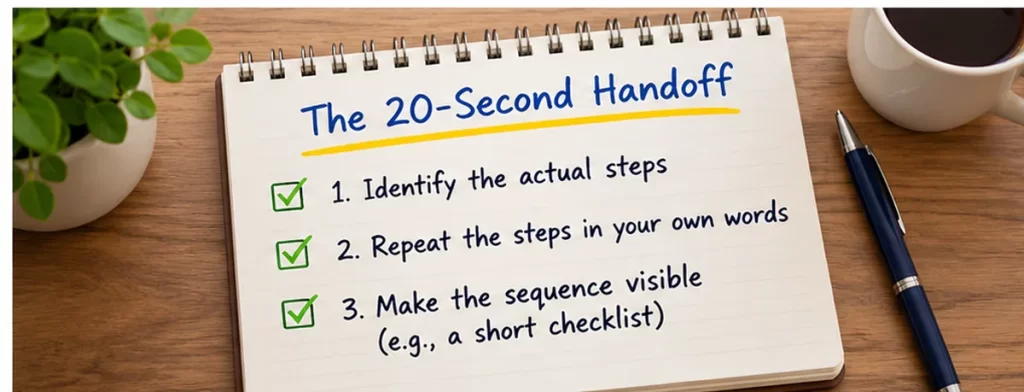
The 20-Second Handoff: A Simple Way to Remember Instructions

The next time someone gives you several instructions, change what happens immediately afterward. Rather than saying “Got it” and moving on, take a few seconds to transfer the information into a usable form.

Three-step checklist for remembering spoken instructions

A simple three-step approach to turning spoken instructions into actions.

1. Identify the actual steps

Don’t just remember the subject. Identify the actions. “The spreadsheet needs updating” is the subject. “Update October, compare with September, and send the revised file” describes what to do.

2. Repeat the steps in your own words

Try saying: “Okay, first I update October. Then I compare the two months. Then I email the revised file.” If anything is missing or out of order, the other person can correct it before you begin.

3. Make the sequence visible

For instructions involving several steps, write a short checklist. It doesn’t need to be elaborate:

Update October numbers → Compare with September → Send revised file

Our article on why writing things down helps you remember to act explores how reminders and action cues can reduce the burden of remembering everything at the right moment.

4. Start the first action when practical

If you can begin immediately, open the document, gather the materials, or set up the first step. Moving from an abstract verbal instruction to an action can reduce how much information you need to keep in mind.

Not every situation allows you to begin right away. That’s when a written checklist or reminder is especially helpful.

The purpose of this handoff isn’t to memorize every word perfectly. It’s to keep the next action from disappearing before you can use it.

Why Trying Harder to Remember Isn’t Always the Answer

When people become frustrated with forgetfulness, they may assume they simply need to concentrate harder. Sometimes deliberate attention helps. But effort alone doesn’t remove working-memory limits.

If someone gives you eight unfamiliar steps while you’re distracted, telling yourself to “remember harder” is unlikely to be the most reliable strategy.

Instead, try reducing how much information must be held at once. Request instructions in smaller sections. Ask for a written summary when precision is essential. Repeat the sequence before the conversation ends. Capture key steps before switching to something unrelated.

These strategies can be useful at work, where missing an instruction may contribute to small mistakes at work. The goal isn’t perfect memory; it’s a dependable system for important details.

What About Memory Changes After 50?

Occasionally forgetting a spoken instruction doesn’t automatically mean you have a serious memory problem. Sleep difficulties, stress, divided attention, hearing problems, medication effects, and other health factors can influence how information is processed.

The National Institute on Aging’s guide to memory problems, forgetfulness, and aging explains that occasional forgetfulness can accompany normal aging, while changes that interfere with everyday activities may deserve medical evaluation.

If you increasingly struggle to follow familiar directions, manage routine responsibilities, or complete tasks you previously handled easily, discuss the changes with a healthcare professional. Sudden confusion or abrupt changes in thinking require urgent medical evaluation.

The important thing is the overall pattern—not one frustrating moment.

Supporting the Mental Clarity You Rely On

Remembering spoken instructions depends on more than one cognitive skill. You need attention to take in the information, working memory to hold it temporarily, and enough mental bandwidth to organize what comes next.

That is why practical cognitive-wellness habits are worth considering together. Sleep, exercise, manageable distractions, effective reminders, and routines that reduce unnecessary mental load can all form part of your approach.

For readers exploring supplements as part of their wellness routine, Lumultra is the brand’s cognitive-support formula, while Lumultra Nova is positioned as an energy-support formula.

Neither product should be presented as a proven treatment for forgetting instructions. The research described in this article did not test either formula, and supplements are not substitutes for appropriate medical advice, sufficient sleep, or effective memory strategies.

Explore Lumultra and Nova to learn more about the available formulas and subscription options.

Eligible new subscription orders may qualify for 30% off the first subscription purchase with code NEWU26. Check the current offer terms before ordering.

The Bottom Line: Remember the Action, Not Just the Conversation

When instructions disappear moments after you hear them, remember what your brain was being asked to do: listen, interpret, organize, remember, and possibly plan several actions at once.

That’s a demanding task for a limited mental workspace. Fortunately, you can make important information easier to use by asking for manageable steps, repeating actions in your own words, connecting words with demonstrations, and writing down anything that needs to be exact.

Sometimes the difference between forgetting an instruction and following it successfully is what you do with the information in the first few seconds after hearing it.

Frequently Asked Questions

Why do I forget instructions immediately after hearing them?

You may understand the information but struggle to hold and organize all the steps in working memory. Distractions, mental workload, fatigue, stress, and instruction complexity can contribute.

Does forgetting verbal instructions mean my short-term memory is getting worse?

Not necessarily. Following multi-step instructions depends on attention and working memory as well as recall. Persistent or worsening changes, especially those affecting daily life, should be discussed with a healthcare professional.

Can aging make it harder to follow multiple instructions?

Some working-memory and processing demands may become harder with age, but experiences vary widely. Demonstrations, smaller instruction sets, and written reminders can make certain tasks easier to manage.

What’s the easiest way to remember multi-step instructions?

Identify the actions, repeat them in your own words, write a short checklist, and begin the first step when possible. For safety-critical or complicated tasks, use verified written directions rather than relying on memory alone.


These statements regarding dietary supplements have not been evaluated by the Food and Drug Administration. These products are not intended to diagnose, treat, cure, or prevent any disease.

Why Embarrassing Memories Stick but Important Details Fade

You can remember something embarrassing you said at a meeting 15 years ago.

You remember the room. The person who looked at you. Maybe even the awkward silence afterward.

Yet yesterday, someone told you an important piece of information—and today you cannot remember it.

Why do embarrassing memories stick while useful information seems to disappear so easily?

It is one of the stranger contradictions of human memory. Your brain can preserve an uncomfortable moment for decades while struggling to remember an appointment, a new name, or something you intended to do just an hour ago.

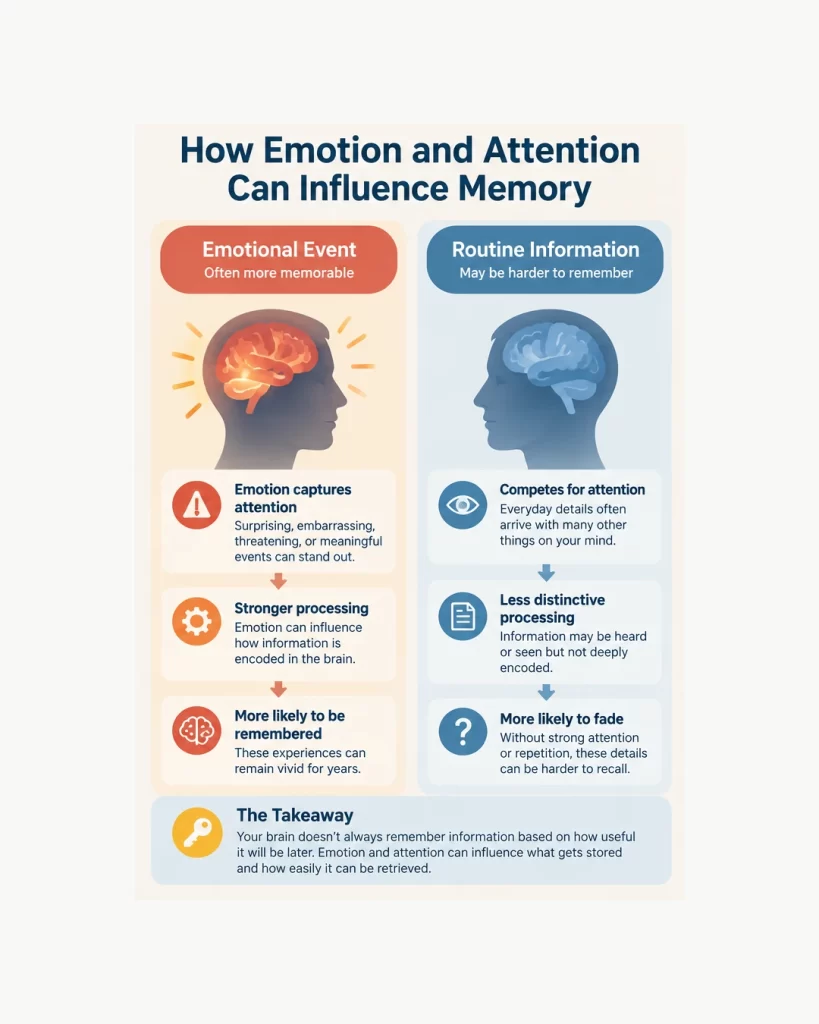
There is a reason for this. Your brain does not necessarily remember information according to how useful it will be later. Emotion can influence what gets attention and what remains accessible over time.

Understanding that difference can help you approach everyday forgetfulness differently.

Why Embarrassing Memories Stick

Think about two ordinary experiences.

In the first, you attend a meeting and hear several important updates. You understand everything, but none of it feels particularly remarkable.

In the second, you confidently make a statement—and discover that you misunderstood something obvious. Everyone notices. You feel embarrassed.

Years later, which experience is easier to remember?

For many people, it is the embarrassing one.

That is partly because emotional arousal can change the way information is processed and retained.

A study of emotional-memory encoding published in Nature Human Behaviour examined activity in the hippocampus and amygdala, two brain regions involved in memory and emotional processing. Researchers found patterns of activity linked to emotional arousal and successful memory encoding.

This does not mean embarrassment automatically creates a perfect or permanent memory. It means emotionally significant experiences can be processed differently from ordinary, emotionally neutral information.

An awkward moment may stand out from thousands of ordinary interactions. A routine appointment may not.

Emotion Helps Your Brain Decide What Stands Out

Your brain encounters far more information than it can preserve in detail: conversations, names, numbers, emails, background sounds, images, and small decisions.

Much of this information is relevant only briefly. Attention helps determine which information gets processed more deeply.

When something feels surprising, threatening, exciting, or personally meaningful, emotional arousal can influence how it competes for your attention.

A scientific review of emotional memory explains that these effects are selective rather than universal. Some details become more memorable, while other details may receive less attention.

This helps explain why you can remember how a conversation made you feel without recalling the exact words.

It is closely related to why you remember the big picture but forget the details. Your memory may preserve what felt significant without preserving everything that happened.

Important Information Is Not Always Memorable Information

How emotional memory and everyday information are processed differently through attention and recall

Here is the distinction that matters most for everyday life: something can be important without being memorable.

An accountant tells you a deadline. A colleague gives you a number. Someone introduces you to a person you expect to meet again.

You genuinely want to remember. But wanting to remember something is not the same as giving your brain a strong opportunity to encode it.

Imagine someone gives you an important instruction while you are checking your phone, thinking about your next appointment, and preparing to leave.

You hear the information. You even acknowledge it. But your attention is divided.

Later, the information feels strangely difficult to retrieve.

That is not necessarily because your brain considered the instruction unimportant. The information may simply have received less focused processing than it needed.

This is one reason remembering new information after 50 can sometimes feel more demanding, especially when several things compete for attention. The challenge may begin before you actually try to recall anything.

A Vivid Memory Is Not Always an Accurate Memory

There is another surprising aspect of emotional memory: the experiences we remember most vividly are not always the experiences we remember most accurately.

You may clearly remember feeling humiliated during a meeting years ago. But did everyone really notice? Was the silence as long as you remember? Did someone actually react negatively—or did you interpret a neutral expression that way?

Emotional memories can feel unusually convincing.

A review on emotion and the subjective sense of recollection explains that emotion can increase how vividly and confidently we remember an event without guaranteeing that every factual detail is accurate.

Confidence in a memory and accuracy of a memory are not the same thing.

You may remember the emotional center of an event while losing or reconstructing some surrounding details.

The same principle applies to positive experiences. A wedding, an important victory, or an unexpected reunion may remain vivid for years, but that does not mean every detail has been preserved perfectly.

Emotion can influence memory without turning the brain into a video recorder.

This connection between emotion and recall also helps explain why certain smells bring back memories you thought you forgot. Familiar scents can evoke surprisingly emotional recollections, even though the strength of the feeling does not guarantee that every remembered detail is accurate.

Why Some Old Memories Keep Returning

Emotional intensity is not the only reason an old moment can remain accessible. Repetition matters too.

Perhaps you have mentally replayed an embarrassing experience several times. You remembered what happened, wondered what you should have said, imagined a better response, or mentioned the story to a friend.

Each time, you revisited the memory.

Repeated retrieval can influence how accessible a memory becomes, although remembering an event again does not guarantee that every detail remains accurate.

Meanwhile, yesterday’s routine conversation may have received little attention and never been recalled afterward.

That creates an interesting contrast. The old embarrassing experience has been revisited repeatedly. The useful information from yesterday may have been encountered only once.

It is not necessarily a fair comparison of your overall memory ability. It is a comparison between two experiences that were processed and revisited very differently.

Why This Can Feel More Concerning After 40 or 50

When you are younger, everyday forgetfulness may feel like an inconvenience. As you get older, the same experience can carry a different interpretation.

Forgetting a name can make you wonder whether your recall is slowing. Missing an important detail might raise concerns about declining concentration. Meanwhile, a memory from 1998 remains perfectly clear, even though something someone said last Tuesday is difficult to recall.

The contrast can seem alarming.

However, the National Library of Medicine’s MedlinePlus guide to memory explains that occasional forgetfulness can be a normal part of aging, while memory difficulties that affect everyday tasks deserve attention.

Memory also involves multiple abilities. Long-established knowledge, attention, recent learning, and retrieval do not necessarily change in identical ways.

That does not mean all memory changes should be dismissed as normal. New, worsening, or disruptive difficulties deserve professional evaluation, especially when they interfere with familiar tasks or everyday independence.

But an occasional forgotten detail does not, by itself, establish that your overall memory is deteriorating.

How to Make Important Information More Memorable

You cannot make every routine detail emotionally powerful. Nor would you want to.

Fortunately, there are more practical ways to help useful information stand out.

1. Give the Information a Meaningful Connection

Instead of simply telling yourself, “I need to remember this,” connect the information to something concrete.

Suppose someone tells you: “The presentation starts Thursday at 10.”

You might think: “Thursday at 10 means I need the slides finished Wednesday afternoon.”

You have connected a date and time to an action you already understand. Meaningful associations can make information easier to organize and retrieve.

The goal is not to manufacture anxiety. It is to give the information a recognizable place in your thinking.

2. Make One Important Detail Distinctive

When several pieces of information sound similar, choose one that truly matters. Instead of trying to remember an entire conversation, identify the decision you need to act on.

“The client wants the revised proposal by Friday.”

You can also say the important detail out loud. Speaking selected information may make it more distinctive than simply hearing or reading it.

You do not need to repeat everything—just the information you want to remember.

3. Test Your Memory Instead of Repeatedly Looking

After learning something useful, briefly look away and ask yourself: “What was the important point?”

Try to retrieve the answer before checking. This is called retrieval practice.

A review published in the Annual Review of Psychology describes how practicing retrieval can support later remembering and reduce forgetting.

Our guide to retrieval practice for memory explores how to use this technique without turning everyday life into a series of memory tests.

Try recalling an important instruction after a short delay, then checking whether you got it right. For information that matters, accuracy still comes first.

4. Use External Reminders for Things You Cannot Afford to Forget

Not everything needs to be stored in your head.

Appointments, payments, medication schedules, and deadlines are often better supported by reliable reminders.

A calendar does not make your memory weaker simply because you use it. It gives you a dependable way to act on information when the appropriate moment arrives.

There is an important difference between developing memory skills and expecting memory to manage every responsibility without assistance.

Sometimes writing things down helps you remember to act because it creates a cue at the moment the task needs to happen.

5. Protect Attention Before Expecting Better Recall

Perhaps the most useful question is not “Why can’t I remember this?” but “Did I give this information enough attention when I first encountered it?”

If you are already carrying several unfinished tasks, responding to messages, and thinking about what comes next, important information may receive less processing than you intended.

Try reducing competing input when receiving instructions, learning new information, or having conversations that matter.

You cannot guarantee that you will remember everything. But you can improve the conditions under which remembering begins.

Where Lumultra Fits Into the Picture

Emotional-memory research teaches us something important: memory is not just about retrieving information later. It also involves attention, encoding, mental organization, and the ability to stay engaged with information when you first encounter it.

Those functions are connected to everyday cognitive performance.

Lumultra is marketed as a cognitive-support supplement for adults interested in focus, memory, and mental clarity. However, the studies discussed here did not test Lumultra. They do not establish that Lumultra can erase embarrassing memories, prevent age-related memory changes, or reproduce the memory effects of emotional arousal.

The practical approach is to combine healthy routines, useful memory strategies, and informed choices about cognitive support.

Explore Lumultra

If supporting your everyday focus and mental clarity is part of your routine, explore Lumultra and its ingredients.

New subscribers can use code NEWU26 for 30% off their first subscription, subject to current eligibility and offer terms.

*These statements have not been evaluated by the Food and Drug Administration. This product is not intended to diagnose, treat, cure, or prevent any disease.

Frequently Asked Questions

Why do embarrassing memories stay with us for years?

Emotionally significant events may receive more attention and be retained or revisited differently from neutral experiences. Recalling an event repeatedly can also influence how accessible it feels.

Why do I remember old events but forget recent information?

Older experiences may have been processed deeply, recalled many times, or connected to important emotions. New information may have been encountered briefly or while attention was divided. Some changes in new learning and retrieval can also occur with age.

Are emotional memories more accurate?

Not necessarily. Emotion can improve memory for some aspects of an experience while increasing confidence without preserving every detail accurately.

Can I train myself to remember important details?

Strategies such as focused attention, meaningful associations, saying selected information aloud, retrieval practice, and external reminders can help manage everyday memory demands. No single technique guarantees perfect recall.

When should I worry about everyday forgetfulness?

Discuss memory changes with a healthcare professional if they become noticeably worse, persist, or interfere with familiar activities, responsibilities, navigation, or everyday independence. Sudden confusion or neurological symptoms require prompt medical assessment.

The Takeaway: Memory Does Not Always Prioritize What Matters Most

That embarrassing moment from years ago may still feel vivid. The name you heard yesterday may be gone.

That difference can be frustrating, particularly when you are concerned about maintaining your mental sharpness. But it does not necessarily mean your brain has lost the ability to remember important things.

The two experiences may have received different amounts of attention, emotional significance, repetition, and opportunities for retrieval.

You cannot make every ordinary moment unforgettable. But you can give information that genuinely matters a better chance of being noticed, organized, revisited, and remembered.

And sometimes, that is more useful than simply trying harder to remember.

Why You Recognize Someone but Can’t Remember Where You Know Them From

Ever recognize someone but can’t remember where from? You’re at a restaurant, an airport, or a business event when someone suddenly looks familiar.

You recognize their face immediately, yet something feels incomplete.

Although you’re certain you’ve met before, the details of your previous conversation remain just out of reach.

But something is missing.

Where do I know this person from?

Was it a former coworker? Someone from the gym? A parent from your child’s school? A person you met on vacation?

You search through your memory while trying not to look confused.

And the harder you search, the more uncomfortable the moment becomes.

When you recognize someone but can’t remember where from, the explanation involves how your brain retrieves different types of information.

Recognizing a face and remembering the context in which you met that person are not exactly the same memory task.

Understanding that difference can help explain why familiar faces sometimes become surprisingly difficult to place.

Why You Recognize Someone but Can’t Remember Where From

We often think of recognizing someone as a single mental process.

Either you know the person or you don’t.

But your brain handles several pieces of information that can be retrieved separately.

You might recognize a person’s face without remembering:

  • Their name
  • Where you met
  • What they do
  • Who introduced you
  • When you last saw them

The feeling of recognition can arrive before any of those details.

Memory researchers distinguish between familiarity and recollection.

Familiarity is the sense that you’ve encountered something before.

Recollection involves retrieving additional details about the experience.

One particularly important form is called source memory.

Source memory helps you remember where information came from or the circumstances in which you encountered it.

When you recognize a person’s face but cannot remember where you know them from, the familiarity may be present even though the contextual memory is temporarily difficult to retrieve.

This is different from forgetting a person’s name. As we explained in our article Why Can’t I Remember Names Like I Used To?, retrieving names presents its own challenges.

In this case, the missing information may not be the name at all.

It’s the story attached to the face.

Why You Recognize a Face but Can’t Remember Where You Met

Consider a familiar situation.

Every Tuesday, you see the same person at the gym.

You recognize their face, exchange a few words, and occasionally discuss your workouts.

Then, several months later, you encounter that person at an airport.

They’re wearing a suit rather than workout clothes.

The setting is completely different.

You immediately sense that you know them.

But you cannot place them.

This illustrates an important principle of memory: the setting in which we encounter information can provide useful cues for remembering it later.

At the gym, the surroundings may help bring the person’s identity to mind.

At the airport, those familiar cues are absent.

Now your brain has to search through possible contexts.

The person hasn’t changed.

What has changed is the information available to help you remember.

When you recognize someone but can’t remember where from, the missing environmental cues may be part of the reason.

A similar process helps explain why certain smells bring back memories you thought you forgot. A familiar scent can act as a retrieval cue, helping your brain reconnect with people, places, and experiences from years ago.

A classic example in memory psychology describes unexpectedly encountering a familiar butcher on a bus. The face is recognizable, but identifying the person can be difficult because the usual setting is missing.

This example is also discussed in a scientific paper on familiar faces, recognition, and source memory.

When Recognizing Someone Leads to the Wrong Memory

There’s another interesting complication.

Sometimes you don’t simply fail to remember where you know someone from.

You become convinced that you remember — and you’re wrong.

Researchers have studied how familiarity can influence our judgments about where a face was previously encountered.

In a study published in Experimental Psychology, researchers examined recognition and source memory using familiar and unfamiliar faces presented in different contexts.

Across two experiments, they investigated how previously familiar faces and faces made familiar through repetition affected recognition accuracy.

In one experiment, faces were paired with background locations to examine how strongly people associated each face with its setting.

The results showed that familiar faces were generally easier to recognize. However, previously familiar faces were also more likely to be incorrectly judged as having appeared before when paired with new background locations.

You can read the full study on false memories of familiar faces.

The experiments involved controlled laboratory tasks rather than ordinary social encounters, so the results should not be treated as a direct measurement of everyday forgetfulness.

Nevertheless, the findings illustrate an important distinction.

Feeling certain that a face is familiar is not the same as accurately remembering where you encountered it.

When you recognize someone but can’t remember where from, you may be tempted to connect that familiar face with an incorrect setting.

This helps explain why you might confidently think someone is from your workplace only to discover that you met them through a mutual friend.

Your sense of recognition may be genuine.

Your explanation for that recognition may be mistaken.

Why This Can Feel More Frustrating as You Get Older

Many adults become more aware of these moments in their forties, fifties, and sixties.

Part of the frustration comes from confidence.

You may have spent decades building relationships, managing responsibilities, and recognizing hundreds of people across different parts of your life.

You’re accustomed to trusting your memory.

Then an ordinary social interaction suddenly leaves you searching for something that once seemed easy.

Research on cognitive aging suggests that certain aspects of contextual memory and strategic retrieval can become less efficient with age.

For example, a scientific review titled The Executive Control of Face Memory discusses how difficulties with contextual recollection and source monitoring can contribute to mistaken recognition judgments in older adults.

But not all memory abilities change in the same way.

Familiarity, accumulated knowledge, vocabulary, and professional expertise may remain relatively strong even when retrieving precise details becomes more difficult.

This connects with another distinction discussed in our article Why You Remember the Big Picture but Forget the Details.

You may retain an overall impression while struggling to recover a particular detail.

If you recognize someone but can’t remember where from, an occasional lapse does not automatically mean something is wrong with your memory.

The National Institute on Aging’s guidance on memory problems and aging explains that mild changes in memory retrieval can occur with normal aging, while more substantial changes deserve medical attention.

The important question is whether the difficulty is occasional or part of a noticeable pattern affecting everyday life.

What to Do When You Recognize Someone but Can’t Remember Where From

When you recognize someone but can’t remember where from, a few simple retrieval strategies may help you recover the missing context.

1. Search for the Setting, Not Just the Name

Instead of repeatedly asking yourself, “Who is this person?”, ask:

  • Where might I have seen this face?
  • Was it through work or socially?
  • Was it indoors or outdoors?
  • Did we meet through another person?
  • What were we doing when we talked?

You’re giving your memory different cues.

Sometimes remembering one piece of the setting helps another detail become accessible.

For example:

“That was at the golf tournament.”

Then:

“He was sitting with David.”

And suddenly:

“That’s David’s business partner.”

The setting provides a route toward the identity.

2. Don’t Confuse Familiarity With Certainty

If you’re not sure, resist the urge to invent an explanation.

You might think someone is a former colleague when they’re actually a neighbor.

A natural question can be more effective than an incorrect guess:

“Good to see you. Remind me where we last crossed paths?”

There’s nothing unusual about occasionally needing a reminder.

And asking can save you from building a conversation around a mistaken assumption.

3. Give the Context a Stronger Connection Next Time

When you meet someone you expect to encounter again, connect their face with a meaningful detail.

Instead of simply remembering:

“Michael.”

Try:

“Michael — met at the conference — works with Robert.”

Or:

“James — golf event — discussed a trip to Japan.”

You’re connecting the person’s identity with the circumstances of your meeting.

That gives you additional information to work with when you encounter the person again.

These are practical cue-building strategies, not a guaranteed training program for source memory.

The Bigger Role of Attention

Remembering people also depends on what happened when you first met them.

Were you paying attention?

Or were you simultaneously checking your phone, following another conversation, and thinking about your next appointment?

Sometimes you remember a face because you looked directly at it.

But you fail to remember the surrounding details because your attention was divided.

The original encounter may not have been encoded with enough contextual information to make later retrieval easy.

A useful habit is to pause briefly after an important introduction.

Ask yourself:

Who is this person, where did we meet, and what is one meaningful thing I learned?

You don’t have to memorize every person you meet.

The goal is simply to give important connections enough attention to make them more memorable.

Where Lumultra Fits Into Everyday Cognitive Support

Recognizing faces, remembering names, following conversations, and recalling information all depend on interconnected cognitive processes.

Attention helps you register information.

Working memory helps you keep relevant details available.

Long-term memory allows you to recognize and retrieve information from previous experiences.

These processes don’t operate independently.

That’s why supporting everyday cognitive performance involves more than practicing isolated memory tricks.

Sleep, physical activity, overall health, consistent routines, and focused attention all matter.

Lumultra is a nootropic supplement marketed for adults interested in supporting cognitive functions such as focus, working memory, and mental clarity.

However, Lumultra has not been established by the face-recognition research discussed here to improve source memory, correct face-recognition difficulties, or prevent age-related memory disorders.

If you’re exploring nutritional supplements as part of your broader wellness routine, you can learn more about the formula, its ingredients, and its intended uses on the Lumultra product page.

Explore Lumultra for Everyday Cognitive Support →

The Bottom Line

Recognizing someone without remembering where you met them can feel surprisingly uncomfortable.

But the experience reveals something interesting about the way memory works.

The familiar feeling and the contextual details don’t always arrive together.

You may recognize the person before you retrieve the story.

The next time you recognize someone but can’t remember where from, focus on recalling the setting, the conversation, or the people you were with.

Give yourself a moment.

Use a natural question if necessary.

And remember that occasionally needing a little extra context is different from losing the entire memory.

This article is for educational purposes and does not replace medical advice. New, persistent, or worsening difficulties with memory, recognition, or everyday functioning should be evaluated by a qualified healthcare professional. Sudden cognitive changes, particularly with neurological symptoms, require urgent medical attention.

Dietary supplements are not intended to diagnose, treat, cure, or prevent any disease.

Learning by Teaching: Why Explaining Something Helps You Remember It

You just finished reading an interesting article.

Everything made sense.

The examples were clear. The ideas seemed familiar. You felt confident that you understood the subject.

Then someone asks:

“Can you explain it to me?”

Suddenly, things become less clear.

You remember the general idea, but the details are harder to organize. You know the concept makes sense, yet you struggle to put it into words.

This experience reveals something important about learning.

Recognizing information is not always the same as being able to explain it.

And one way to learn something better may be to prepare to teach it to someone else.

Researchers call this learning by teaching.

Why Understanding Something Can Be Harder Than It Feels

Imagine learning a new software feature at work.

You watch a tutorial. The instructor walks through every step. You follow along successfully.

At the end, you think, “Got it.”

But the next morning, a colleague asks you to demonstrate the feature without the tutorial.

Now you have to remember the steps, explain why they matter, and show how they fit together.

That requires something more than recognizing what the instructor did.

You have to organize the information yourself.

This is one reason learning can sometimes feel easier than it actually is. When information is directly in front of you, the structure has already been provided. When you explain it to someone else, you have to create that structure yourself.

If you’ve experienced this while reading, our article on why you read a page and remember nothing explores how attention, understanding, and memory can come apart.

What Research Says About Learning by Teaching

Psychologists have studied whether preparing to teach information changes how people learn it.

A 2014 study published in Memory & Cognition investigated an interesting question: What happens when someone studies information expecting to teach it rather than simply expecting a test?

Participants studied reading passages. One group expected to take a test afterward. Another group believed they would teach the information to another student.

In reality, neither group taught anyone. Both groups were tested.

The researchers found that participants who expected to teach demonstrated better-organized free recall and, under certain conditions, answered more questions correctly.

The expectation of teaching appeared to influence how participants processed and organized information.

Read the research on expecting to teach and memory.

Another 2014 study published in Contemporary Educational Psychology compared preparing to teach with actually teaching material through an explanation.

Its findings suggested that preparing to teach could benefit immediate comprehension, while actually teaching, particularly after preparing to teach, provided stronger benefits on a delayed comprehension test in the study’s conditions.

Explore the research on explanations and learning by teaching.

These studies do not mean teaching guarantees perfect memory. But they suggest something useful:

Learning with the intention of explaining information can change how carefully you process it.

Why Explaining Something Can Make It Stick

There are several reasons learning by teaching may be helpful.

1. You Have to Identify What Really Matters

When you read an article, every paragraph arrives in an order chosen by the writer.

When you explain the article, you must decide what deserves attention.

What is the main idea? Which details support it? What can be left out? What must be understood first?

These decisions encourage you to organize information rather than simply receive it.

For example, suppose you learn about a new investment product.

You might remember several features, fees, and financial terms. But if someone asks you to explain how the product works, you have to identify the essential concepts and their relationships.

That organizational work can reveal whether you understand the investment beyond recognizing its terminology.

2. You Must Connect New Information to Existing Knowledge

A good explanation rarely consists of isolated facts. It uses comparisons, provides examples, and connects unfamiliar ideas with familiar ones.

Suppose you’re learning about computer memory.

You might explain working memory as a temporary mental workspace. Or you might compare short-term and long-term memory with information currently on a desk versus information stored in a filing system.

Analogies are not perfect representations. But they can help make abstract concepts more understandable.

This connects with another learning principle we’ve explored: new information can become easier to remember when you connect it to what you already know.

Teaching encourages you to build those connections because your explanation has to make sense to someone who doesn’t already know the material.

3. Explaining Reveals What You Don’t Understand

Sometimes the most valuable part of explaining something is discovering where your explanation stops.

You begin confidently: “The main reason this works is…”

Then you hesitate. You cannot explain the next step.

That hesitation provides useful feedback.

You may have understood the general concept without understanding a particular relationship. Now you know what to review.

Instead of rereading everything, you can return to the specific part that remains unclear.

This turns uncertainty into a guide for more focused learning.

4. You Practice Retrieving Information Without the Answer in Front of You

Explaining also requires remembering.

When your notes are closed, you must bring the information back from memory.

That connects learning by teaching with retrieval practice for memory.

But teaching adds another useful challenge. You are not merely recalling an answer. You are arranging ideas into an explanation that another person could follow.

That combination of recall, organization, and explanation may help you engage more deeply with what you’ve learned.

Try the Two-Minute Teach-Back Method

Five-step teach-back method for learning: choose, close notes, explain, check, and repeat.

You don’t need a classroom or an audience to experiment with learning by teaching.

You can try a simple two-minute routine.

This is a practical exercise inspired by learning research, not a scientifically established two-minute protocol.

Step 1: Choose One Idea

Pick something you learned recently. It could be:

  • A concept from an article
  • A feature in new software
  • An unfamiliar financial term
  • A business process
  • A key point from a presentation

Keep the topic narrow enough to explain briefly.

Step 2: Close Your Notes

Put the original material aside.

Imagine someone has just asked: “What does that mean?”

Step 3: Explain It for One Minute

Use ordinary language. Start with the main idea. Then describe how it works and why it matters. Try to include one simple example.

If you find yourself relying on technical language you cannot define, that’s a useful signal.

You may need to clarify the concept before you can communicate it well.

Step 4: Check What You Missed

Open the original material. Compare your explanation with the source.

Did you remember the important points? Consider whether you left out any crucial details or accidentally explained something incorrectly.

Correct any gaps.

Step 5: Explain It Again

Close your notes and give a shorter, clearer explanation.

You don’t need to repeat every detail. Concentrate on communicating the essential idea accurately.

The goal is not to sound impressive. It’s to make your understanding more complete.

Where Learning by Teaching Fits Into Everyday Life

This method isn’t limited to students. For adults, many learning opportunities happen outside classrooms.

  • At work: After learning a new process, explain it as though you’re introducing it to a new colleague.
  • While reading: At the end of a useful article, ask yourself how you would summarize its central idea to a friend.
  • When evaluating financial decisions: Try explaining an unfamiliar product in plain language, including its costs, limitations, and risks.
  • When preparing a presentation: Explain the subject without slides before creating the final presentation.
  • When learning new technology: Describe what a feature does, why it’s useful, and when you would use it.

You don’t have to turn every learning experience into an assignment.

Choose information you genuinely care about remembering or understanding.

Teaching Doesn’t Replace Checking the Facts

There is an important limitation.

Being able to explain something confidently doesn’t necessarily mean your explanation is correct.

A person can organize incorrect information into a convincing story. That is why the verification step matters.

After explaining something, compare your understanding with a reliable source. Correct mistakes before practicing the explanation again.

And remember that learning by teaching is one strategy among many. Sleep, attention, repeated practice, meaningful connections, and appropriate review all contribute to learning.

The Most Useful Question to Ask After Learning Something

The next time you finish an article, tutorial, or important conversation, resist the temptation to evaluate your learning only by asking:

“Did that make sense?”

Instead, ask:

“Could I explain this clearly to someone who wasn’t here?”

If the answer is yes, you may have developed a more useful understanding than simple familiarity.

If the answer is no, you’ve discovered what still needs attention.

Either outcome can help guide your next step.

Sometimes the most powerful part of learning is not hearing a better explanation. It’s attempting to create one yourself.

Support Focus, Memory, and Mental Clarity

Learning strategies work alongside the habits that support everyday cognitive performance.

Adequate sleep, consistent attention, meaningful practice, and appropriate recovery all play important roles.

Lumultra is marketed as a cognitive-support supplement for areas including focus, memory, and mental clarity. Evidence about learning by teaching does not establish that Lumultra improves learning or recall.

If you’re exploring a broader routine around cognitive performance, you can learn more about Lumultra and its formula.

Dietary supplements are not intended to diagnose, treat, cure, or prevent any disease. This article is for educational purposes and is not medical advic

Why Drawing a Simple Sketch Can Help You Remember More

Why Drawing a Simple Sketch Can Help You Remember More

Drawing to improve memory may be simpler than you think. Research suggests that creating a quick, meaningful sketch can sometimes help information stick better than repeatedly writing it down. And you don’t need any artistic talent to try it.

You read something important.

At the time, it makes perfect sense.

Maybe you even write it down.

But the next day, when you try to explain what you learned, the details are surprisingly difficult to remember.

Now imagine doing something different.

Instead of copying the information into your notes, you pick up a pen and make a quick sketch.

Nothing beautiful or complicated.

Just a rough drawing that represents the idea.

Could that small change make the information easier to remember?

Research suggests it sometimes can.

Scientists call this the drawing effect—a memory advantage observed when people draw information they want to remember rather than simply write it out.

And one of the most interesting findings is that the technique has also shown benefits in older adults.

What Is the Drawing Effect?

The drawing effect describes an advantage in remembering information that you have actively drawn.

In a series of seven experiments published in The Quarterly Journal of Experimental Psychology, researchers Jeffrey Wammes, Melissa Meade, and Myra Fernandes tested how drawing compared with writing words repeatedly.

Participants were asked to remember information using different learning methods.

In these experiments, information that participants drew was generally recalled better than information they wrote.

The researchers proposed that drawing brings together several types of processing instead of relying on words alone.

Rather than simply seeing the information, you think about what it means, decide how to represent it, and physically create that representation.

These actions may help produce a richer memory.

Drawing to improve memory is not about creating perfect artwork. Instead, it involves actively processing information by turning an idea into something meaningful and visual.

You can read the original drawing-effect research for the experimental details.

The finding is not that every picture becomes unforgettable.

Rather, drawing relevant information can provide a useful memory advantage under certain learning conditions.

Why Drawing to Improve Memory May Help Information Stick

Think about the word bicycle.

If you write it five times, you repeat the same word.

Bicycle. Bicycle. Bicycle.

But if you draw a bicycle, even a terrible one, you have to make several decisions.

What makes a bicycle recognizable?

Perhaps it’s the two wheels, the frame, or the handlebars.

To represent the object, you have to retrieve what you know about it and turn that knowledge into something visible.

Researchers suggest that this process can engage three overlapping elements.

1. Meaning

To draw something, you first have to think about what it represents.

A quick sketch requires you to identify the meaningful features of an object or idea.

This connects with another important learning principle: new information can become more memorable when you connect it to something you already know.

You are no longer dealing only with an unfamiliar word.

Instead, you are giving the idea a recognizable form.

2. Visual Information

A sketch creates visual details that may help distinguish one memory from another.

For example, you might forget the exact wording of a note but remember the unusual diagram or simple picture you drew beside it.

These additional visual features can provide another way to retrieve the idea later.

3. Physical Action

Drawing also involves producing something with your hand.

As you move the pen, you choose where lines belong and adjust the image as it develops.

Researchers have proposed that integrating visual, meaningful, and motor information helps explain why drawing can outperform some other memory strategies.

An Association for Psychological Science review of drawing and memory discusses this combination of processes.

The important point is not that every pencil movement strengthens memory.

Instead, purposeful drawing makes you interact with information in several complementary ways.

Does Drawing Help Memory After 50?

This is where the research becomes especially interesting.

Memory is not one ability that suddenly disappears at a certain age.

Different cognitive functions can change differently over time.

For example, some older adults notice that learning new information requires more effort, even though their accumulated knowledge and experience remain strong.

Researchers wanted to know whether drawing could provide a useful way to support learning.

In a 2018 study, scientists compared drawing with writing and other learning methods in younger and older adults.

Participants studied lists of words, sometimes drawing the objects they represented and sometimes writing the words.

Both younger and older adults showed memory benefits from drawing.

In one experiment, the advantage for drawn items was particularly pronounced among older participants.

The researchers also found that drawing could reduce certain age-related differences in recollection-based memory performance.

The study, Drawing as an Encoding Tool: Memorial Benefits in Younger and Older Adults, provides the details.

These findings do not establish that drawing prevents dementia, reverses cognitive aging, or improves every kind of memory.

For adults interested in drawing to improve memory after 50, however, these findings offer a practical reason to experiment with simple sketches as part of everyday learning.

The results suggest that drawing can be a useful learning strategy across different adult age groups.

That fits a broader idea we explored in Can Your Brain Still Change After 50?

Your brain can continue learning throughout adulthood, and the strategies you use can influence how effectively you learn.

You Don’t Need to Be Good at Drawing

Perhaps the best part of this technique is that artistic skill is not the objective.

There’s no need to worry about shading, perspective, or expensive supplies.

A recognizable stick figure, crude diagram, or a few connected shapes may be enough to represent what you are trying to learn.

Suppose you are learning a new work process with three stages:

  • Receive the request.
  • Review the details.
  • Send the completed work.

You could copy those steps into a notebook.

Or you could sketch an envelope, an eye examining a page, and an outgoing arrow.

The drawing might look ridiculous, but that does not matter.

Choosing those pictures requires you to consider what each stage means.

Later, those same pictures may help you reconstruct the process.

After all, the goal is not to create art.

The goal is to create a visual representation that means something to you.

Drawing Is Different From Random Doodling

There is an important distinction.

Drawing something related to what you are learning is not the same as filling the margins of your notebook with unrelated shapes.

Researchers have tested that difference.

In a 2019 study comparing drawing, writing, and doodling, participants performed best when they drew images representing the information they needed to remember.

Free-form doodling unrelated to that information produced poorer recall than drawing or writing in the tested tasks.

Structured doodling did not provide the same recall advantage as purposeful drawing.

You can read the research comparing doodling, drawing, and writing.

That leads to a useful rule:

Draw the thing you want to remember—not simply something to occupy your pen.

When learning a concept, sketch the concept itself.

For a process, illustrate the sequence of steps.

And if you are trying to understand how two ideas relate, create a simple drawing of their relationship.

Whatever you choose, keep the drawing connected to the information.

Try the 30-Second Sketch Method

You can experiment with this approach the next time you encounter something worth remembering.

Step 1: Choose One Idea

Start small.

Pick a new concept, a process, or one meaningful piece of information.

For example:

“A habit becomes easier when I connect it to something I already do.”

Step 2: Turn the Idea Into a Picture

Draw two simple boxes.

Label the first “Existing habit” and the second “New habit.”

Next, connect them with an arrow.

You have now represented a relationship visually, without needing to create an attractive illustration.

Step 3: Explain What You Drew

Look at your sketch and describe the meaning in your own words.

“My existing routine becomes the cue for the new action.”

If you want, say the explanation aloud.

This introduces another learning method we discussed in Why Saying Something Out Loud Can Help You Remember It.

The methods are different, but both require active interaction with the information.

Step 4: Look Away and Recall

Set the drawing aside.

A few minutes later, ask yourself what the sketch represented.

Can you remember the relationship without seeing it?

If not, look again and clarify the idea.

Then try once more.

This combines drawing with retrieval practice—trying to remember before immediately looking up the answer.

Step 5: Revisit It Later

Come back to the concept the next day.

Try explaining it without opening your notes.

You may discover that the simple picture gives you a useful starting point.

To make drawing to improve memory a regular habit, start with just one concept each day. Keep your sketches simple, connect them to meaningful information, and test what you remember later.

This five-step approach is a practical application of several research findings, not a separately tested or guaranteed memory-training program.

When Should You Draw Instead of Write?

Drawing is worth experimenting with when information has a clear visual or conceptual structure.

Drawing to improve memory may be especially useful when you are learning processes, relationships, or concepts that are easy to represent visually.

Here are a few examples.

What You’re Learning What You Might Sketch
A new work process Three boxes connected by arrows
How two concepts relate Two circles with a connecting line
The stages of a project A simple visual timeline
A basic scientific concept A labeled diagram
A new vocabulary word A recognizable picture of its meaning

However, drawing is not always the best tool.

For exact appointment times, medication instructions, financial figures, or important addresses, accurate written information and dependable reminders are essential.

A picture may help you understand something without preserving every detail precisely.

Therefore, use drawing when it supports the kind of information you actually need to remember.

For situations where accuracy matters more than creating a memorable representation, rely on written records instead.

Better Memory Is Not Always About More Repetition

It is natural to assume that if information does not stick, you simply need to read it again.

Then perhaps you read it one more time, hoping that repetition will make the details stay in your memory.

But repetition is only one part of learning.

Sometimes the more useful question is:

What am I doing with this information while I am learning it?

Rather than simply looking at words again, consider how actively you are engaging with their meaning.

  • Have I connected the information to something meaningful?
  • Could a quick sketch help me visualize the concept?
  • Can I explain the idea in my own words?
  • What happens when I try to recall it later?

Each approach engages the learning process differently.

That is why a rough sketch can sometimes be more useful than another pass through the same sentence.

The advantage does not come from drawing being magical.

Instead, creating the drawing asks you to process the information actively.

Where Lumultra Fits Into Your Cognitive Routine

Good cognitive habits often work together.

First, you give important information your attention.

Then you process it meaningfully and create reminders when needed.

Along the way, adequate sleep and recovery can support your overall well-being, while retrieval practice offers another opportunity to strengthen learning.

Lumultra is formulated with ingredients selected to support areas of cognitive function such as focus, working memory, mental clarity, and processing speed.

For people interested in a broader daily cognitive-wellness routine, the formula offers another option to explore.

The drawing studies discussed here did not test Lumultra, and they do not demonstrate that a supplement increases the drawing effect.

The learning technique stands on its own.

Explore Lumultra to learn more about the formula, ingredients, and how it may fit your routine.

The Takeaway: Sometimes a Simple Sketch Is Worth More Than Another Line of Notes

The next time you want to remember something important, try a different approach.

Instead of writing the same information repeatedly, ask yourself:

“What would this idea look like if I had to draw it?”

Then make a simple sketch.

Your drawing may be clumsy, with crooked lines or awkward shapes.

Perhaps it looks nothing like something an artist would create. That’s perfectly fine because artistic quality is not the goal.

What matters is whether the process helps you think about the information more meaningfully.

Drawing to improve memory doesn’t require special tools, expensive materials, or impressive artistic skills. A pencil, a few simple shapes, and a willingness to think differently are enough to begin experimenting.

Because sometimes the most valuable part of a drawing is not the picture left on the page.

It’s the thinking you did while creating it.

Educational information only. This article is not medical advice. Persistent or worsening memory problems that interfere with daily life should be discussed with a qualified healthcare professional. Lumultra is not intended to diagnose, treat, cure, or prevent any disease.
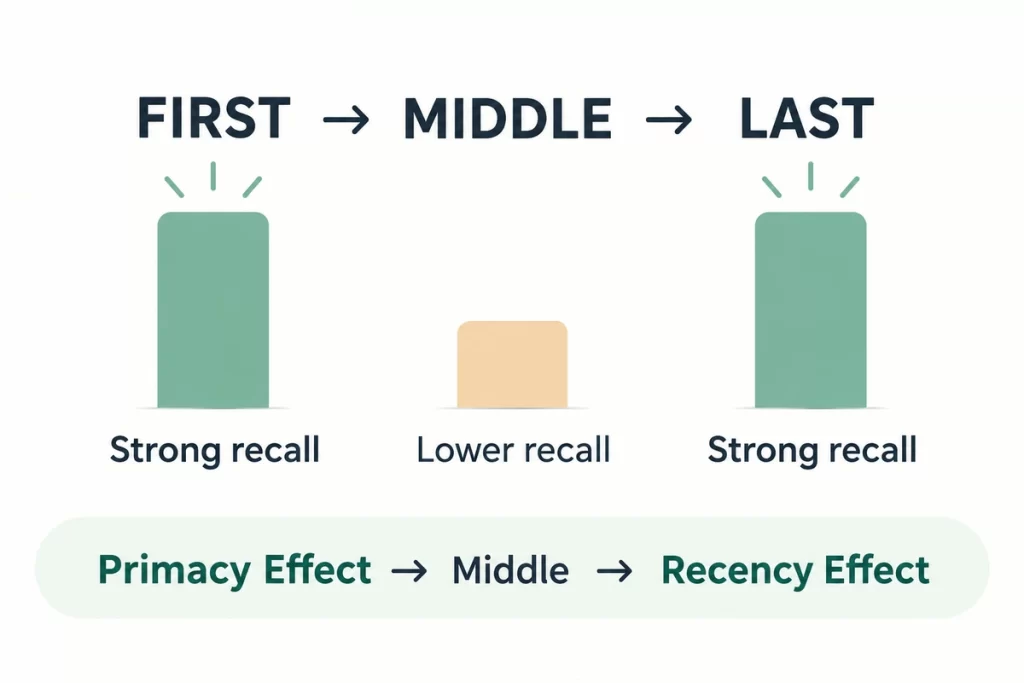
Why You Remember the First and Last Things—but Forget the Middle

You have five things to remember.

Call David.

Pick up the prescription.

Send the document.

Buy coffee.

Confirm tomorrow’s appointment.

A few minutes later, someone asks what was on your list.

You remember the first thing.

You remember the last thing.

But somewhere in the middle?

Something disappeared.

That pattern may feel random, but psychologists have been studying it for decades. It is called the serial position effect.

When people are asked to remember a sequence of information, items appearing near the beginning and end are often recalled better than items appearing in the middle.

The stronger memory for early information is called the primacy effect.

The stronger memory for information near the end is called the recency effect.

Together, they reveal something surprisingly useful about memory:

Where information appears can influence how easily you remember it.

Primacy and recency effects showing better recall for the first and last items

What Is the Serial Position Effect?

Imagine hearing a list of twelve unrelated words.

You listen carefully. Then someone asks you to repeat as many as possible.

You probably won’t remember each word equally well.

Research on the serial position effect has repeatedly found a characteristic pattern: people tend to recall more items from the beginning and end of a list than from the middle.

Researchers call this pattern the serial-position curve. A psychology textbook explanation of the serial-position curve illustrates how early and late items can receive a recall advantage.

That doesn’t mean the brain has a rule saying:

“Forget the middle.”

Instead, information appearing at different points in a sequence encounters different memory conditions.

That distinction matters.

Because forgetting the middle of a list is not necessarily evidence that your memory is failing.

It can be part of the normal way memory works.

Why the Beginning Can Stick: The Primacy Effect

The tendency to remember the beginning of a sequence is called the primacy effect.

One traditional explanation is surprisingly intuitive.

When the first item arrives, nothing else is competing with it yet.

You have an opportunity to think about it.

Maybe you repeat it mentally.

Then the second item arrives.

You may repeat both.

The early items can therefore receive more attention or rehearsal before the sequence becomes crowded with additional information.

Researchers continue to debate the exact mechanisms behind primacy and recency. They shouldn’t be treated as two simple switches in the brain.

But the practical observation is consistent:

Early information often has an advantage.

Think about introductions.

Someone says:

“Before we begin, there are three things you need to know.”

Your attention is probably high.

The first point arrives in a relatively uncluttered mental environment.

By point seven of a long explanation, the situation is different.

You are now trying to remember what you already heard while simultaneously processing what is coming next.

This is one reason connecting new information to what you already know can be helpful. Giving an unfamiliar idea meaningful context may provide additional ways to retrieve it later.

Why the Last Thing Can Stick Too: The Recency Effect

Then there is the opposite end of the list.

The final items often receive their own advantage.

This is called the recency effect.

When someone finishes a list and immediately asks you what you remember, the final information is still relatively recent.

You may still have some of it active and accessible.

That can make the end of a sequence easier to retrieve than information buried several items earlier.

Think about a conversation.

Someone gives you six instructions.

You might remember:

  • The first instruction.
  • Several pieces of the conversation.
  • And the final reminder.

“Oh, and don’t forget to bring your passport.”

That final instruction may feel unusually easy to remember.

Its position helped make it distinctive.

However, recency is not guaranteed. A delay or a distracting activity can change how well the final items are recalled.

The research on primacy and recency effects explains how the timing of recall and intervening tasks influence these patterns.

Why Information in the Middle Is Easier to Forget

Now look at what happens to the middle.

The middle doesn’t have the clean beginning.

It doesn’t have the freshness of the end.

Instead, middle items are surrounded by competing information.

New information arrived before them.

More information arrived after them.

They may receive less rehearsal and be less distinctive from neighboring items.

So when you later attempt to retrieve the sequence, the middle can become the vulnerable zone.

You’ve probably experienced this without realizing it.

Someone tells you:

“The meeting is Tuesday at 2. Bring your sales numbers, the revised proposal, the customer notes, and your laptop. We’ll meet in Conference Room B.”

Later you remember:

  • Tuesday at 2.
  • Conference Room B.
  • Your laptop.

What disappeared?

Possibly one of the details sitting quietly in the middle.

In controlled experiments, these differences form a recognizable recall pattern. A Baylor University educational resource on serial-position effects explores how researchers study recall across different positions in a list.

Everyday situations are more complicated than laboratory word lists, but the underlying observation offers a useful way to think about information overload.

Don’t Turn This Into a Memory Test

There is an important distinction here.

The serial position effect is a well-established experimental finding.

It is not a do-it-yourself neurological test.

Forgetting the middle item on your grocery list does not diagnose anything.

Likewise, deliberately testing yourself with word lists isn’t a reliable way to decide whether your memory is normal.

Everyday memory is affected by attention, familiarity, stress, sleep, distractions, meaning, and many other factors.

The useful lesson isn’t to test your brain.

It’s to understand one more characteristic of how memory behaves.

And once you understand it, you can work with it.

How to Remember Important Information in the Middle

You cannot eliminate the serial position effect.

But you can stop treating every piece of information as though its position doesn’t matter.

1. Put the Most Important Thing First

If you are giving yourself instructions, writing meeting notes, or creating a short task list, consider what absolutely cannot be forgotten.

Don’t automatically bury it halfway down the page.

Give important information prominence.

Your first position is valuable real estate.

Use it.

For example, instead of writing:

“Pick up coffee, send the report, buy batteries, confirm the doctor’s appointment, and check the mail.”

Try:

“Confirm the doctor’s appointment first. Then handle the remaining errands.”

The important action now stands out rather than competing with several routine tasks.

2. Break Long Information Into Smaller Sections

Suppose you have twelve things to review.

One uninterrupted sequence gives you:

Beginning → Long Middle → End

Instead, dividing the material into several meaningful groups gives the information more structure.

For example:

Before the meeting:

  • Review the agenda.
  • Prepare the financial report.
  • Confirm the participants.

During the meeting:

  • Discuss the proposal.
  • Review feedback.
  • Assign responsibilities.

After the meeting:

  • Send the summary.
  • Update the project schedule.
  • Confirm the next meeting.

You’re no longer asking your brain to deal with one anonymous block of information.

You’re giving it organized sections.

This also connects with another important memory principle: information can become easier to work with when it has meaningful structure.

Grouping information is not a guarantee that every item will be remembered. It is a practical way to reduce unnecessary complexity and make important details easier to locate.

3. Pay Special Attention to the Middle

Here’s a simple habit:

After hearing several important instructions, ask yourself:

“What were the middle things?”

Don’t immediately review the entire list from the beginning.

Try retrieving the items that are most likely to disappear.

For example:

“I know the first instruction was to call Robert, and the last was to send the invoice. What were the two things between them?”

Now you’re using retrieval practice for memory strategically instead of treating every item equally.

Trying to retrieve information before checking your notes can be useful when you genuinely want to remember it later.

But remember to verify the answer.

The goal is to practice accurate recall, not to become more confident in an incorrect detail.

4. Make an Important Middle Item Distinctive

If something important is buried among several other pieces of information, give it an additional cue.

  • Say it aloud.
  • Connect it with something you already know.
  • Write it separately.
  • Explain why it matters.
  • Move it into its own category.

You’ve already seen these principles in some of our recent memory articles.

The goal isn’t to turn everyday life into a memory-training exercise.

It’s simply to recognize when something important deserves more attention.

You can also reinforce important information by revisiting it after a delay using the spacing effect, rather than repeating it several times in one sitting.

Try the First-Middle-Last Memory Check

Here’s an easy habit you can use after a meeting, conversation, article, or set of instructions.

Ask yourself three questions:

FIRST: What Was the First Important Idea?

Start by identifying the opening point.

What did the person say first?

What was the beginning of the explanation about?

Try to recall it without immediately checking your notes.

MIDDLE: What Information Was Buried Between the Beginning and End?

This is the most important part of the exercise.

Think about the details that came after the introduction but before the conclusion.

What instructions were mentioned?

Was there a number, name, deadline, or important decision?

Don’t rush to the final point before giving the middle information a chance to come back.

LAST: What Was the Final Important Point?

Finally, recall the ending.

What was the last instruction or recommendation?

Was there a final reminder or action item?

Once you’ve attempted all three, compare your answers with the original information when possible.

First → Middle → Last → Check

Many people naturally find the first and last questions easier in list-recall situations.

That’s exactly why the middle question can be useful.

It directs attention toward information that might otherwise disappear quietly.

This First-Middle-Last check is a practical suggestion based on memory principles, not a clinically validated memory-training program.

What the Serial Position Effect Teaches Us About Reading

Reading provides another opportunity to think about information order.

You begin an article.

The introduction captures your attention.

You read several sections.

Then you reach the conclusion.

Later, you remember the opening idea and the final takeaway.

But what about the explanations and examples in between?

The classic serial position effect comes from controlled recall experiments, so it doesn’t automatically predict exactly which paragraphs of an article you’ll remember.

Still, it offers a useful reminder that long sequences of information can become difficult to manage.

Instead of reading continuously and hoping everything sticks, consider pausing after meaningful sections.

Ask yourself:

“What was the point of that section?”

Try explaining it in one sentence.

Then continue.

This approach works naturally with the strategies discussed in our article Why You Read a Page and Remember Nothing, which explains how attention, encoding, and active recall influence reading comprehension.

This Also Matters When You’re Communicating

The serial position effect isn’t only useful when you’re trying to remember.

It can also change how you present information to other people.

Suppose you’re sending someone five instructions.

If one instruction is absolutely critical, hiding it in the middle of a long paragraph may not be ideal.

Give it emphasis.

Put it near the beginning.

Separate it visually.

Or reinforce the key point at the end.

The same idea applies to presentations, meetings, instructions, and conversations.

For example, imagine explaining a new process to your team.

Instead of delivering ten instructions without interruption, you could:

  • Begin with the main objective.
  • Divide the instructions into meaningful stages.
  • Highlight important requirements within each stage.
  • Finish with the most important next action.

This doesn’t guarantee that your audience will remember everything.

But it makes the information easier to navigate and reduces the chance that important details become lost inside a long explanation.

Sometimes clearer communication isn’t about saying more.

It’s about deciding where the important information goes.

Where Lumultra Fits

Memory isn’t one isolated ability.

For information to become useful later, your brain first has to pay attention to it, process it, organize it, and eventually retrieve it.

Those processes also depend on cognitive functions such as focus, working memory, and mental clarity.

That is why memory strategies work best as part of a broader routine that supports cognitive well-being.

Lumultra is formulated to support cognitive functions including focus, memory, processing speed, and mental clarity as part of a daily cognitive-support routine.

It isn’t a replacement for good learning strategies, adequate sleep, regular exercise, effective organization, or appropriate medical care.

Think of strategies like the First-Middle-Last check as ways to use your cognitive resources more deliberately.

Lumultra is designed to support the broader cognitive foundation behind everyday mental performance.

The Takeaway: Remember What Gets Lost in the Middle

Memory does not necessarily give every piece of information equal treatment.

The beginning of a sequence may benefit from greater opportunity for attention and rehearsal.

The end may benefit from being especially recent.

The middle can get squeezed between the two.

So the next time you need to remember several important things, don’t simply repeat the entire list again.

Ask:

“What is hiding in the middle?”

Pull that information out.

Give it meaning.

Try retrieving it.

And make sure the information that matters most isn’t the easiest thing to overlook.

Sometimes remembering better begins with understanding where forgetting is most likely to happen.

Support Focus, Memory, and Mental Clarity

Your daily mental performance depends on more than one memory trick.

Consistent habits, meaningful learning, adequate rest, and attention all contribute to the way you process and remember information.

Lumultra is designed to support the cognitive functions you rely on every day, including focus, memory, processing speed, and mental clarity.

Explore Lumultra and its cognitive-support formula →

Dietary supplements are not intended to diagnose, treat, cure, or prevent disease. Significant, sudden, or progressively worsening changes in memory or thinking should be discussed with a qualified healthcare professional.
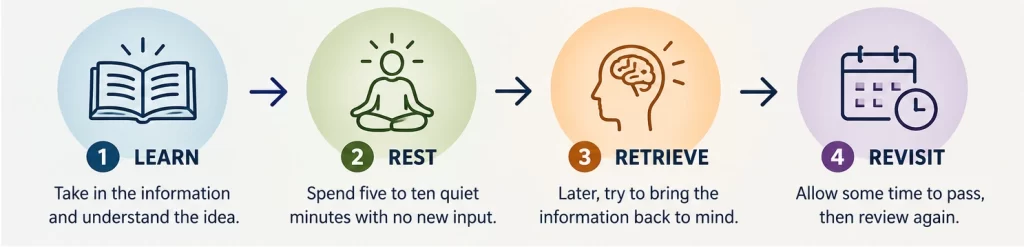
Why Doing Nothing After Learning May Help You Remember More

You finish reading something important.

Maybe it is a report.

Maybe someone has just explained a new process at work.

Maybe you are trying to remember instructions, a few names from a meeting, or something you genuinely want to understand.

What do you do next?

Probably what most of us do.

You check your phone.

Open another tab.

Answer an email.

Read the next article.

Turn on a podcast.

Start thinking about the next problem.

Our instinct is to keep feeding the brain more information.

But research on wakeful rest and memory suggests there may be times when the better move is surprisingly simple:

Do almost nothing for a few minutes.

Researchers call this wakeful rest.

There is growing evidence that a short period of quiet rest immediately after learning may help the brain retain newly learned information.

Memory Doesn’t Stop Working When Learning Stops

We often think of memory as a single event.

You hear something.

You understand it.

Your brain stores it.

Done.

But creating a durable memory is more of a process.

First, information has to receive enough attention to be encoded.

Then the newly formed memory has to become more stable.

That later process is commonly referred to as memory consolidation.

In other words, just because you understood something ten seconds ago does not necessarily mean the memory has finished forming.

What happens shortly afterward may matter too.

Research on wakeful rest has explored a deceptively simple question:

What happens if, instead of immediately giving the brain another task, we give it several quiet minutes?

A 2025 systematic review and meta-analysis combined results from 37 studies involving 63 experiments and found an overall benefit of wakeful rest for memory consolidation. The researchers also reported that some of the memory advantage persisted on delayed testing.

That does not mean ten minutes of silence will magically give you perfect memory.

But it does raise an interesting possibility:

Sometimes your brain may need a little less input, not more.

What Is Wakeful Rest?

Wakeful rest is exactly what it sounds like.

You are awake.

But for a short period, you are not actively consuming new information or performing another demanding cognitive task.

In laboratory studies, participants may sit quietly for several minutes, sometimes with their eyes closed.

No reading.

No puzzles.

No phone.

No new information to memorize.

Just a brief period of reduced mental input.

A review examining research on memory consolidation during waking rest discusses how quiet rest following learning can benefit memory compared with spending that same time engaged in other cognitive activities.

That distinction matters.

Rest in this context does not necessarily mean sleep.

It does not mean taking the afternoon off.

It may simply mean allowing your brain several relatively undisturbed minutes after learning something important.

Why Might Quiet Rest Help Memory?

Researchers are still investigating exactly why wakeful rest sometimes benefits memory.

One leading explanation involves reduced interference.

Imagine trying to write something in wet cement.

Before it has time to set, someone keeps walking across it.

The original imprint becomes harder to preserve.

Memory is obviously far more complicated than wet cement, but the analogy illustrates the basic idea.

Immediately after learning something, your brain may still be processing and stabilizing that information.

Then another email arrives.

Another conversation starts.

You begin reading something unrelated.

A notification appears.

More information starts competing for attention and memory systems.

Quiet rest reduces that competition.

There is also evidence that recently experienced information can become spontaneously reactivated during periods of rest.

Researchers have proposed that this internal activity may contribute to the consolidation of newly formed memories.

You don’t necessarily experience this as deliberate rehearsal.

Your brain may continue working with recent information even when you are no longer consciously studying it.

That is an important distinction:

Doing nothing externally does not mean your brain is doing nothing internally.

The Modern Problem: We Almost Never Leave an Empty Moment

Think about the last time you learned something important.

What happened during the following ten minutes?

There is a good chance that some combination of these occurred:

  • You opened another browser tab.
  • You checked your phone.
  • You answered a message.
  • You started another task.
  • You turned on a video.
  • You scrolled through social media.
  • Someone began talking to you.
  • You started mentally planning something else.

Modern life is extraordinarily efficient at eliminating quiet moments.

There is always something else to consume.

That can be useful.

But it may also mean we rarely give newly learned information a low-interference window immediately afterward.

We tend to assume that every unused minute should be filled.

From a memory perspective, that may not always be necessary.

Older Adults May Find This Particularly Interesting

Wakeful-rest research becomes especially interesting in the context of cognitive aging.

One study examining wakeful rest in younger and older adults compared memory retention after learning verbal information.

Participants either rested quietly for eight minutes or performed a cognitively demanding task.

The researchers found better retention following wakeful rest overall, with the benefit particularly apparent in the older-adult group.

That does not mean everyone over 50 needs to sit silently every time they hear someone’s name.

Nor does one study establish a universal rule.

But it fits a larger theme we have discussed before.

As we explored in Why Is It Harder to Remember New Information After 50?, successful memory depends on more than storage.

Attention, working memory, processing speed, interference, and retrieval all contribute.

When information really matters, changing the environment around learning can sometimes be more useful than simply trying harder.

This Doesn’t Mean Every Distraction Destroys a Memory

There is an important qualification.

Wakeful rest is not magic, and research results are not perfectly uniform.

For example, a recent educational study compared eight minutes of wakeful rest with social media use, a mathematics task, and additional reading after university students studied an educational text.

The researchers did not find a memory advantage for wakeful rest in that setting.

A 2026 meta-analysis of wakeful rest also noted that some studies failed to find significant effects, particularly among healthy younger adults.

So the takeaway should not be:

“Never do anything after learning.”

A more reasonable interpretation is:

When information is important and you have the opportunity, a few quiet minutes afterward may be worth trying.

The cost is tiny.

And it may give your brain a cleaner transition from learning to whatever comes next.

Try the Learn → Rest → Retrieve Method

our-step memory strategy showing Learn, Rest, Retrieve, and Revisit.

You can turn the research into a very simple everyday routine.

Step 1: Learn

Read the important material.

Listen carefully during the explanation.

Understand the idea.

If possible, connect it to something you already know.

That last step matters because, as we discussed in Why New Information Sticks Better When You Connect It to What You Already Know, meaningful associations give the brain additional ways to organize and later access information.

Step 2: Rest

Once you finish, don’t immediately reach for another information source.

Try five to ten quiet minutes.

Sit.

Look out the window.

Close your eyes if comfortable.

Or simply allow yourself a few minutes without another demanding task.

You do not need to force yourself to think about the material.

The objective is simply to reduce new cognitive input for a short period.

These five to ten minutes are a practical starting point, not a scientifically established ideal duration for everyone.

Step 3: Retrieve

Later, not necessarily immediately, try bringing the information back to mind.

Ask:

What were the main points?

What was that person’s name?

What were the three things I needed to remember?

This connects with another memory principle we recently explored: retrieval practice.

Trying to remember before looking something up gives the brain practice accessing the information.

Step 4: Revisit Later

Then allow some time to pass before trying again.

That introduces the spacing effect.

Put these ideas together and you get a surprisingly sensible sequence:

Learn → Rest → Retrieve → Revisit

Each stage does something different.

Learning gets information in.

Rest may give it a quieter period for early consolidation.

Retrieval practices finding it again.

Spacing gives the memory another opportunity to strengthen over time.

You do not need to use this system for everything.

Use it for information that actually matters.

What About Reading?

Reading provides an especially easy way to test wakeful rest.

Suppose you spend twenty minutes reading a chapter, research report, or important article.

Your normal habit might be:

Finish reading → grab phone → check email → read news.

Try something different.

Finish reading.

Close the document.

Spend five quiet minutes doing almost nothing.

Later, ask yourself:

What were the three most important ideas?

You may also combine this with the strategy from our article Why Do I Forget What I Read?.

Instead of measuring reading by pages completed, measure it by what you can explain afterward.

Reading more material is not automatically the same as learning more material.

Rest Is Not the Same as Repetition

There is another interesting distinction here.

When people want to remember something, their instinct is often to keep repeating it.

Read it again.

Say it again.

Study it again.

Sometimes that helps.

But repetition and consolidation are not exactly the same process.

Research has begun comparing wakeful rest directly with post-learning repetition because scientists are still working out when one approach may be more useful than another.

So you do not need to choose one memory technique forever.

Different strategies can serve different purposes.

Connect new information to something meaningful.

Try retrieving it later.

Space those retrieval attempts over time.

And after especially important learning, consider giving your brain a few quiet minutes before flooding it with something new.

The Bigger Lesson Isn’t Really About Rest

The deeper lesson is that memory is influenced by what happens around learning.

We tend to judge our memory only at the moment we cannot remember something.

But successful recall begins much earlier.

Were you paying attention?

Did you understand the information?

Did you connect it to anything meaningful?

What happened immediately afterward?

Did you give it another opportunity to be retrieved?

Did you revisit it later?

Memory performance is the product of an entire sequence.

That is also why cognitive performance should not be reduced to one isolated ability.

Focus supports learning.

Working memory helps you manipulate new information.

Mental clarity helps you distinguish what matters.

Processing speed affects how efficiently you deal with incoming information.

And memory allows useful information to remain available after the moment has passed.

Where Lumultra Fits

Memory techniques work best when the cognitive systems required to use them are functioning well.

You still need enough focus to receive the information.

Enough mental clarity to process it.

Enough working memory to connect ideas.

And enough cognitive consistency to return to the information later.

Lumultra is formulated to support cognitive functions including focus, memory, and mental clarity as part of a broader cognitive-performance routine.

It is not a substitute for sleep, learning strategies, physical activity, or good memory habits. Nor has wakeful-rest research established that Lumultra enhances the effects of quiet rest.

Think of those habits as the method.

Lumultra is designed to complement a routine focused on everyday cognitive performance.

The Takeaway

We spend much of modern life trying to make every minute productive.

Read something.

Answer something.

Watch something.

Listen to something.

Move immediately to the next thing.

But your brain may not require constant input.

Sometimes information needs an opportunity to settle.

The next time you learn something that genuinely matters, experiment with something surprisingly simple:

Learn it.

Then stop.

Give yourself five or ten quiet minutes before feeding your brain another stream of information.

Later, try retrieving what you learned.

You may discover that one of the simplest memory strategies is not doing more.

It’s knowing when to briefly do less.

Why New Information Sticks Better When You Connect It to What You Already Know

How to make new information stick is a question many people begin asking when names, facts, and new ideas seem harder to remember than they used to.

Someone tells you a new name.

You repeat it once.

Ten minutes later, it is gone.

You read an interesting idea in an article. It makes perfect sense while you are reading it. The next day, you remember that the article was interesting—but you cannot explain what it actually said.

The good news is that learning how to make new information stick doesn’t always require more repetition. Sometimes, the key is connecting something unfamiliar to knowledge you already have.

Then something different happens.

Someone tells you a new name.

You repeat it once.

Ten minutes later, it is gone.

You read an interesting idea in an article. It makes perfect sense while you are reading it. The next day, you remember that the article was interesting—but you cannot explain what it actually said.

Then something different happens.

Someone tells you that a new client named Roger grew up in the same town as your brother.

Suddenly Roger is easier to remember.

Or you learn a new financial term and realize:

“Oh, that’s basically like something I already understand, except for one important difference.”

That idea sticks.

Why?

Because your brain did not have to store the new information in isolation.

It had somewhere to put it.

One of the most useful principles in memory is surprisingly simple:

New information can become easier to remember when you connect it to information you already understand.

Researchers often describe this process as elaboration.

And it offers a practical lesson for anyone who feels as though new information simply does not stick as easily as it used to.

Your Brain Does Not Store Every Fact as an Isolated File

Understanding how to make new information stick begins with recognizing that memories are connected to existing knowledge and experiences.

It is tempting to imagine memory like a filing cabinet.

You learn something.

Your brain creates a file.

Later, you open the correct drawer and retrieve it.

But human memory is much more interconnected than that.

An idea may become associated with:

  • Another person
  • A place
  • An experience
  • A category
  • An image
  • An emotion
  • Something you already understand
  • Several related ideas

Those relationships can matter.

Meaningful connections can help information stick, but where information appears in a sequence can affect recall too, with the first and last items often enjoying an advantage over those in the middle.

Research on how prior knowledge influences memory suggests that existing knowledge can affect how new information is encoded, integrated, and later retrieved.

Rather than creating one isolated mental entry, you may be building several possible paths leading back to the same information.

Think about meeting someone named Jack.

If all you process is:

Jack.

There is not much attached to the name.

But suppose you learn:

Jack grew up in Seattle.

You lived in Seattle.

He plays golf.

Your son plays golf.

He works in commercial real estate.

You spent ten minutes discussing a building you both know.

Now “Jack” is attached to an entire network of information.

Later, if the name temporarily disappears, one of those other connections may help bring it back.

This can be particularly useful when you are wondering why new information can feel harder to remember after 50. Attention and encoding matter, but giving information meaningful context can also help.

This Is Called Elaboration

One practical way to approach how to make new information stick is to give unfamiliar ideas meaning through elaboration.

In learning science, elaboration generally refers to adding meaning or associations to information rather than processing it only at a surface level.

A review titled Teaching the Science of Learning identifies elaboration as one of several evidence-supported learning strategies.

It involves asking how and why things work, explaining ideas, and connecting new material to knowledge you already have.

That distinction matters.

Consider two ways of trying to remember this fact:

The hippocampus is involved in memory.

Method 1: Repeat the Information

Read the sentence several times, focusing on the words without exploring what they mean.

You might repeat the statement until it feels familiar, assuming that repetition alone will help you remember it later.

However, recognizing a sentence after reading it multiple times does not necessarily mean you will be able to recall or explain it later.

You may become extremely familiar with the sentence.

But familiarity is not necessarily the same as durable understanding.

Method 2: Connect the Information

Ask:

“What does that remind me of?”

Maybe you picture the hippocampus as one part of the brain’s memory system.

Perhaps you connect it with an article you previously read about forming memories.

Maybe you explain to yourself:

“That’s why discussions of memory research keep mentioning the hippocampus.”

Now you are doing something more than repeating words.

You are fitting the new information into an existing structure.

Meaning Gives Your Memory More to Work With

If you’re exploring how to make new information stick, start by looking for patterns, categories, or associations that make the material meaningful.

Imagine being handed this sequence:

7 — 1 — 7 — 7 — 6 — 5

You could memorize the six digits individually.

But suppose someone tells you:

“Think of 717 as one group and 765 as another.”

Or suppose those numbers correspond to two things you already know.

Suddenly the sequence has structure.

The information itself did not change.

Your relationship to it changed.

That is a recurring theme in memory.

Meaning helps organize information.

Prior knowledge can provide a framework into which new information can be integrated. However, existing knowledge can sometimes bias memory when what we expect conflicts with what actually happened.

So the lesson is not simply:

“Relate everything to anything.”

The useful question is:

What meaningful connection will help me understand this information more clearly?

Ask “How Does This Relate to Something I Already Know?”

A useful principle in how to make new information stick is to connect an unfamiliar concept to something you already understand.

This is one of the simplest memory habits you can use.

When you encounter something you genuinely want to remember, stop for a few seconds and ask:

How does this connect to something I already know?

Suppose someone teaches you a new feature in software.

Instead of memorizing:

“Click Settings → Campaign → Audience → Segment.”

You might think:

“Okay. Segment is basically the filter that decides which group receives the campaign.”

Now you have attached the unfamiliar sequence to an idea you understand.

Or someone explains a new investment concept.

Instead of memorizing the definition word for word, you ask:

“What investment I already understand is this most similar to?”

You identify the similarity.

Then you identify the difference.

The new concept begins acquiring structure.

This is why understanding and memory often reinforce one another.

Information that makes sense has more places to connect.

Explain It in Your Own Words

Another useful form of elaboration is deceptively simple:

Explain the idea without using the original wording.

Suppose you read three paragraphs about a new concept.

Close the article.

Then ask yourself:

“What did that actually mean?”

Not:

“What exact sentence did I just read?”

Instead:

“How would I explain it to someone else?”

The U.S. Department of Education’s What Works Clearinghouse recommends asking deep explanatory questions to support learning and understanding.

Those questions force you to interact with information.

They turn reading from:

Information coming in

Into:

Your brain doing something with the information.

Try questions such as:

  • Why is this true?
  • How is this different from what I already know?
  • What caused this?
  • What would be a good example?
  • When would this not apply?
  • How would I explain this to someone in one sentence?

You do not need to answer all six.

Often, one good question is enough to create another useful connection.

Try the CONNECT Method

The CONNECT method offers a practical approach to how to make new information stick without relying on repetition alone.

For information you really want to remember, use this simple sequence:

1. Notice

Give the information your attention.

Do not attempt to learn it while simultaneously answering a text message.

2. Connect

Ask:

“What does this remind me of?”

Find one meaningful relationship to something already familiar.

3. Explain

You can take the explanation step further with the teach-back method, which encourages you to organize a new idea as if you were teaching it to another person.

Put the idea into your own words.

4. Recall

Look away from the information and try to bring it back from memory.

5. Revisit

Return to it later rather than doing all of your review immediately.

That gives you:

NOTICE → CONNECT → EXPLAIN → RECALL → REVISIT

Notice Connect Explain Recall Revisit method for remembering new information

The five-step CONNECT method helps make new information more meaningful and easier to recall.

This combines several useful memory principles.

Connecting information gives it meaning.

Explaining requires deeper processing.

Trying to recall it gives you practice retrieving it.

Returning later introduces spacing.

You do not need to turn everyday life into a study session.

Use the method selectively for information you actually care about remembering.

For ideas that are easier to picture than describe, discover how drawing to improve memory can add a useful visual element to the way you learn.

Example: Remembering Someone’s Name

You meet someone named Michael Chen.
Simply repeating his name several times may help you remember it briefly, but creating a meaningful connection can make it easier to recall later.

May help briefly.

Instead, add a connection.

Michael is from Vancouver.

Your cousin lives in Vancouver.

Michael works in aviation.

You recently booked several international flights.

Now try:

“Michael Chen — Vancouver — aviation.”

Later, don’t immediately check your contacts.

Ask yourself:

“What was his name?”

That adds retrieval practice.

Try again tomorrow.

Now you have combined meaningful association, retrieval, and spacing rather than relying on repetition alone.

You can also strengthen the initial experience by saying important information aloud. Speaking a name naturally during a conversation may help make it more distinctive.

Example: Remembering Something You Read

Suppose you read an article explaining that processing speed can become somewhat slower with age even while accumulated knowledge and judgment remain strong.

Instead of simply moving to the next article, stop.

Ask:

“How does that fit with what I’ve noticed?”

Maybe your answer is:

“I sometimes need slightly longer to understand a new software system, but once I understand it, my experience helps me use it better.”

That is an elaboration.

The abstract concept has become connected to something you already know from your own life.

That is very different from memorizing the sentence:

“Processing speed declines with age.”

Your Existing Knowledge Can Actually Become an Advantage

For older adults wondering how to make new information stick, accumulated knowledge and experience can provide valuable context for learning.

This point becomes particularly interesting as we get older.

Younger adults may sometimes process unfamiliar information more rapidly.

But older adults have something younger adults cannot instantly manufacture:

Decades of accumulated knowledge and experience.

That existing knowledge can give new information somewhere to attach.

Research suggests that prior knowledge can sometimes support learning by helping people organize and integrate unfamiliar information.

However, this does not mean that existing knowledge eliminates every age-related memory challenge. Different types of memory and learning can change in different ways.

What matters is recognizing that knowledge accumulated over a lifetime can remain useful when learning something new.

That fits with another important principle: your brain can continue learning and changing after 50.

Instead of always trying to learn the way you did at 20, make greater use of what decades of experience have already built.

Ask:

  • What does this remind me of?
  • What pattern have I seen before?
  • What is similar?
  • What is different?
  • Where does this fit into what I already understand?

Your existing knowledge is not merely old information occupying space.

It can become part of the architecture for learning something new.

Don’t Confuse Recognition With Knowing

There is another reason elaboration is useful.

Reading something repeatedly can create a powerful feeling of familiarity.

You look at the information and think:

“Of course. I know that.”

But remove the information and the feeling can disappear.

This is one reason retrieval practice is so valuable.

After you connect the information to something meaningful, look away and ask:

“What was the idea?”

If you cannot explain it, go back.

Read again.

Build a better connection.

Then try recalling it once more.

As we discussed in our article on retrieval practice, trying to remember information before looking it up can help strengthen later recall.

The goal is not to make learning difficult for the sake of difficulty.

The goal is to find out whether the information is actually accessible when the answer is no longer sitting in front of you.

Space Those Connections Over Time

Another useful step may come immediately afterward: brief wakeful rest after learning may give newly encoded information a quieter window for consolidation.

Once you have created a meaningful connection, give your brain more than one opportunity to use it.

Suppose today you learn:

“Sarah — architect — daughter attends UCLA.”

You make the connection:

“My niece attends UCLA too.”

This afternoon, ask:

“Who was the architect I met?”

Tomorrow, try again.

Several days later, try once more.

That is very different from repeating Sarah’s name fifteen times immediately after meeting her.

You are building, retrieving, and strengthening the network over time.

Research on the spacing effect suggests that spacing your memory practice over time can support longer-term retention compared with concentrating all your repetitions into a single session.

Good Memory Is Often About Better Processing

People frequently respond to forgetfulness by trying harder.

Read it again.

Repeat it again.

Concentrate harder.

But better memory is not always about applying more force.

Sometimes the more useful question is:

What am I asking my brain to do with this information?

Did you merely see it?

Or did you understand it?

Did you connect it to something familiar, explain it in your own words, or try to retrieve it from memory? Perhaps you even revisited it later to strengthen your recall.

Those are different experiences for the brain.

And that is why the way information is processed can matter as much as how many times you encounter it.

Where Lumultra Fits

Memory techniques still depend on the cognitive systems that allow you to use them.

You need enough attention to register the information.

Enough working memory to hold it while you connect ideas.

Enough mental clarity to separate important information from everything competing for your attention.

And enough cognitive consistency to retrieve and revisit information later.

Lumultra is formulated to support cognitive functions including focus, memory, processing speed, and mental clarity as part of a broader daily cognitive routine.

It does not replace learning strategies, sleep, exercise, or good memory systems.

Think of the memory techniques as the strategy.

Lumultra is designed to support the cognitive foundation you use to carry out that strategy.

The Takeaway

Ultimately, how to make new information stick comes down to processing it meaningfully, practicing retrieval, and revisiting it over time.

The next time you encounter something you genuinely want to remember, don’t immediately repeat it five more times.

Ask:

What does this connect to?

Find something already familiar.

Explain the new information in your own words.

Then look away and try to recall it.

Come back to it later.

New information does not have to enter your brain alone.

Give new information meaningful context by connecting it to something familiar, so your brain has more ways to remember it later.

Because sometimes the easiest way to make something new easier to remember is to connect it to something that isn’t new at all.

Support Clearer Everyday Cognitive Performance

Lumultra is formulated to support focus, memory, processing speed, and mental clarity.

Explore Lumultra and learn more about the formula.

New subscribers can use code NEWU26 for 30% off their first subscription, subject to current offer terms.

This article is for educational purposes and is not a substitute for medical advice, diagnosis, or treatment. These statements have not been evaluated by the Food and Drug Administration. This product is not intended to diagnose, treat, cure, or prevent any disease.

Spacing Effect Memory: Why Spacing Out What You Learn Helps You Remember More

The spacing effect memory principle explains something surprising about learning: being able to remember something immediately is not the same as being able to remember it later.

You learn someone’s name.

You repeat it a few times.

Five minutes later, you still remember it.

The next morning?

Gone.

Repeating information over and over in one sitting can make it feel familiar, but familiarity isn’t always the same as durable memory. Sometimes your brain benefits from something much simpler:

Time.

Timing isn’t the only thing that shapes recall—the position of information can matter too, which helps explain why we often remember the beginning and end better than the middle.

The Problem With Repeating Something Right Away

Imagine someone introduces himself as Daniel.

You quietly repeat:

Daniel. Daniel. Daniel. Daniel.

For the next few minutes, Daniel’s name feels familiar.

That familiarity can fool you into thinking you’ve learned it.

But much of what makes the name easy to recall is still fresh. You haven’t really had to search your memory for it yet.

Now imagine meeting Daniel again the next afternoon.

His name doesn’t immediately come to you.

You think for a moment.

Daniel.

That second retrieval is harder—but that difficulty can be useful.

Your brain has now had to reconstruct information that was beginning to fade.

How the Spacing Effect Memory Works

Memory researchers have studied this phenomenon for more than a century.

In general, learning experiences spread across time tend to produce better long-term retention than the same practice compressed into a single session. This is known as distributed practice, or the spacing effect.

A major review examined 317 experiments involving 839 assessments of distributed practice and found that the amount of spacing that works best can depend on how long the information needs to be retained. In other words, there is no single perfect review schedule for every situation.

Research on distributed practice and the spacing effect provides a detailed review of these findings.

More recent research has also examined whether these findings apply outside laboratory experiments. A 2025 meta-analysis of classroom research found an overall advantage for distributed practice compared with massed practice across the studies included in its analysis.

A 2025 meta-analysis of distributed practice in classroom learning provides additional evidence on how spacing can affect learning in applied settings.

So the lesson isn’t:

“Wait exactly 24 hours.”

It’s simpler:

Don’t do all of your remembering at once.

Spacing effect process showing learning and recall separated by time

Why a Little Forgetting Can Actually Help

This seems backward.

Shouldn’t you review information before you start forgetting it?

Not necessarily.

When something is still completely fresh, retrieving it requires almost no effort.

But after some time passes, recall becomes slightly more difficult.

You have to search.

You may hesitate.

You may even get it wrong before correcting yourself.

That effort can make the retrieval more meaningful.

What happens before that longer delay may matter as well: a brief period of wakeful rest after learning can give the brain a low-interference window immediately after new information is encoded.

This connects directly to another powerful memory principle: trying to retrieve information before immediately looking it up can strengthen learning.

Spacing gives that retrieval something useful to work against: a little bit of forgetting.

Think of Memory as Repeated Rebuilding

Suppose you want to remember a new client’s name.

Instead of saying it ten times during the meeting, you could:

  • Use the name naturally during the conversation.
  • Try to recall it a few hours later.
  • Recall it again the following morning.
  • See whether you still remember it several days later.

Each attempt is another reconstruction of the memory.

You’re not merely keeping the information continuously active.

You’re teaching your brain how to find it again.

This is one reason spacing and retrieval practice can work particularly well together. Rather than simply rereading information, you create opportunities to bring it back to mind after some time has passed.

Spacing Effect Memory in Everyday Life

The spacing effect memory principle isn’t just useful for students memorizing vocabulary. It can also be applied to ordinary information you want to remember in daily life.

Consider how much information adults encounter every day:

  • Names
  • Passwords
  • Instructions
  • Ideas from something you read
  • Details from meetings
  • New software
  • Travel information
  • Phone numbers
  • Things you meant to tell someone

The instinct is often to repeat or reread something immediately.

Instead, try returning to important information later.

For example, after reading something useful in the morning, ask yourself that afternoon:

Example of spaced repetition over several days

What were the three things I wanted to remember?

Then ask again the next day.

You’re turning ordinary information into repeated retrieval opportunities.

Before spacing your reviews, it can also help to make new information more meaningful by connecting it to something you already know.

Combine Spacing With Saying It Out Loud

You can also combine memory techniques.

If you learn someone’s name, say it naturally during the conversation.

Later, try to retrieve it without checking.

Then recall it again after more time has passed.

Saying information aloud can make it more distinctive, and revisiting it after a delay gives your brain another opportunity to retrieve it.

The techniques don’t have to compete.

They can reinforce one another.

Don’t Turn This Into Another Complicated System

You don’t need flash-card software or an elaborate schedule to benefit from spacing.

For everyday information, a simple rhythm is enough:

Learn it.

Come back to it later.

Try to remember before checking.

Come back again after a longer delay.

The important part is that some time has passed between attempts.

If recall is always effortless because you just looked at the answer, you’re not really testing whether the information is available when you’ll actually need it.

And the ideal amount of spacing does not have to be identical for everyone or every type of information. Research suggests that the useful interval depends partly on how long you need to retain what you’ve learned.

Memory Is Often About Timing

People sometimes respond to forgetting by concentrating harder.

They read the same sentence again.

Repeat the same name again.

Look at the same note again.

But the problem may not be effort.

It may be timing.

Your brain often benefits when it encounters information, allows some time to pass, and then has to locate that information again.

So the next time there’s something you really want to remember, don’t just repeat it five more times.

Give it some space.

Then see whether your brain can find it again.

Support Clear, Consistent Thinking

Memory habits work best as part of a broader routine that supports mental performance.

Lumultra is designed to support focus, mental clarity, and cognitive performance as part of your daily routine.

Stay sharp. Stay engaged. Make your mental energy count.

“`