Why Trying to Remember Before Looking It Up Can Make Memory Stronger

Retrieval practice for memory is a simple strategy that involves trying to remember information before immediately looking it up. That brief effort may help make the information easier to retrieve again later.

Think about the last time you were trying to remember the name of a restaurant someone recommended.

You know you saved it somewhere.

Your first instinct?

Reach for your phone.

Or maybe you are trying to remember the time of tomorrow’s appointment.

Instead of thinking about it for another five seconds, you open the calendar.

Someone mentions a person you met last week.

The name feels familiar but doesn’t immediately appear.

You search your messages.

Problem solved.

That convenience is enormously useful.

But when the information is something you actually want to remember, there may be value in doing something first:

Try to remember it before you look.

That brief attempt is one of the basic ideas behind retrieval practice.

Research on learning and memory suggests that retrieving information from memory can improve your ability to retrieve it again later. A major review of retrieval-practice research found that practicing retrieval can slow forgetting and improve later access to learned information.

It’s also useful to separate memory from mental processing speed, because knowing something and retrieving or working with it quickly are not exactly the same cognitive ability.

Read the research on retrieval practice.

In other words:

Sometimes remembering is itself part of learning.

Not all memorable experiences require deliberate practice, however. Emotion can also affect how information is retained, which helps explain why embarrassing memories stick while some important everyday details fade.

Memory Is Not Just About Putting Information In

Most people think about memory as storage.

You read something.

You hear something.

You study something.

Your brain stores it.

Then later, hopefully, you remember it.

But memory also depends on your ability to find information again.

Imagine storing a document somewhere on your computer.

Having the file is one thing.

Knowing how to find it when you need it is another.

Memory works somewhat similarly.

You need to encode information in the first place.

But you also need pathways that allow you to retrieve it later.

That is why memory practice does not have to consist entirely of putting information back in.

Sometimes the useful practice is trying to pull the information back out.

Another quirk of memory is that information in the middle of a sequence can be harder to recall than information near the beginning or end, a pattern known as the serial-position effect.

What Is Retrieval Practice for Memory?

Retrieval matters after information has been encoded, but the period immediately after learning may matter too; research suggests that quiet rest after learning can sometimes support memory consolidation.

Retrieval practice for memory is simply attempting to recall something without immediately looking at the answer.

Suppose you meet someone named Jonathan.

Later that evening, instead of checking your contacts immediately, you ask yourself:

“What was his name?”

You search your memory.

Jonathan.

Then you check.

Correct.

That small act is different from opening your phone, seeing “Jonathan,” and thinking:

“Oh yes. That’s right.”

The second experience is recognition.

The first requires retrieval.

And the distinction matters.

Research on retrieval practice has repeatedly found that actively trying to retrieve information can improve later retention compared with simply studying the information again. A meta-analysis of testing effects also found evidence that retrieval can provide a retention benefit beyond restudying, although the size of the benefit varies depending on the conditions.

See the meta-analysis on testing and retention.

That does not mean every memory should become a test.

But it does suggest a useful principle:

If something is worth remembering, occasionally give your brain the opportunity to retrieve it.

Another way to practice meaningful recall is explaining what you’ve learned to someone else, which adds the challenge of organizing information into a clear explanation.

Why Rereading Can Feel Better Than It Works

One reason retrieval practice is easy to overlook is that rereading feels reassuring.

You look at the information again and immediately recognize it.

“Yes. I know this.”

The problem is that familiarity and recall are not identical.

Imagine rereading the same meeting notes three times.

Every time you see the information, it becomes increasingly familiar.

That familiarity can create confidence.

But close the document and ask:

“What were the three decisions we made?”

Now the experience may be very different.

You remember two.

The third is fuzzy.

That gap tells you something useful.

Recognition showed you that the information looked familiar.

Retrieval showed you whether you could actually access it.

This same distinction helps explain why you can sometimes read an entire page and remember very little afterward.

You recognized every sentence while reading it.

But you did not necessarily practice bringing the ideas back from memory.

If that happens frequently, our article Why You Read a Page and Remember Nothing explains how attention and encoding affect what gets stored in the first place.

Retrieval can become even more useful when the information was first encoded with meaningful connections to things you already understand.

How Retrieval Practice for Memory Requires a Little More Effort

There is a reason people naturally prefer checking.

Retrieval takes effort.

You have to pause.

Search your memory.

Tolerate a few seconds of uncertainty.

Sometimes the answer comes immediately.

Sometimes it arrives slowly.

Sometimes it doesn’t arrive at all.

That effort can feel inefficient.

But when the information matters, that effort may be part of what makes retrieval practice useful.

You are asking your brain to find the pathway back to the information instead of simply presenting the information again.

Research reviews have found that retrieval practice can be more effective for long-term retention than additional studying, particularly when retrieval involves actually recalling the information rather than simply recognizing it.

Read more about the role of retrieval practice in long-term retention.

The goal, however, is not to struggle endlessly.

Think:

Try → Check → Correct.

Not:

Try → Become frustrated → Keep guessing.

Once you’ve practiced pulling information from memory, spacing those retrieval attempts over time can help make the memory more durable.

What If You Can’t Remember?

This is where retrieval practice gets especially interesting.

Suppose you try to remember something and fail.

Was the attempt wasted?

Not necessarily.

Trying first can make the subsequent answer more meaningful because you now know exactly what you could not retrieve.

Research has found that retrieval practice can be useful even when the information is difficult to recall, particularly when the correct answer is subsequently provided and reviewed.

But there is an important second step:

Check the answer.

You do not want to repeatedly rehearse the wrong information.

If you think the appointment is at 2:00 but it is actually at 2:30, verify it.

If you cannot remember someone’s name, check it.

If you misremember a statistic, correct it.

Retrieval practice works best as part of a feedback loop.

Try.

Check.

Correct.

Then move on.

The 10-Second Retrieval Practice for Memory Habit

You do not need flashcards or a complicated memory-training routine.

For everyday information, try a very simple habit:

Before you look something up, give yourself roughly ten seconds to retrieve it.

For example:

Someone asks:

“What was the name of that hotel?”

Pause.

Try.

Then check.

You are preparing for a meeting and want to remember yesterday’s three main decisions.

Before reopening the notes, ask yourself what they were.

Then compare your answer with the notes.

You finish an article.

Before scrolling back through it, ask:

“What were the two main ideas?”

Then review.

You leave a conversation after being introduced to someone.

Five minutes later, ask:

“What was her name?”

Then verify if necessary.

This doesn’t need to become work.

The goal is simply to create occasional moments where the brain has to retrieve information instead of always receiving it again.

Use This for the Information That Actually Matters

You do not need to memorize everything.

Modern life contains far too much information for that.

You do not need to remember every confirmation number.

Every phone number.

Every appointment time.

Every password.

Every item on your shopping list.

External tools exist for a reason.

As we discussed in Why Writing Things Down Helps You Remember to Act, reminders and notes can remove unnecessary memory demands and put information where you will actually need it.

Retrieval practice serves a different purpose.

Use it when you genuinely want information to become easier to access.

That might include:

  • someone’s name
  • an important idea from a book
  • the key point of a conversation
  • something you are learning for work
  • a presentation you need to give
  • a new process
  • important terminology
  • a decision you made
  • the major details of something you just read

The objective is not to replace external memory.

It is to distinguish between information your tools should remember and information you want your brain to know.

Retrieval Can Be Especially Useful When Details Matter

Recently, we discussed why you can remember the big picture but forget the details.

You may remember that a meeting went well but forget the exact number.

You remember the recommendation but not the name.

You remember the decision but not the deadline.

When a particular detail matters, retrieval practice gives that detail another opportunity to become accessible.

Suppose someone tells you:

“The appointment is Thursday at 2:30.”

A few minutes later, ask yourself:

“When was that appointment?”

Thursday at 2:30.

Then check.

You just gave your brain another encounter with the information—but this time through retrieval rather than passive repetition.

The difference is subtle.

But the process is active.

Combine Retrieval With Saying It Out Loud

Week 24-2 explored another useful memory phenomenon: Why Saying Something Out Loud Can Help You Remember It.

These two strategies can work together naturally.

Imagine someone gives you an important instruction:

“Bring the signed document Thursday morning.”

First, you say it:

“Signed document. Thursday morning.”

Later, instead of checking your note immediately, ask:

“What was I supposed to bring Thursday?”

Retrieve it.

“The signed document.”

Then check.

You have now interacted with the information in several different ways.

You heard it.

You produced it.

You retrieved it.

And if the consequence of forgetting matters, you can still put it in your calendar.

Good memory strategy does not have to depend on one technique.

Retrieval Practice for Memory After 50

If remembering new information feels less automatic than it once did, retrieval practice for memory may be particularly interesting.

In one study comparing younger adults with adults age 50 and older, both groups benefited from retrieval practice compared with restudying, although the older adults showed a smaller benefit. The retrieval advantage was still present immediately after learning and seven days later.

Read the study on retrieval practice in younger and older adults.

That fits an important theme we have discussed throughout this series:

Getting older does not mean your brain stops learning.

It may mean that some information benefits from more deliberate attention, repetition, retrieval, and association.

Our article Can Your Brain Still Change After 50? explores this broader idea of lifelong learning and neuroplasticity.

The goal is not to constantly evaluate your memory.

It is to use the way memory works to your advantage.

Don’t Turn Everyday Life Into a Memory Test

There is a balance here.

Constantly checking yourself can become counterproductive.

“What was his name?”

“Why can’t I remember?”

“What did she say?”

“Why am I forgetting this?”

That turns ordinary memory lapses into a judgment about your cognitive ability.

Retrieval practice is supposed to be a tool.

Not a source of anxiety.

Use it deliberately for information you care about.

Let everything else go.

Your brain is not designed to permanently preserve every piece of information you encounter.

Forgetting is normal.

External tools are useful.

And occasionally forgetting a name, time, number, or detail does not by itself tell you very much about your overall cognitive health.

Where Lumultra Fits

Retrieval practice is a behavioral memory strategy.

It still depends on the broader cognitive conditions surrounding memory.

You first need enough attention to register information.

You need enough mental clarity to work with it.

And you need sufficient cognitive engagement to search for it again later.

That is why memory cannot always be separated neatly from focus and mental clarity.

Lumultra is formulated to support cognitive functions including focus, memory, mental clarity, and overall cognitive performance.

It does not replace retrieval practice, sleep, good learning habits, reminders, or medical care.

Think of retrieval practice as something you do.

Think of Lumultra as part of the broader cognitive-support routine around what you are asking your brain to do.

Explore Lumultra

Try This Today

Choose one piece of information you genuinely want to remember.

A name.

A fact.

A meeting decision.

Something you just read.

Do not immediately save yourself with Google, your notes, or your calendar.

Pause.

Try to retrieve it.

Then check.

Tomorrow, try again.

It is an extraordinarily small habit.

But it changes the direction in which information is moving.

Instead of always putting information back into your brain…

you occasionally ask your brain to bring it back to you.

And that act of remembering may help make the next act of remembering easier.


This article is for educational purposes and is not a substitute for medical advice, diagnosis, or treatment.
Why Saying Something Out Loud Can Help You Remember It

Someone tells you a name.

You repeat it silently in your head.

Five minutes later, it is gone.

You read the time of an appointment. You are certain you will remember it. Later that afternoon, you find yourself checking again.

Or you read an important sentence in a report, understand it perfectly, and discover the next day that almost none of the wording comes back.

But sometimes something different happens.

You say the information out loud.

“Thursday at 10:30.”

“Robert from Denver.”

“Call the accountant before Friday.”

And somehow it seems easier to retrieve later.

That may not be your imagination.

Researchers have studied a phenomenon known as the production effect: information that you actively say aloud can sometimes be remembered better than information you only read silently.

The explanation is surprisingly useful for everyday memory.

Saying Something Creates Another Memory Cue

When you silently read a piece of information, your brain processes the words visually and mentally.

When you say those same words aloud, you add something else.

You see the information.

You form the words.

You hear yourself saying them.

And because you produced the information yourself, it may become more distinctive from everything else you were processing at the time.

Researchers studying the production effect have found that selected words spoken aloud can be remembered better later than words studied silently.

That does not mean you should walk around narrating everything you want to remember.

The benefit appears to come partly from distinctiveness.

If everything becomes special, nothing is especially distinctive.

That makes this technique most useful for the few pieces of information that actually matter.

Speaking is one way to make information more memorable, but another is to create a meaningful picture—here’s why drawing a simple sketch can help you remember more.

Why Important Information Disappears So Easily

Memory does not begin when you try to remember something later.

It begins when the information first enters your attention.

Imagine someone gives you three instructions while you are:

  • checking your phone,
  • thinking about another problem,
  • watching someone walk past,
  • and deciding what you need to do next.

You may technically hear all three instructions.

But hearing something is not the same as giving your brain a strong opportunity to encode it.

This is one reason people occasionally interpret an attention problem as a memory problem.

The information did not necessarily disappear from memory. It may never have been strongly established there in the first place.

That is also why reading the same sentence repeatedly does not always solve the problem.

Passive exposure can create familiarity without creating reliable recall.

Something can look very familiar and still be surprisingly difficult to retrieve when the page is no longer in front of you.

Saying It Out Loud Forces a Small Moment of Attention

Try this with a piece of information you actually need later.

Instead of simply looking at:

Dentist — Thursday — 3:00 PM

say:

“Dentist. Thursday at three.”

That tiny action forces you to interact with the information instead of merely noticing it.

You have to select the words, produce them, hear them, and briefly hold their meaning together.

This creates a stronger event around the information.

The point is not that your voice has magical memory-enhancing properties.

The benefit comes from what producing the information makes your brain do.

There Is an Important Difference Between Remembering and Understanding

Reading something aloud may make certain information more memorable.

That does not necessarily mean you understand it better.

Researchers examining longer passages have found that reading aloud can improve memory for material without producing the same advantage for comprehension.

This distinction matters.

Suppose you are trying to understand a complicated investment document.

Reading one important definition aloud may help you remember the wording.

But that does not automatically mean you understand the financial implications.

For understanding, you still need to:

  • connect ideas,
  • ask questions,
  • compare information,
  • and explain the concept in your own words.

Memory and comprehension work together, but they are not identical.

For more detail, see this research on reading text aloud, memory, and comprehension.

An Even Better Trick: Say It Without Looking

There is another important memory principle here.

After you encounter something important, stop looking at it for a moment and try to retrieve it.

Instead of reading:

“Meeting moved to Wednesday at 2:00.”

five times, look away and ask:

“When is the meeting?”

Then answer:

“Wednesday at two.”

That small act changes the task.

You are no longer simply exposing yourself to the information.

You are practicing finding it.

Research on retrieval practice has found that attempting to retrieve recently learned information can strengthen later retention more effectively than simply restudying it.

This is why quizzing yourself can sometimes be more useful than rereading.

You are practicing the exact ability you will need later: getting the information back when the answer is no longer sitting in front of you.

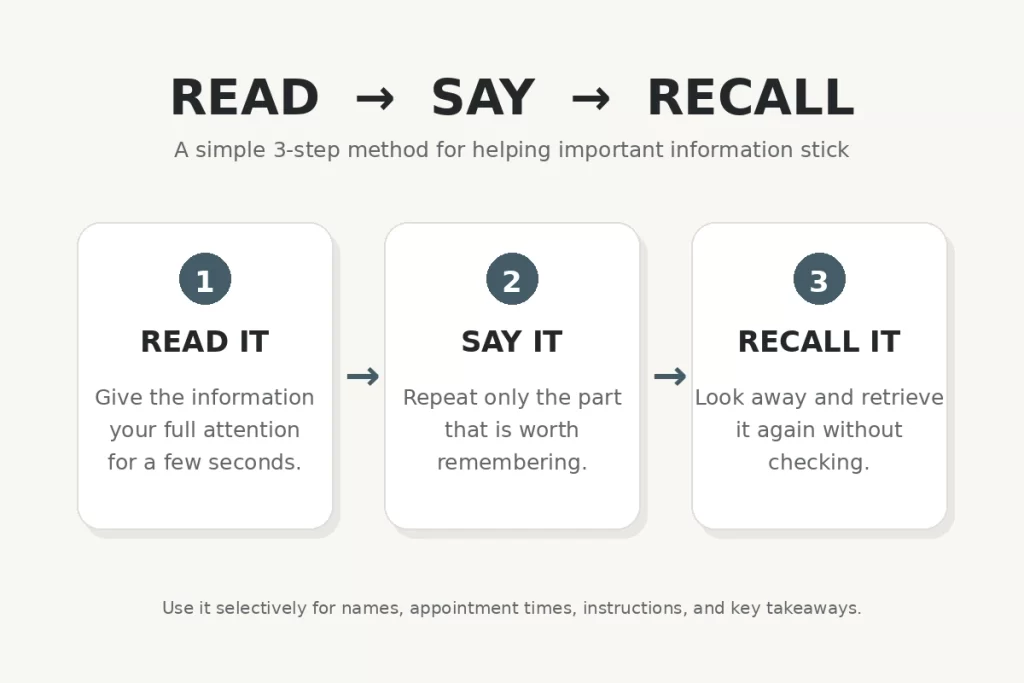
Try the Read → Say → Recall Method

Read Say Recall three-step method for remembering important information

For information that really matters, use a simple three-step sequence.

1. Read It

Give the information your full attention for a few seconds.

2. Say It

Repeat the key information aloud in a simple form.

Not the entire paragraph. Just what you want to preserve.

3. Recall It

Look away.

Wait a few seconds.

Then say it again without checking.

READ → SAY → RECALL

For example:

You meet someone named Elizabeth who works with your accountant.

Instead of thinking:

“I need to remember her name.”

Try:

“Elizabeth. She works with David.”

Continue the conversation.

Thirty seconds later, mentally ask:

“What was her name?”

Elizabeth.

You have now done more than hear the name.

You have encoded it, produced it, and retrieved it.

What Kinds of Information Are Worth Saying Out Loud?

This technique works best when you are selective.

Good candidates include:

  • names you genuinely want to remember,
  • appointment times,
  • a short instruction,
  • an unfamiliar term,
  • a phone number you need temporarily,
  • a key takeaway from something you just read,
  • a next step you cannot act on immediately,
  • or one important detail from a conversation.

You probably do not need to vocalize your entire grocery list.

The purpose is to make selected information more distinctive.

Repeating a new name aloud can be especially useful when you meet someone you want to remember.

Saying something aloud can make it more distinctive, and revisiting it after a delay gives your brain another opportunity to retrieve it.

Combine Speaking With Writing When Something Really Matters

There is no rule saying you must choose between remembering something internally and using an external reminder.

Often, the smartest approach is both.

Suppose someone tells you:

“Bring the signed document Tuesday morning.”

You might say:

“Signed document, Tuesday morning.”

Then put a reminder next to your keys.

Writing things down gives you an external reminder, while saying the information gives your brain an additional encounter with it.

This is especially useful for responsibilities where forgetting has consequences.

Good memory systems do not require your brain to carry everything alone.

Why This Matters More Than Simply “Trying Harder”

When memory feels unreliable, the natural response is usually effort.

Concentrate harder.

Repeat something more times.

Force yourself to remember.

But better memory is often less about force and more about how information is processed.

Is the information receiving your attention?

Another useful strategy is to try retrieving the information before looking at it again, because the act of recall itself can help strengthen later memory.

Is it distinctive?

Did you actively retrieve it?

Did you create a useful cue for later?

These questions are often more productive than simply asking yourself to “remember better.”

Where Lumultra Fits

Memory techniques work best when the cognitive conditions around them are strong.

You still need enough attention to register information, enough working memory to hold it while using it, and enough mental clarity to separate what matters from everything competing for your attention.

Lumultra is formulated as daily cognitive support around those interconnected areas—focus, working memory, mental clarity, and overall cognitive performance.

It does not replace good sleep, useful memory systems, or habits such as retrieval practice.

Think of those behaviors as the strategy.

Lumultra is designed to support the cognitive foundation you are asking to carry out that strategy.

Because sometimes remembering more is not about forcing your brain harder.

It is about giving important information a better chance to stick.

Support clearer, more dependable cognitive performance with Lumultra.

Learn More About Lumultra

Why You Remember the Big Picture but Forget the Details

If you have ever wondered, “Why do I forget details even when I remember what happened?”, the answer may lie in how your brain stores the big picture and the finer parts of an experience differently.

You remember the meeting.

You remember what everyone decided.

You even remember which person seemed skeptical about the idea.

But someone asks:

“What was the exact number they gave us?”

And suddenly you’re not sure.

Was it 18 percent or 28 percent?

Was the deadline Tuesday or Thursday?

Did Sarah say it—or was it Mark?

The strange part is that the memory does not feel gone.

You remember what happened. You just cannot reconstruct all the little pieces.

If this has become more noticeable as you’ve gotten older, you may repeatedly ask, “Why do I forget details that seemed clear at the time?”

But memory does not preserve every part of an experience equally. Sometimes your brain keeps the story while gradually losing the fine print.

Sometimes your brain keeps the story while gradually losing the fine print.

Your Brain Can Remember Meaning Without Remembering Everything

Think about a movie you watched six months ago.

You may remember:

  • who the main characters were
  • the general plot
  • whether you liked it
  • how it ended

But you probably cannot repeat the dialogue.

You may not remember exactly what the characters were wearing or which scene came immediately before another.

Yet you would still say you remember the movie.

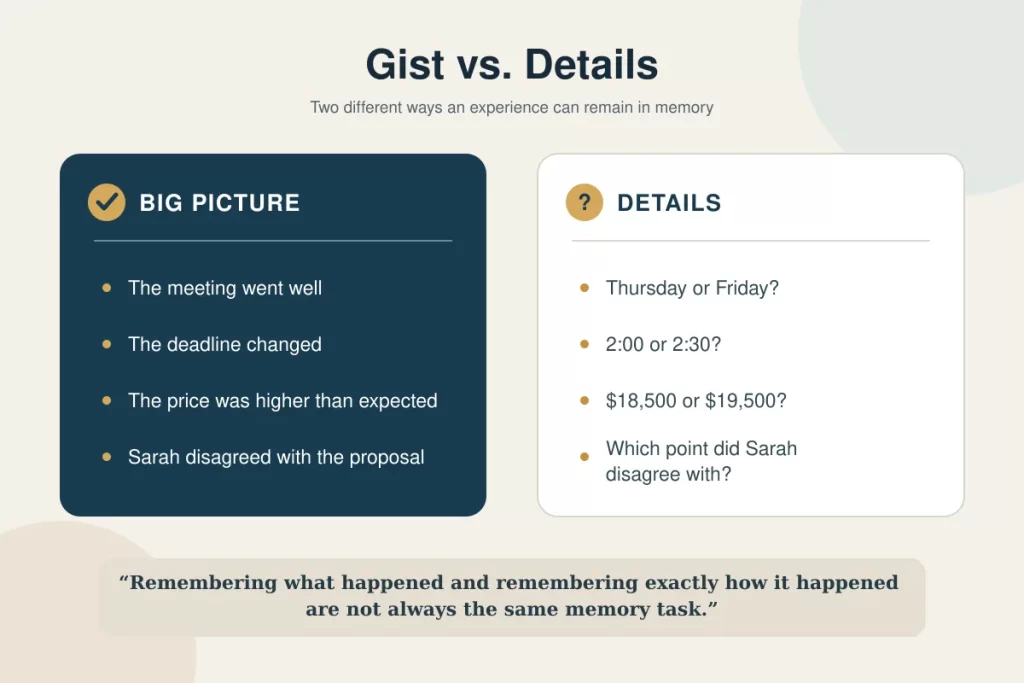
Memory researchers often distinguish between the general meaning of an experience—sometimes called its gist—and its specific details.

The gist answers:

What basically happened?

The details answer:

Exactly how did it happen?

Those are related forms of memory, but they are not identical.

And that distinction explains a surprisingly large number of everyday memory frustrations.

Understanding the difference between gist and detail helps answer the question, “Why do I forget details while still remembering the overall experience?”

Emotion can make this selectivity even more noticeable, which helps explain why embarrassing memories stick long after ordinary details have faded.

The Big Picture Has More Ways Back

 Comparison between remembering the overall meaning of an event and recalling its precise details.

Specific details can be fragile.

Imagine someone tells you during lunch:

“The presentation has been moved to Thursday at 2:30 in Conference Room B.”

There are several separate pieces your brain could retain:

  • the presentation was moved
  • Thursday
  • 2:30
  • Conference Room B

An hour later, you may clearly remember:

The presentation changed.

But 2:30 has somehow become 3:00.

Or you remember Thursday but cannot remember the room.

The general meaning was connected to the larger conversation. The individual details had fewer mental connections supporting them.

The big picture often has many routes back into memory.

A similar experience happens when you recognize someone’s face but can’t remember where you met them. The face may feel familiar even when the specific details of your previous encounter are difficult to retrieve.

A precise number may have only one.

If you are asking, “Why do I forget details such as names, numbers, or times?”, one reason may be that those isolated facts have fewer connections leading back to them.

That is one reason you can feel certain you remember an event while still being uncertain about a particular detail.

This Can Become More Noticeable With Age

Healthy cognitive aging does not mean that everything about memory declines at the same rate.

Research on autobiographical memory and aging describes an age-related shift in which the broader gist of personal experiences may remain available even as specific episodic details become less prominent.

Vocabulary, accumulated knowledge, judgment, pattern recognition, and the broader meaning of experiences can remain quite strong.

Specific episodic details can become less dependable. Research examining memory for details and the overall structure of an experience also suggests that these two aspects of memory can behave differently with age.

This may explain why the question “Why do I forget details?” can become more common as people notice changes in the precision of their memories.

That creates an interesting experience:

You may understand situations extremely well while feeling less confident about exactly when, where, or how something occurred.

You remember the conclusion of the conversation but not the wording.

You remember that the restaurant was good but not its name.

You remember that the price was surprisingly high but not whether it was $189 or $219.

You remember the story.

The resolution is simply lower.

That does not make the memory useless.

In many situations, the gist is actually what matters most.

Experience May Make the Big Picture More Important

There is another side to this.

As you accumulate decades of experience, your brain has an enormous library of patterns to compare new information against.

You are often no longer processing an event as a collection of unrelated details.

You are asking:

What does this mean?

Have I seen something like this before?

Is this important?

What should I do with it?

That ability is valuable.

Someone with decades of business experience may leave a meeting unable to quote every number on a slide but immediately understand:

This deal has a problem.

Someone who has raised children may not remember every sentence in a conversation with a teenager but recognize immediately:

Something is bothering him.

The details matter.

But meaning matters too.

Memory is not only an archive of the past. It helps you interpret what is happening now.

But Sometimes the Details Really Matter

There are also situations where “close enough” is not enough.

A medication dose.

A bank account instruction.

A meeting time.

A password.

A contractual number.

A flight departure.

A client’s exact request.

These are situations where your brain should not be expected to decide automatically that the detail deserves permanent storage.

You have to signal:

This particular piece matters.

One everyday example is forgetting a set of spoken directions: you understand the request but may still struggle to remember the individual instructions in the correct order.

That starts with attention.

When accuracy matters, asking “Why do I forget details?” should lead you to examine whether the information received enough attention in the first place.

As we discussed in our article Why Is It Harder to Remember New Information After 50?, information must first receive enough attention to be encoded clearly before you can expect to retrieve it later.

If someone gives you an important number while you are reading an email, checking your phone, thinking about your next meeting, and preparing a response, you may retain the general message without securely capturing the number.

Later, it feels like the detail disappeared.

But it may never have been encoded strongly in the first place.

Mental Load Can Lower the Resolution of Memory

Imagine taking a photograph while moving.

The subject may still be recognizable.

The finer details become blurry.

Something similar can happen when you are trying to take in information while mentally overloaded.

You hear the conversation.

You understand it.

You respond appropriately.

But your attention is also carrying:

  • an unfinished task
  • three notifications
  • something you need to remember later
  • the next thing you plan to say
  • another problem running quietly in the background

Mental overload is another useful answer when you wonder, “Why do I forget details during busy or stressful days?”

Your brain may capture enough information to understand the situation without capturing every part of it equally well.

That is why mentally crowded days can leave you with many memories that feel approximately right but strangely incomplete.

It also helps explain why you can forget what you just read even though the paragraph made perfect sense while you were reading it.

Understanding something in the moment does not guarantee that every detail became a durable memory.

Stop Asking Your Brain to Remember Every Detail

There is a temptation, especially when you become more aware of memory changes, to start testing yourself constantly.

What was his name?

What time did she say?

What was the exact number?

Why don’t I remember?

That can make normal memory feel like a constant examination.

Constantly asking “Why do I forget details?” can turn ordinary moments of forgetfulness into a stressful test of your memory.

A more useful approach is to decide which information actually deserves detail-level memory.

Most of yesterday does not.

You probably do not need to remember what time you ate lunch or what color shirt someone wore.

Your brain is doing you a favor by not preserving every detail of every ordinary experience equally.

Instead, identify the details that matter.

Then give those details better conditions for being remembered.

Try the “One Detail” Rule

When something important happens, pause for a moment and ask:

What is the one detail I absolutely need later?

Maybe it is:

“Thursday at 2:30.”

“$18,500.”

“Call Robert.”

“Bring the passport.”

Then give that information your complete attention for several seconds.

Repeat it.

Connect it to something.

Write it down if accuracy matters.

The goal is not to photograph the entire experience.

It is to increase the resolution around the part you actually need.

Retrieve the Detail Before Looking It Up

There is another useful habit.

Before immediately checking your notes, give yourself a moment to retrieve the information.

What was the number?

What was the person’s name?

What were the three things we decided?

Then check your answer.

Retrieval is different from recognition.

Seeing “Thursday at 2:30” and thinking, “Yes, that’s it,” can make information feel familiar.

Trying to produce “Thursday at 2:30” before looking requires your brain to find the pathway back to the information.

That effort is part of learning.

This technique is known as retrieval practice, and research suggests that trying to bring information back from memory can improve your ability to remember it later.

This is one reason retrieval plays such an important role in the learning strategies discussed in Can Your Brain Still Change After 50?

You do not need to turn everyday life into a memory exercise.

If you regularly wonder, “Why do I forget details shortly after hearing them?”, practicing retrieval may help strengthen the pathway back to important information.

But when something genuinely matters, briefly retrieving it can be more useful than repeatedly rereading it.

Use Meaning to Hold Onto Details

Specific information becomes easier to organize when it has somewhere to belong.

Instead of remembering:

$18,500

Remember:

The repair estimate was $18,500—about $1,500 below the $20,000 number I expected.

Instead of:

Thursday at 2:30

Think:

Thursday afternoon, right after lunch.

Instead of trying to memorize someone’s name as an isolated sound, connect it with where you met, what you discussed, or something distinctive about the interaction.

Meaning creates more ways back to the information.

You are not simply storing another isolated fact.

You are attaching it to a network that already exists.

Let Tools Protect the Details

Some information should not depend on memory at all.

If getting a detail wrong would create a meaningful problem, write it down.

Use the calendar.

Save the confirmation.

Put the number in the contact.

Create the reminder.

This is not giving up on your memory.

It is assigning different jobs appropriately.

Your brain is excellent at understanding patterns, extracting meaning, solving problems, connecting ideas, and making judgments.

Your calendar is excellent at remembering that the dentist appointment is Wednesday at 10:40.

Let each one do what it does well.

When Changes Deserve More Attention

It can help to understand the difference between normal age-related forgetfulness and memory problems that deserve attention.

Occasionally forgetting a detail is different from experiencing cognitive changes that increasingly interfere with normal responsibilities.

If memory changes are worsening or beginning to affect things such as managing finances, following familiar procedures, navigating known places, taking medications safely, or maintaining everyday independence, discuss them with a qualified healthcare professional.

The important distinction is not whether you occasionally forget something.

Everyone does.

It is whether the pattern is substantially changing your ability to function normally.

Where Lumultra Fits

Memory does not begin at the moment you try to remember something.

It begins earlier—with attention, working memory, mental clarity, and the ability to stay engaged long enough for information to be processed.

Lumultra is designed to support cognitive functions including focus, working memory, mental clarity, and everyday cognitive performance.

That does not mean a supplement can decide which details matter for you or guarantee that you will remember them.

The research behind gist and detail memory does not test Lumultra.

But if your interest in memory is part of a broader desire to feel more focused, mentally present, and cognitively engaged, Lumultra is designed to support that larger cognitive-performance picture.

The Bottom Line

You can remember a conversation without remembering every sentence.

You can remember a trip without remembering every restaurant.

You can remember the lesson without remembering every example.

Memory is not an exact recording of experience.

It preserves some things better than others.

And as you get older, the contrast between remembering what happened and remembering every detail of what happened may become more noticeable.

So when a small detail disappears, do not judge your entire memory by that one missing piece.

Ask instead:

Did I remember what mattered?

And when the precise detail truly does matter, give your brain—and your external tools—a clear signal that this one is worth keeping.

Explore Lumultra

Why Writing Things Down Helps You Remember to Act

Why writing things down helps you remember becomes clearer when you notice when forgotten tasks return. The package comes to mind when you pull into your driveway, the meeting question returns five minutes too late, and the unanswered message surfaces as you turn out the light.

This helps explain why writing things down helps you remember: the note moves part of the memory task outside your head and creates a cue you can encounter later.

Writing is not the only way to make information more distinctive—saying selected information out loud can also make it easier to remember later.

The difference between “Insurance” and a complete instruction shows why writing things down helps you remember. A specific note gives your future self a recognizable action instead of another decision to make.

Understanding why writing things down helps you remember can help you build better reminders. Write the action clearly, connect it to the right time or place, and make sure the details you need are easy to find.

If this sounds familiar, it helps to look at the timing of your reminders. Writing things down helps you remember to act when the note becomes a cue you encounter at the right moment.

“Mail the package” on a page you never reopen cannot do much for you. The same note attached to your keys has a chance to catch you before you leave.

Remembering an Intention Is Its Own Kind of Memory Task

Remembering to carry out a future action is called prospective memory. It includes remembering to make a call, bring a document, or do something at a particular time.

One way people support this process is by placing part of the job outside their heads: in a calendar, a written note, or an alert. Researchers call this intention offloading.

In experiments involving delayed intentions, participants performed better when they could create external reminders. They also used reminders more often when the memory load or likelihood of distraction increased.

These findings support reminders as a practical aid; they do not show that making lists increases your underlying memory capacity.

External authority link:
Read the original research on external reminders.

For a related everyday experience, see why you forget what you were about to do.

Give the Reminder a Job

Think about the last task you remembered too late.

Where were you when you first decided to do it?

Where would you have needed to see the reminder?

Those may be two different places.

A note made during breakfast might need to reach you at your desk. A document you prepare at your desk might need to leave the house with you tomorrow.

Try treating each reminder as a short instruction for your future self.

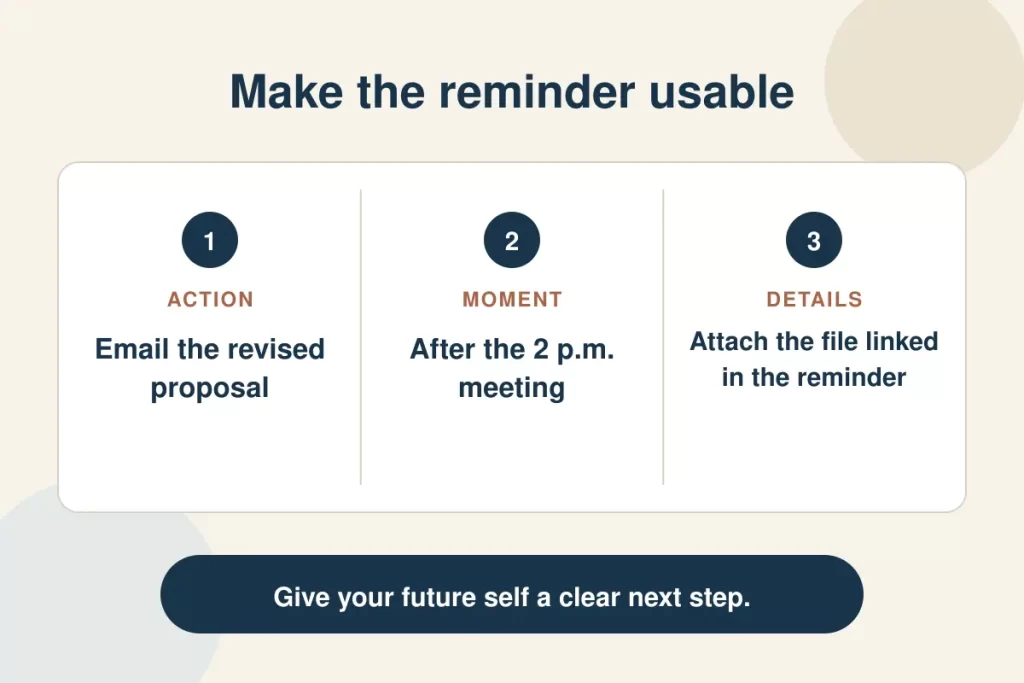
It should answer three questions:

  • What exactly do I need to do?
  • When or where can I do it?
  • What do I need in front of me?

This gives you something concrete to build, especially on days when every unfinished responsibility feels like another thing you must keep track of.

Our article on  explores that related experience.


Turn a Vague Note Into an Action

“Insurance.”

You knew what that meant when you wrote it.

Tomorrow, you might have to work it out again.

Was there a bill to pay?

A form to find?

A question to ask?

Try:

“Call the insurer Tuesday at 10 a.m. to ask about the renewal; policy number is in the saved email.”

That is longer, but it leaves fewer decisions for later.

Here are a few practical examples:

Vague Note More Usable Reminder
Send file After the 2 p.m. meeting, email the revised proposal to Alex.
Return package Put the sealed return beside the work bag tonight; take it when leaving tomorrow.
Book appointment At lunch Tuesday, call the clinic using the number saved in this reminder.
Ask about invoice Add “confirm invoice due date” to the agenda for Thursday’s supplier call.


A useful reminder specifies the action, the moment to act, and the details needed

You are leaving yourself a next step you can recognize quickly.

This is especially useful when someone gives you several directions at once, since forgetting verbal instructions can happen even when you understood the explanation perfectly.

Put the Cue Where the Action Can Happen

A reminder at 9 a.m. is awkward if you are driving and cannot act until noon.

For that situation, set it for a time when you expect to be available.

If plans change, reschedule it deliberately before dismissing it.

For something you need to take with you, place it safely beside an item you already collect before leaving.

For a question you need to ask, put it on the agenda you will open during the conversation.

An alert, an agenda item, and a package beside your bag serve different purposes.

Choose the one that matches the task.

The goal is simple:

Make the reminder available where you need it.

Make the System Easy Enough to Keep Using

You could build an elaborate collection of lists, labels, and reminders.

You could also spend more time organizing it than using it.

Start smaller.

Choose one place for loose tasks and keep appointments in the calendar you already check.

Give yourself a regular moment to review the task list, such as when you first sit down at your desk.

Research on reminder-setting offers a useful reason to care about convenience: in two experiments, people set fewer reminders when doing so required more physical effort.

Making a reminder easy to create can matter to whether you use it.

External authority link:
Read the study on reminder-setting effort.

For tomorrow, choose just one responsibility you keep remembering at inconvenient moments.

Write the action clearly.

Give it a time or a visible cue.

Then notice whether you encounter it when you can do something about it.

Using Support Does Not Have to Become a Judgment About Yourself

A shopping list is an ordinary tool.

So is a meeting agenda.

You can choose to use a reminder because a task matters to you, without treating the choice as a verdict on your abilities.

If you are exploring how to keep learning as you get older, our article Can Your Brain Still Change After 50? offers a related starting point.

Memory changes that worsen or interfere with everyday responsibilities deserve a conversation with a healthcare professional.

The National Institute on Aging explains the distinction between everyday forgetfulness and memory problems that need attention.

Writing something down can help you remember what needs to be done, while reviewing important information again after a delay can help strengthen your ability to recall the information itself.


Make Room for the Part of the Day You Want to Engage With

Tomorrow morning, you may still have the same responsibilities.

But one well-placed reminder can give a recurring task a clear place and time.

That is a useful starting point for a more deliberate approach to your day.

If that same interest in everyday focus and memory brought you to Lumultra, you can explore the formula and product details as you consider your routine.

The reminder studies discussed here did not test Lumultra or establish a supplement benefit for remembering intentions.

Explore Lumultra

Why Can’t I Remember Names Like I Used To? The Science of Word Retrieval After 50

Remembering names after 50 can sometimes feel harder than it used to. You see someone you have known for years, recognize their face immediately, and remember where you met—but their name suddenly seems just out of reach.

You may even remember what they do for a living.

But their name?

Nothing.

It feels as though the answer is sitting just beyond reach.

Then, ten minutes later—usually when you are thinking about something completely different—the name suddenly appears.

If this happens more often than it used to, you are certainly not alone.

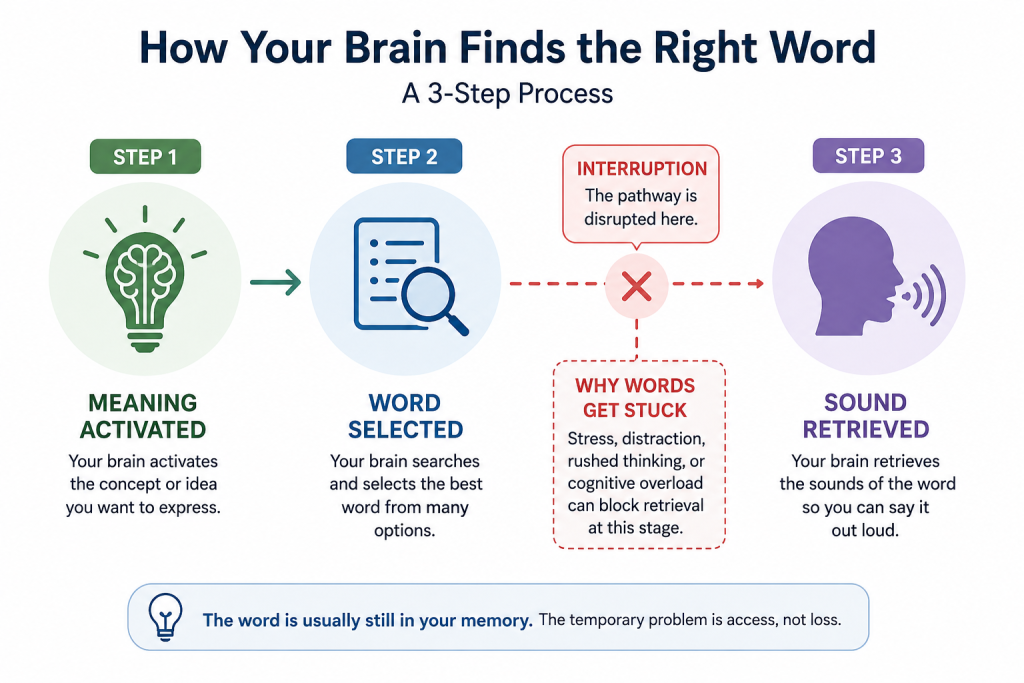
Researchers describe this familiar experience as a tip-of-the-tongue state: you know that you know a word or name, but temporarily cannot retrieve it. Word-finding and name-recall can also become slower with normal aging.

Importantly, occasionally struggling to find a word is not the same thing as losing the underlying knowledge.

Often, the information is still there.

The challenge is accessing it quickly.

Remembering Has More Than One Step

We tend to think of memory as one ability.

You either remember something or you don’t.

The brain is considerably more complicated.

Memory involves several different processes, including:

  1. Encoding — getting information into memory.
  2. Storage — maintaining that information.
  3. Retrieval — accessing it when you need it.

That distinction explains something many adults experience after 50.

You can recognize someone’s name instantly when another person says it:

“That’s right — David!”

Yet seconds earlier, you couldn’t produce “David” yourself.

The memory existed.

Your brain simply had difficulty retrieving it on demand.

This is also why recognizing an answer on a multiple-choice test can feel easier than producing the answer without any clues.

For more on the other side of memory—getting new information into memory—see our related guide.

Why Names Are Especially Difficult

Remembering names after 50 can feel especially frustrating because names are surprisingly demanding pieces of information.

Imagine meeting someone named Michael.

Knowing that he is your neighbor’s brother gives your brain useful context.

Knowing that he owns a restaurant creates another association.

But the word Michael itself does not tell you much about him.

Names often have fewer meaningful clues attached to them than ordinary words.

Remembering someone’s name is only one part of recognizing a person. You might also recognize a familiar face but struggle to remember where you know them from, because recognizing a face and recalling the context of a previous meeting involve different aspects of memory.

If you forget the word “hammer,” your brain can work backward:

It’s a tool… you hit nails with it…

Those associations help lead you toward the word.

A person’s name may provide far fewer clues.

That is one reason proper names can feel particularly vulnerable to temporary retrieval failures.

The Aging Brain May Need More Time to Find the Answer

Remembering names after 50 can become more challenging as some cognitive abilities change gradually with age, even while other abilities remain remarkably strong.

According to the National Institute on Aging, older adults may be slower to find words and recall names, experience more difficulty with multitasking, and notice mild changes in attention.

That does not necessarily mean vocabulary or knowledge has disappeared.

In fact, decades of learning can leave older adults with an enormous store of knowledge.

The challenge can instead become navigating that mental library quickly enough to retrieve exactly the right piece of information at exactly the right moment.

Think of it this way:

Your mental library may contain more books than ever.

Finding one particular book can sometimes take longer.

A noisy environment creates another challenge because your brain must separate the speaker’s voice from competing sounds before it can give the name enough attention to encode it.

Attention Matters Before Retrieval Even Begins

There’s another important piece of the puzzle.

Memory and attention constantly interact.

Suppose someone introduces herself while you are:

  • checking your phone,
  • listening to another conversation,
  • deciding what to say next,
  • thinking about work,
  • or worrying about something else.

You may feel as though you “forgot her name.”

But your brain may never have encoded the name very strongly in the first place.

This is one reason memory problems can sometimes begin as attention problems.

If information enters the brain weakly, retrieving it later becomes much harder.

That makes sustained attention especially important.

The goal isn’t simply to “try harder to remember.”

It’s to give information enough attention that the brain has something strong to retrieve later.

For a deeper look at how divided attention can affect memory, read our guide on memory and attention when multitasking.

Why Trying Harder Can Sometimes Make the Word Disappear

You’ve probably experienced this:

You desperately try to remember a name.

You mentally repeat:

“Come on. What is it? I know this.”

And the harder you try, the further away it seems.

Then you stop thinking about it.

Five minutes later:

Susan.

There it is.

When the correct word isn’t immediately accessible, repeatedly forcing the search does not always help. Sometimes shifting your attention briefly can give you a mental reset.

That doesn’t mean giving up on your memory.

It means understanding that retrieval is not always instantaneous.

Four Ways to Make Names Easier to Retrieve

You cannot prevent every tip-of-the-tongue moment.

But you can make information easier for your brain to find.

1. Create an Association Immediately

When you hear a new name, connect it to something meaningful.

Instead of simply hearing:

Robert

Create an association:

Robert → golf → John’s brother

Now your brain has several pathways back to the information instead of one.

2. Use the Name

Say it naturally during the conversation.

“Nice to meet you, Robert.”

Repeating a new name aloud is more than polite conversation—it may also help make that name more distinctive in memory.

Using information requires more active processing than simply hearing it.

3. Remove Competing Input

If remembering something matters, give it your attention.

Trying to encode a name while simultaneously checking a message, following another conversation, and thinking about what happens next creates unnecessary cognitive competition.

4. Support the Conditions Your Brain Needs

Cognitive performance doesn’t operate independently of the rest of the body.

Sleep, physical activity, cardiovascular health, medications, mood, and other health factors can affect cognitive function. The National Institute on Aging recommends paying attention to overall health as part of supporting cognitive health as people age.

For more background, explore the National Institute on Aging’s brain health resources.

The objective isn’t perfection.

It’s creating better conditions for your brain to perform consistently.

The Bigger Question Isn’t Whether You Occasionally Forget a Name

Almost everyone experiences temporary word-finding failures.

The National Institute on Aging notes that occasionally forgetting which word to use can occur with normal aging.

The more useful question is:

How reliably does your brain give you access to the information you know?

For many adults, remembering names after 50 is where that frustration becomes especially noticeable.

They aren’t suddenly missing decades of knowledge.

They simply feel that their brain takes longer to deliver the answer.

A name arrives ten minutes late.

The perfect word appears after the conversation.

A thought is clear internally but difficult to express quickly.

That gap between knowing and accessing what you know is why supporting cognitive performance becomes increasingly important with age.

Supporting More Consistent Cognitive Performance

There is no single switch that controls memory.

Attention, working memory, mental energy, retrieval, sleep, stress, and overall health continuously interact.

That’s also why supporting cognitive performance requires a broader approach than simply memorizing more things.

At Lumultra, the focus is on daily cognitive support for people who want to support focus, memory, processing speed, and mental performance.

Lumultra is designed to support overall cognitive function, working memory, focus, and mental clarity as part of a broader daily routine.

It isn’t about expecting your brain to work exactly like it did at 20.

It’s about supporting the brain you have today and giving yourself better conditions for consistent cognitive performance.

Because sometimes the information isn’t gone.

Your brain just needs a clearer path back to it.

Learn more about Lumultra

A Note About Memory Changes

Occasional difficulty finding a word or name can happen with normal aging. However, memory or language changes that become frequent, progressively worse, interfere with everyday activities, or make normal conversation difficult deserve medical evaluation.

The National Institute on Aging explains the difference between normal age-related forgetfulness and more serious memory problems and recommends talking with a doctor about changes that concern you.

Why Is It Harder to Remember New Information After 50?

You may remember the address of the house you lived in 30 years ago.

You may remember lyrics to a song you haven’t heard since college.

You might even remember exactly what someone said to you during an important conversation years ago.

But then someone tells you a name, gives you a three-step instruction, or explains something at lunch—and ten minutes later, part of it is gone.

That can be unsettling.

It can make you wonder: Why can I remember things from decades ago but have trouble remembering something I just heard?

The answer is more complicated—and often more encouraging—than simply saying your memory is getting worse.

Memory isn’t one single ability. Remembering new information requires several cognitive systems to cooperate. Before information can become a memory, your brain first has to notice it, focus on it, hold it long enough to process it, and encode it.

And some of those abilities can become less efficient with age.

The National Institute on Aging notes that aging can affect memory, learning and other cognitive functions, while also emphasizing that cognitive aging varies substantially from person to person.

So when new information doesn’t seem to “stick,” the problem may begin before what we normally think of as memory even takes over.

Memory Starts Before You Remember Anything

It helps to think about memory as a process rather than a storage container.

In simplified terms, your brain has to:

Pay attention → encode the information → store it → retrieve it later

If the first step is weak, everything downstream becomes more difficult.

Imagine someone introducing themselves while you’re simultaneously thinking about where you parked, looking at your phone and listening to another conversation.

Five minutes later, you can’t remember the person’s name.

It feels like a memory failure.

But there is another possibility: your brain never gave the name enough attention to create a strong memory in the first place.

Research has long demonstrated a close relationship between attention and memory. Attention helps determine which information receives priority, while working memory temporarily keeps relevant information accessible so the brain can work with it.

That’s why the question isn’t always:

“Why can’t I remember?”

Sometimes the better question is:

“How well was I paying attention when I first learned it?”

Working Memory Is Your Brain’s Temporary Workspace

Another important part of this process is working memory.

Working memory allows you to temporarily keep a small amount of information available while you’re doing something with it.

You use it when you:

Working memory has been described by researchers as the ability to keep a limited amount of information readily accessible for tasks such as comprehension, reasoning and problem-solving.

That temporary workspace is important because new information often passes through it before becoming something you can recall later.

If your attention is divided or your mental resources are already stretched, information can disappear from that temporary workspace before it has been processed deeply enough to become a stronger memory.

This connects directly to our recent article, Why Is It So Hard to Focus on One Thing?

Focus isn’t separate from memory.

Focus is part of the memory process.

Why New Information Can Feel Harder After 50

Healthy aging does not mean that everything about memory suddenly deteriorates.

In fact, many older adults retain extensive knowledge, vocabulary, expertise and memories accumulated over decades.

But certain aspects of cognition can become less efficient.

Research on normal cognitive aging has identified age-related differences in areas including processing speed, attention, working memory and episodic memory. Older adults can also find it more difficult to ignore irrelevant information competing for attention.

Even though some cognitive processes change with age, the brain retains an important capacity to adapt and learn. Read more in Can Your Brain Still Change After 50?.

That distinction helps explain a common experience:

Old information is already established. New information still has to get through the door.

A memory from 25 years ago may have been strengthened through repetition, emotion, associations and repeated retrieval.

Those long-established associations also help explain why certain smells bring back memories you thought you forgot. A familiar smell can provide a powerful retrieval cue for an older experience, even when recently learned information is more difficult to remember.

This contrast also helps explain why emotional memories can remain vivid for decades while important information from yesterday may be difficult to recall.

The name someone gave you 30 seconds ago has none of those advantages.

Your brain has to capture it while simultaneously filtering out everything else demanding your attention.

That can become particularly noticeable in busy environments.

Slower processing can also make new information feel harder to capture when several things are happening at once. See Why Your Brain Feels Slower After 50 for more on this connection.

That same filtering challenge helps explain why following conversations in noisy restaurants or crowded rooms can require noticeably more attention after 50.

You may find it harder to remember:

  • names during crowded social situations
  • verbal instructions given quickly
  • something your spouse tells you while you’re answering an email
  • details from meetings with several people speaking
  • information you read while notifications keep appearing
  • why you opened another browser tab
  • several items someone asks you to pick up later

Those situations don’t just test memory.

They test attention, filtering, processing speed and working memory at the same time.

Multitasking Makes Encoding Even Harder

Modern life isn’t exactly designed to make this easier.

We’re frequently trying to absorb information while checking messages, responding to notifications, watching television, navigating, listening to podcasts or thinking about the next task.

What we call multitasking often requires the brain to divide or rapidly redirect attention.

And that can interfere with memory formation.

In a study involving 252 adults ages 50 to 89, researchers found that performing competing tasks during memory encoding negatively affected performance, with age influencing some of the costs associated with that interference.

In everyday life, this means something very practical:

If you want to remember something, give your brain a real opportunity to receive it.

Listening while scrolling isn’t the same as listening.

Reading while checking email isn’t the same as reading.

Having a conversation while mentally rehearsing your next five tasks isn’t the same as being fully present for that conversation.

The brain can only remember what it successfully processes.

Sometimes the problem isn’t storing new information at all—it is retrieving information you already know, which helps explain why familiar names and words can suddenly feel just out of reach.

Mental Fatigue Can Make the Problem Worse

There’s another connection worth recognizing.

In our article Why Do I Feel Mentally Tired Even When I Haven’t Done Much?, we discussed how mental energy can be depleted by activities that don’t look physically demanding.

Decision-making, constant switching, information filtering and prolonged concentration all place demands on cognitive resources.

That matters for memory.

Think about how differently your brain functions at 9:00 in the morning compared with the end of a mentally demanding day.

A conversation that would have been easy to follow earlier may suddenly require more effort.

You reread the same paragraph.

Someone gives you three instructions and you retain two.

You walk away from a discussion remembering the general idea but not the details.

This same pattern can show up when you remember the big picture but forget the details, because general meaning and specific information are not always retained equally.

The issue may not be memory in isolation.

Your attention and working-memory systems may simply be operating under greater load.

That is why focus, mental stamina and memory should not always be treated as separate problems.

They are interconnected parts of cognitive performance.

Sometimes the issue is not memory alone—understanding the difference between brain fog and mental fatigue can help explain why thinking becomes less clear as cognitive demands build.

How to Help New Information “Stick”

You don’t have to memorize everything you encounter.

But when something genuinely matters, a few simple habits can give your brain a better chance to encode it.

1. Stop doing something else for a moment

When someone tells you something important, look away from the phone or computer.

Give the information a few seconds of undivided attention.

It sounds almost too simple, but attention is the entry point.

2. Repeat important information

If someone says:

“Dinner is at Marco’s at 7:15.”

Mentally repeat:

“Marco’s. 7:15.”

You’re giving the information another pass through your cognitive system instead of allowing it to disappear immediately.


3. Connect new information to something you already know

New information becomes easier to organize when it has context.

If you meet someone named Robert who lives in Austin, connect him mentally with another Robert you know or something memorable about Austin.

Instead of storing an isolated fact, you’re creating associations.

Another reason this can work is that connecting new information to knowledge you already have gives the brain more meaningful context for encoding and later retrieval.

4. Put information into your own words

After reading something important, stop and ask:

“What did that just say?”

Explaining the idea to yourself forces you to actively process it instead of simply looking at words.

5. Reduce unnecessary cognitive competition

If you’re learning something important, remove distractions when possible.

This can be especially useful when you’re already mentally tired.

You don’t need complete silence for every task. But there are times when giving one thing priority helps your brain do its job.

6. Use external memory strategically

Calendars, reminders and notes are not evidence that your memory has failed.

They’re tools that allow you to reserve mental resources for information that actually requires thinking.

You probably wouldn’t refuse to use a calculator because you believe your brain “should” handle every calculation.

Memory tools can serve the same purpose.

Supporting Memory May Start With Supporting Focus

People interested in cognitive supplements often begin with one goal:

“I want to improve my memory.”

But memory isn’t isolated from the rest of cognitive performance.

If your attention keeps drifting, information may never be encoded properly.

If your working memory is overloaded, you may lose details before you’ve had a chance to process them.

If mental fatigue makes sustained concentration difficult, learning new information becomes harder.

That is one reason Lumultra’s focus on cognitive performance goes beyond simply thinking about memory as storage.

Lumultra is designed to support areas such as focus, mental clarity and memory performance—cognitive functions that work together throughout the process of learning and remembering.

Think of it this way:

Better remembering begins with better receiving.

The goal isn’t to turn every passing detail into a permanent memory.

It’s to help create better conditions for your brain to engage with the information that actually matters.

For people whose bigger obstacle is mental energy or difficulty getting mentally engaged in the first place, Nova may address a somewhat different part of the cognitive-performance picture. But for this particular issue—attention, clarity and new-information processing—Lumultra is the more natural starting point.

What About Brain Health Overall?

No supplement replaces the fundamentals of cognitive health.

The National Institute on Aging recommends addressing broader factors associated with brain health, including physical health, sleep, physical activity, management of chronic conditions and social and intellectual engagement.

Lumultra should be viewed within that larger picture.

You want the fundamentals working in your favor while also supporting the specific cognitive functions you depend on every day.

When Memory Changes Deserve More Attention

Some forgetfulness is common.

But not every memory change should automatically be attributed to normal aging.

Forgetting a name and remembering it later is very different from becoming lost in familiar places, repeatedly asking the same questions or experiencing cognitive changes that interfere substantially with everyday activities.

The National Institute on Aging distinguishes ordinary age-related forgetfulness from patterns that may warrant medical evaluation.

If you or someone close to you notices a significant or rapidly progressing change in memory, reasoning or the ability to perform familiar tasks, discussing it with a healthcare professional is appropriate.

The Bigger Lesson: Memory Depends on More Than Memory

One of the most useful ways to think about cognitive aging is to stop treating focus, memory and mental stamina as three unrelated abilities.

They constantly influence one another.

Your brain needs enough attention to capture information.

It needs working memory to keep that information active.

It needs enough mental stamina to process it.

Then it needs to encode and eventually retrieve it.

That’s why you can remember something that happened decades ago yet forget what someone told you this morning.

The older memory has had years of reinforcement.

The new one had only a few seconds to compete for your attention.

So the next time something doesn’t stick, don’t immediately conclude:

“My memory is getting terrible.”

Ask a different question first:

“Did my brain really have a chance to take that information in?”

Supporting memory may begin much earlier than we think—with the quality of attention we bring to the moment in front of us.


Ready to Support Focus, Clarity and Memory?

If you’re noticing that information doesn’t seem to stick the way it once did, consider supporting the cognitive functions that come before recall.

Explore Lumultra →

Support clearer focus, stronger mental engagement and everyday cognitive performance.

Why Do I Forget What I Was About to Do?

You walk into the kitchen with a clear purpose.

Then you notice a package on the counter. You move it, glance at a message on your phone, and suddenly stop.

Why did I come in here?

If you have started asking yourself, “Why do I forget what I was about to do?”, these moments can feel more significant than they appear.

You open a new browser tab to look something up. Before the page loads, an email arrives. You read it, reply, return to the blank tab—and have no idea what you meant to search for.

These moments are small, but they can feel strangely personal.

When they start happening more often, you may wonder whether your memory is getting worse. You may even feel embarrassed by something nobody else noticed.

But forgetting what you were about to do is not always the same as forgetting information.

Often, the fact or intention was never lost from long-term memory. The breakdown happened during the few seconds between deciding to do something and actually doing it.

That gap has a name: prospective memory.

Not all everyday forgetting works the same way. Sometimes the challenge isn’t remembering an intention, but successfully encoding new information in the first place.

The Kind of Memory We Rarely Talk About

Most people think of memory as the ability to look backward:

  • Remembering someone’s name
  • Recalling a conversation
  • Finding a fact you learned
  • Describing what happened yesterday

That is retrospective memory—remembering the past.

Prospective memory is different. It is your ability to remember to carry out an intention in the future, even when “the future” is only 20 seconds away.

It allows you to remember to:

  • Bring a document when you leave the house
  • Send a message after a meeting
  • Take something out of the oven
  • Mention an important detail during a call
  • Look up a name after opening a browser
  • Retrieve the item you walked into another room to get

Researchers sometimes describe prospective memory is sometimes described as “remembering to remember”, It plays an important role in everyday functioning because much of life involves holding an intention while other things are happening, then recognizing the appropriate moment to act.

That sounds simple—until you consider how much has to go right.

Your Brain Has to Complete a Three-Part Handoff

When you decide, “I need to get my glasses from upstairs,” your brain must do at least three things:

  1. Form the intention. You decide what needs to happen.
  2. Keep the intention available. You hold it while walking, thinking, or responding to other information.
  3. Recognize the cue and act. When you reach the appropriate place or moment, you retrieve the intention and complete it.

If attention is pulled away during any part of that sequence, the handoff can fail.

You may still know what your glasses are. You may remember perfectly well where you usually leave them.

The missing piece is the active link between:

I need my glasses.

And:

This is the moment to get them.

This is why the blank can feel so odd. Your memory does not feel completely empty. It feels as though the thought was there one second ago and then vanished behind a closed door.

Why Do I Forget What I Was About to Do After an Interruption?

An intention that has not been completed is mentally fragile.

While you are carrying it, your working memory keeps some version of it active. Then an interruption arrives:

  • A notification
  • A question from someone nearby
  • Another unfinished task
  • A thought about something urgent
  • A change in environment
  • A new tab, screen, or conversation

The interruption does not need to last long. It only needs to become important enough to replace what your mind was holding.

Research on resuming an interrupted task shows that people often experience a “resumption lag” before effectively returning to the original activity. Attention and working memory are limited, so the intention to return can become more difficult to retrieve when other demands compete for those resources.

This is why you can walk ten steps and forget your purpose.

The room did not erase the thought.

The transition gave your brain several opportunities to replace it.

This is closely related to the experience of losing your train of thought, when new information replaces the mental sequence you were holding.

The intention may return eventually, but rebuilding it is part of how long it takes to refocus after an interruption.

The Problem May Be Mental Competition, Not Memory Storage

Imagine placing a sticky note on a crowded desk.

The note is still there. But as more papers land on top of it, it becomes harder to see.

Your working memory operates in a similar way. It gives you a temporary mental workspace for information you need right now.

That workspace is useful—but limited.

If you are already carrying:

  • Three things you need to do
  • Part of an unfinished conversation
  • An unresolved problem
  • An approaching deadline
  • Background worry
  • Several digital interruptions

then a small new intention may not remain active for long.

When people ask, “Why do I forget what I was about to do?”, they often assume the answer must be declining memory.

But these moments frequently become more common on mentally crowded days. You may remember perfectly well when you are relaxed, then feel unexpectedly scattered when your brain is managing too many open loops.

The issue is not necessarily that you suddenly became less intelligent.

The intention simply lost the competition for attention.

For a practical way to support these intentions, learn why writing things down helps you remember to act—and how to place reminders where you will use them.

Why It Can Feel More Noticeable With Age

Many adults first become concerned about these moments in their forties, fifties, or sixties.

Part of the concern comes from awareness.

A younger person may laugh and move on. An older adult may interpret the same blank as evidence that something is changing.

Some changes in memory and thinking can occur with age, but occasional forgetfulness is different from a pattern that interferes with everyday functioning.

Information about age-related forgetfulness from the National Institute on Aging explains that occasional memory lapses can be a normal part of aging, while changes that interfere with everyday activities deserve medical evaluation.

Forgetting why you entered a room once in a while is not, by itself, proof of serious memory loss.

Still, divided attention, fatigue, poor sleep, stress, and constant task switching can leave less room for a fragile intention to survive.

The important question is not simply:

Did I forget?

It is:

Under what conditions do I forget—and is the pattern changing my ability to function?

A noticeable or worsening change that interferes with normal responsibilities should be discussed with a qualified healthcare professional.

Five Situations That Make This Happen More Often

1. You Changed Environments

Walking through a doorway, moving from one screen to another, or switching from a conversation to a task changes the cues around you.

If the intention was weakly formed, the new environment may not contain anything that reminds you of it.

You arrive—but the reason you moved is no longer mentally attached to the place.

2. You Formed the Intention While Distracted

Sometimes the intention never became strong enough in the first place.

You thought, “I should reply to that,” while simultaneously reading something else.

It felt like a decision, but your attention never fully registered it.

The intention was created in the background, so it disappeared as soon as something more immediate demanded your attention.

3. You Are Carrying Too Many Open Loops

Every unfinished task competes for mental space.

Even when you are not consciously thinking about each one, your brain may be monitoring deadlines, responsibilities, and unresolved decisions in the background.

You may feel as though you are doing only one thing, while your mind is quietly managing ten.

The ability to protect important thoughts under pressure is one component of cognitive resilience under stress.

4. You Are Mentally Tired

Fatigue does not only make you sleepy.

It can make it harder to hold a thought stable while something else happens.

That is why small intentions may be easier to lose late in the day, after a demanding meeting, or during a period of sustained stress.

5. Your Cues Are Too Vague

“Remember that later” is a weak instruction.

Your brain performs better when the intention is attached to a specific cue:

When I finish this call, I will send the document.

Or:

When I put my cup in the sink, I will take the medication beside it.

The stronger the connection between the cue and the action, the less your brain has to search for the intention later.

How to Stop Losing Small Intentions

You do not need to hold everything in your head.

In fact, one of the smartest ways to protect memory is to reduce how much your brain must remember without support.

Make the Intention Concrete

Replace:

I need to do that later.

With:

When this meeting ends, I will email Daniel the file.

A clear action combined with a clear cue gives your brain a stronger retrieval path.

Leave a Physical Marker

Place an object where it interrupts your normal routine.

Put the return package by the door. Leave the document on top of your keys. Place the item you need to bring directly inside your bag.

The environment can remember for you.

Capture the Thought Before Switching

Before opening another tab or answering a message, write three to six words describing what you intended to do next.

For example:

Compare July revenue by channel.

That tiny note can prevent several minutes of mental reconstruction.

Say the Intention Out Loud

Say:

I’m going upstairs to get my glasses.

This may feel unnecessary, but it gives the intention a clearer verbal form instead of leaving it as a faint internal impulse.

Use Reminders Without Guilt

A reminder is not evidence that your memory is failing.

It is a tool for moving an intention out of a crowded mental workspace and into a dependable external system.

Research shows that reminders can protect prospective memory, eliminating age-related performance differences under cognitively demanding conditions by allowing people to offload intentions into reliable external cues.

The goal is not to prove that you can remember everything unaided.

The goal is to make sure the right things happen.

What This Reveals About Mental Sharpness

Most people respond to forgetfulness by trying harder.

They repeat the intention, criticize themselves, and promise to pay closer attention.

But the deeper issue may not be effort.

It may be the stability of the mental state carrying the intention.

When focus is fragile, even a small interruption can replace the thought you were holding. When working memory is overloaded, an intention can disappear before it reaches the moment of action.

This helps explain why the same person can feel completely sharp one day and scattered the next.

Your underlying knowledge did not vanish overnight.

Your brain simply had less capacity to keep the appropriate information active, protected, and accessible.

Changes in mental load help explain why your focus feels inconsistent, even when your abilities have not fundamentally changed.

Where Lumultra Fits

Lumultra is not intended to replace reminders, sleep, medical care, or healthy routines.

Its role is different.

Lumultra is formulated around cognitive functions involved in dependable everyday thinking, including focus, working memory, mental clarity, and processing speed.

That matters because prospective memory depends on more than storing information.

It depends on keeping an intention mentally available while the day continues around you.

For someone who feels mentally scattered—not because they do not know what to do, but because small intentions keep slipping away—the more relevant goal is not a short burst of stimulation.

It is stronger mental continuity.

The ability to hold the thought.

Move through the interruption.

And still remember what comes next.

Nova can be added on especially demanding days when low mental energy is also contributing to the problem.

But for the core experience described in this article—losing the intention somewhere between thought and action—Lumultra is the more logical starting point.

Support Clearer, More Dependable Thinking

If you are tired of knowing what you meant to do but repeatedly losing the thought along the way, support the focus and working-memory processes that keep intentions accessible.

Explore Lumultra

New subscribers can receive 30% off their first Lumultra + Nova subscription with code NEWU26.

Final Thought

The next time you walk into a room and forget why, do not immediately assume your memory is disappearing.

Ask what happened during the seconds between the intention and the blank.

Did something interrupt you?

Were you already holding too much?

Was the intention vague?

Did you expect your brain to carry one more open loop without a cue?

Sometimes the problem is not that your mind cannot remember.

It is that modern life keeps interrupting the remembering process.

Protect that process, support the cognitive systems underneath it, and those small moments may begin to feel less mysterious—and less personal.

This article is for educational purposes and is not a substitute for medical advice, diagnosis, or treatment.

Where Lumultra Fits

Lumultra is not intended to replace reminders, sleep, medical care, or healthy routines.
Its role is different.

Lumultra is formulated around cognitive functions involved in dependable everyday thinking,
including focus, working memory, mental clarity, and processing speed.

Prospective memory depends on more than storing information. It depends on keeping an
intention mentally available while the day continues around you. If you know what you need
to do but repeatedly lose the thought before you act on it, supporting focus and working
memory may be more helpful than simply looking for a temporary boost in energy.

Support Clearer, More Dependable Thinking

If you’re tired of knowing what you meant to do but repeatedly losing the thought along the
way, support the focus and working-memory processes that help keep intentions accessible.


Explore Lumultra

Get 30% off your first Lumultra + Nova subscription
with code NEWU26.

Why Words Get Stuck on the Tip of Your Tongue

You are halfway through a sentence when it happens.

You know exactly what you want to say. You can picture the person, object, place, or idea clearly. You may even remember the first letter of the word.

But the word itself will not come.

Having words stuck on the tip of your tongue can feel surprisingly unsettling—especially when it happens with a name or expression you have used hundreds of times before.

For many people, the most disturbing part is not the awkward pause. It is the question that immediately follows:

Why can’t I remember something I know that I know?

The reassuring answer is that the information may not be gone. Your brain may simply be having difficulty reaching it quickly.

The Word May Still Be in Your Memory

A tip-of-the-tongue moment is different from having no memory of a word at all.

You usually retain part of the information. You know what the word means. You may remember what it sounds like, how many syllables it has, or another word that begins with the same letter.

This suggests that the knowledge itself is still present. The temporary failure occurs while your brain is attempting to retrieve the word’s complete spoken form.

Researchers describe tip-of-the-tongue experiences as temporary word-finding failures in which someone cannot produce a familiar word despite feeling certain that they know it. These experiences become more common with normal aging, even when broader language knowledge remains strong.

In other words, the memory may still be stored. The path leading to it has become slower or less reliable.

Remembering a Word Is Not One Simple Action

We tend to think of memory as a mental storage cabinet.

Either the information is inside, or it is not.

But retrieving a word requires several processes to work together rapidly.How the brain retrieves familiar words during conversation


First, your brain activates the meaning or concept. Then it identifies the appropriate word among related possibilities. Finally, it retrieves the sounds needed to pronounce that word.

A disruption can occur during any part of that process.

You might know you are thinking of an actor but be unable to retrieve his name. You may remember that a word means “being able to recover quickly,” yet still be unable to produce the word “resilient.”

That is why you can often describe the missing word without being able to say it:

  • “It is the tool you use to tighten that.”
  • “She was in that movie with…”
  • “It means something like adaptable.”
  • “It starts with an R.”

Your brain has reached the concept. It just has not completed the final step.

Why It May Happen More Often as You Get Older

Word-finding pauses can happen at any age. However, many adults notice that they occur more frequently in their 40s, 50s, and beyond. This is one reason many people also begin having more difficulty remembering names, even though they still recognize the people they know.

Research on aging and language production suggests that older adults often retain extensive vocabulary and general knowledge while becoming slower at retrieving the exact sounds of familiar words.

This creates a frustrating contradiction:

You may know more than you did when you were younger, yet occasionally need longer to access what you know.

Your brain has accumulated decades of names, experiences, facts, professional language, places, products, and relationships. But accessing one precise word from that enormous network can require more cognitive control than it once did.

The word has not necessarily disappeared. Retrieval has simply become less immediate.

Word Retrieval Also Depends on Attention

Finding the right word is not a language-only task.

Your brain must hold the meaning of your sentence in working memory, ignore competing words, search long-term memory, select the correct expression, and continue following the conversation.

Research involving adults between ages 55 and 84 found that aspects of executive function—including mental shifting and verbal fluency—were associated with naming speed and accuracy. This suggests that successful word retrieval partly depends on broader cognitive control, not only vocabulary.

That helps explain why word-finding problems may feel worse when:

  • You are doing several things at once.
  • Someone interrupts you.
  • You feel rushed to respond.
  • You are mentally preoccupied.
  • You are trying to speak while reading or checking your phone.
  • Your mind is already carrying too many unfinished thoughts.

Your brain is not merely looking for a word. It is trying to find that word while managing everything else demanding your attention.

Why Forcing the Word Can Make the Moment Worse

When a familiar word disappears, most people respond by pushing harder. Similar brain blanks under pressure can happen during conversations, presentations, or stressful situations when anxiety competes for your attention.

Pressure can affect more than word retrieval; it can also explain why your mind goes blank under pressure even when you know exactly what you want to say

You mentally repeat the idea. You search through similar words. You become increasingly aware that someone is waiting for you to finish speaking.

The pressure quickly becomes part of the problem.

Instead of using your cognitive resources to retrieve the word, you begin using them to monitor yourself:

  • Why can’t I remember this?
  • Do I sound confused?
  • Is this happening more often?
  • What will the other person think?
  • Is something wrong with my memory?

The missing word becomes emotionally charged.

This is why the word often returns five minutes later—after the conversation has ended and you are no longer trying so hard.

The retrieval system is finally operating without the added burden of self-consciousness and urgency.

What to Do When the Word Will Not Come

You cannot guarantee that every word will appear instantly, but you can make retrieval easier.

Pause Instead of Panicking

Give your brain a few seconds.

A brief pause may feel much longer to you than it does to the person listening. Trying to fill every second with nervous speech can create even more interference.

Describe the Meaning

Use a synonym or describe the object, person, or idea.

This keeps the conversation moving and may activate related information that helps your brain reach the missing word.

Think About the Sound

Ask yourself:

  • What letter might it begin with?
  • How many syllables does it have?
  • Does it rhyme with another word?
  • Can I remember how it sounds in a familiar sentence?

Research has found that sound-based cues can sometimes help resolve tip-of-the-tongue states in both younger and older adults.

Stop Searching Temporarily

Move on and allow the word to return naturally.

This is not surrender. It is reducing the mental competition that may be blocking retrieval.

Build Better Conditions for Recall

Most people focus on memory only at the moment it fails.

But recall depends heavily on the condition your brain is in before you need the information.

A brain that is overloaded, constantly interrupted, or mentally depleted has fewer resources available for precise retrieval.

Supporting recall therefore means supporting the broader cognitive environment around it.

That includes:

  • Giving conversations your full attention.
  • Reducing unnecessary task switching.
  • Taking short mental breaks before important discussions.
  • Protecting sleep and recovery.
  • Using names and new words actively instead of only recognizing them.
  • Maintaining a consistent routine that supports focus and cognitive readiness.

The goal is not to force your brain to work harder. It is to reduce the friction between what you know and your ability to access it.

Where Lumultra Fits

When people notice slower recall, their first instinct is often to look for something that creates more stimulation.

But greater stimulation is not always the same as clearer thinking.

Word retrieval depends on attention stability, working memory, mental continuity, and efficient access to stored information. When those systems feel strained, simply adding more intensity may leave you feeling alert but still mentally scattered.

Lumultra is formulated as daily nootropic support for focus, memory recall, mental clarity, and cognitive performance.

The objective is not to overpower your brain. It is to support the conditions that allow your thinking to feel more connected and accessible—so the information you already know is easier to use when you need it.

For particularly demanding days when low mental energy is also part of the problem, Nova can complement Lumultra with additional support for drive and sustained performance.

But for recurring moments when you know the information is there and simply cannot reach it quickly, Lumultra is the more direct place to begin.

When Word-Finding Problems Deserve Medical Attention

Occasionally forgetting a word can be part of normal age-related forgetfulness, although persistent or worsening symptoms deserve evaluation. The National Institute on Aging specifically distinguishes sometimes forgetting which word to use from more serious difficulties that interfere with conversation or everyday functioning.

Speak with a qualified healthcare professional when word-finding problems:

  • Appear suddenly.
  • Become noticeably more frequent.
  • Interfere with ordinary conversations.
  • Involve common, familiar objects repeatedly.
  • Occur alongside confusion, personality changes, weakness, severe headaches, or other new symptoms.
  • Make it difficult to perform tasks you previously handled easily.

A supplement should never be used to ignore a sudden or progressive cognitive change.

The Word Is Often Still There

A tip-of-the-tongue moment feels like memory loss because you cannot produce the information on demand.

But frequently, the word has not disappeared.

Your brain has retained the meaning. It recognizes that the correct word exists. It may even retrieve fragments of its sound.

The temporary problem is access.

And access is influenced by much more than memory alone. It depends on attention, mental energy, cognitive control, pressure, and the overall condition in which your brain is being asked to perform.

The next time a word disappears, pause before assuming the worst.

Your brain may not be empty.

It may simply need a clearer path to what it already knows.

Why You Forget What You Just Read

Why do you forget what you just read? If you often find yourself reading a paragraph, understanding it in the moment, and then forgetting what you just read a few seconds later, you are not alone. Many people reread the same page repeatedly because the information feels like it never fully registered in their brain.

It is frustrating because it does not always feel like true forgetfulness. Instead, the information seems as though it never fully “landed” in the brain.

This is one of the most common modern brain complaints. People say things like:

“Just read that, but already forgot it.”

“Have to reread the same page over and over.”

“Looking at the words, but my brain isn’t absorbing them.”

“My memory feels worse than it used to.”

“My memory feels worse than it used to.”

The natural fear is that your memory is declining. But in many cases, the issue is not that your brain cannot remember. The issue is that your brain never properly encoded the information in the first place.

Memory does not begin when you try to recall something. Memory begins with attention.

If your attention is scattered, overloaded, or mentally tired, your brain may not store the information strongly enough to retrieve it later. That is why forgetting what you just read is often less about “bad memory” and more about focus, cognitive load, and mental clarity.

Reading Is Not Just Seeing Words

It is easy to assume that reading is automatic. Your eyes move across the sentence, so your brain should absorb the meaning.

But real reading takes several mental steps.

Your brain has to recognize the words, hold earlier parts of the sentence in mind, connect the ideas, filter out distractions, and decide what is important enough to remember.

That means reading uses attention, working memory, and comprehension at the same time.

When your brain is fresh, this process feels smooth. You read, understand, and remember naturally.

But when your brain is overloaded, the process becomes weaker. You may still see the words, but your brain is not fully organizing them. The information stays shallow. It does not become useful memory.

That is why you can finish a page and have no idea what you just read.

Your eyes completed the task. Your attention did not.

The Real Problem May Be Poor Encoding

Memory has stages. First, your brain has to take in the information. Then it has to organize and store it. Later, it has to retrieve it.

The first stage is called encoding.

Encoding is the difference between simply seeing information and actually registering it.

For example, imagine someone tells you their name while you are distracted. You hear the sound, but you are also thinking about what you are going to say next. Ten seconds later, you cannot remember the name.

For a deeper explanation of why this happens, read our article on why you can’t remember names, which explores how attention affects memory before recall even begins.

Did your memory fail?

Not exactly. Your brain may never have encoded the name clearly in the first place.

The same thing happens when you read.

If you read while your mind is jumping between tabs, notifications, worries, errands, and unfinished tasks, your brain may not encode the information deeply. Later, it feels like forgetting, but the real issue happened earlier.

The information was never stored well enough to recall.

This is why “trying harder to remember” often does not work. You do not only need more effort at the recall stage. You need better attention at the intake stage.

Working Memory Has Limited Space

Working memory is your brain’s temporary mental workspace. It helps you hold information in mind while you use it.

You use working memory when you remember the beginning of a sentence while reading the end. You use it when you compare ideas, follow instructions, calculate numbers, or keep track of what someone just said.

But working memory has limits.

When too much information competes for space, your brain starts dropping pieces. This is why you may lose track of a sentence halfway through, forget what point the article was making, or have to reread the same paragraph.

The problem is not laziness. It is capacity.

Your brain can only actively hold and process so much at one time.

Modern life constantly pushes against that limit. You may be reading while your phone is nearby, messages are coming in, your mind is rehearsing tomorrow’s schedule, and your body is already tired from a long day.

That creates cognitive overload.

When your working memory is overloaded, even simple reading can feel unusually hard.

The effects of an overloaded working memory are not limited to reading. It can also lead to overlooked details, skipped steps, and other everyday errors. Learn why making small mistakes at work is often a sign of cognitive overload rather than simple carelessness.

Reading becomes even more demanding when the brain must simultaneously filter competing sounds, which helps explain why background noise can make concentration feel surprisingly difficult.

Multitasking Makes Reading Memory Worse

One of the biggest reasons people forget what they read is task-switching.

You may not think of yourself as multitasking. But your brain may be switching constantly:

Reading a paragraph.

Checking a notification.

Going back to the paragraph.

Thinking about an email.

Reading another sentence.

Opening another tab.

Returning to the article.

Each switch has a cost. Your brain has to disengage from one task, reorient to another, and then rebuild context when you come back.

This makes comprehension weaker because reading depends on continuity.

A sentence connects to the one before it. A paragraph builds on the previous idea. A full article requires your brain to maintain a thread.

When you interrupt that thread, your brain has to keep restarting.

That is why you may read for twenty minutes and feel like you absorbed almost nothing.

The issue is not that the article was too complicated. The issue is that your attention was repeatedly broken before memory could form.

Mental Fatigue Reduces Absorption

There is also a difference between reading when your brain is alert and reading when your brain is tired.

Mental fatigue makes reading feel heavier. You may still be able to push through, but your retention drops.

When your brain is fatigued, it becomes harder to focus, harder to filter distractions, and harder to connect ideas. You may notice that short texts or headlines are still manageable, while longer articles require much more effort. Instead of reading carefully, you might skim sections, lose patience more quickly, or find yourself craving quick stimulation rather than deeper thought.

This matters because many people do their most important reading at the worst possible time.

They try to read after a full workday, after hours of screen use, while managing stress, or late at night when the brain is already depleted.

Then they blame their memory.

But sometimes the brain is simply under-fueled, overstimulated, or mentally worn down.

Memory works better when the brain has enough energy to pay attention.

Stress Can Make the Brain Feel Forgetful

Stress also changes how your brain handles information.

When your mind is preoccupied, it becomes harder to stay present. You may read a sentence while another part of your brain is thinking about a problem, a conversation, a deadline, or something you forgot to do.

This creates split attention.

Part of your brain is reading. Part of your brain is monitoring stress.

The result is shallow comprehension.

That is why people often say they “read” something but did not absorb it during stressful seasons of life. Their brain is not broken. It is busy.

The more your mind is carrying, the less space it has available for new information.

This is especially noticeable with names, instructions, books, work documents, and anything that requires sustained focus.

Why Rereading Does Not Always Fix It

When you forget what you read, the obvious solution is to reread it.

Sometimes that helps. But not always.

If the real issue is poor attention, rereading with the same distracted brain may create the same result. You are repeating the input without changing the conditions that prevented memory from forming.

A better approach is to change how you read.

Instead of just rereading passively, pause after each section and ask:

“What was the main point?”

“How would I explain this in one sentence?”

“What does this connect to?”

This forces your brain to process the information actively instead of letting your eyes move over the words.

Active reading improves encoding because it turns information into meaning.

Your brain remembers meaning better than raw words.

That difference between remembering meaning and remembering exact details helps explain why you can understand a passage clearly but later lose some of its specifics

How to Remember More of What You Read

If you often forget what you just read, the goal is not to force your memory harder. The goal is to create better conditions for attention and encoding.

Start by reducing interruptions.

Put your phone out of reach when reading something important. Close extra tabs. Give your brain one stream of information instead of five.

Second, read in shorter blocks.

Trying to force deep reading for an hour when your brain is tired may not work. Ten to fifteen focused minutes can be more effective than thirty distracted minutes.

Third, summarize as you go.

After a paragraph or section, pause and mentally repeat the main idea. This tells your brain, “This matters. Store it.”

Fourth, pay attention to your energy.

If you’re experiencing brain fog, feeling scattered, or mentally slow, it may not be the best time for heavy reading. Your ability to remember what you read depends partly on your cognitive state when you read it.

And finally, support your mental clarity consistently.

Focus is not only a willpower issue. It is also a brain-performance issue. Sleep, hydration, nutrition, movement, and stress management all affect how clearly your brain can process information.

Where Lumultra Fits In

Lumultra was created for people who want to feel sharper, clearer, and more mentally present in everyday life.

Its formula is designed to support focus, mental clarity, and cognitive performance, especially during moments when the brain needs to stay engaged. Lumultra features Noopept, a well-known nootropic ingredient often discussed for its role in cognitive support, along with complementary ingredients selected to help support a clearer mental state.

It is not about turning your brain into something artificial.

It is about supporting the kind of mental environment where focus feels easier, information lands more clearly, and your brain feels more ready to handle the day.

If you find yourself rereading the same page, forgetting what you just saw, or feeling like your brain is not absorbing information the way it used to, it may be time to look beyond memory alone.

The real question may be:

Is your brain getting the focus and clarity it needs before memory even begins?

The Bottom Line

Forgetting what you just read does not automatically mean your memory is failing.

Often, it means your attention was divided, your working memory was overloaded, or your brain was too fatigued to encode the information properly.

Memory starts before recall. It starts with attention.

When your brain is calm, clear, and focused, information has a better chance of sticking. When your brain is scattered, stressed, or overloaded, even simple reading can disappear seconds later.

So the next time you forget what you just read, do not immediately assume your memory is broken.

Your brain may simply be asking for fewer distractions, better mental energy, and stronger support for focus.

Why Your Brain Blanks Under Pressure

Have you ever been in the middle of a conversation, meeting, presentation, or important moment and suddenly your brain blanks under pressure? You know the answer. You know the name. You know the word. It feels like it is sitting right there, just out of reach, but the harder you try to grab it, the further away it seems to move.

This is one of the most frustrating mental experiences because it can make you feel unprepared, forgetful, or even less sharp than you really are.

But in many cases, blanking out is not a sign that your memory is failing. It is often a sign that your brain is under pressure, overloaded, distracted, or trying to perform while your stress system is turned on.

In other words, the information may still be there. Your brain just cannot access it as smoothly in that moment.

The Brain Does Not Work the Same Way Under Pressure

Your brain is not a machine that performs exactly the same under every condition. It is sensitive to sleep, stress, emotions, nutrition, environment, stimulation, and the amount of information it is trying to process at once.

When you are calm, focused, and mentally available, recall feels easier. You can follow a conversation, connect ideas, remember names, pull up words, and respond naturally.

But when pressure rises, the brain has to divide its resources.

Part of your attention is on the task itself. Another part is on how you are being perceived. Another part may be monitoring risk, tension, urgency, or embarrassment. If you are tired, overstimulated, or already mentally drained, there is even less space available.

That is when small pieces of information can suddenly become harder to retrieve.

This is why someone may easily remember a person’s name later in the car, but not while standing directly in front of them. It is also why the perfect reply may come to you ten minutes after the conversation ends.

The memory did not disappear. Your access to it was blocked.

Blanking Out Is Often a Retrieval Problem

Memory is not just one process. To remember something, the brain has to first take in the information, store it, and then retrieve it when needed.

When people think they have a “bad memory,” they often assume the storage part is broken. But many everyday memory lapses are actually retrieval problems.

The information is in your brain, but the cue is weak, your attention is split, or your stress level is interfering with access.

That is why blanking out can feel so strange. You may be fully aware that you know something, but still unable to bring it forward.

This can happen with names, words, dates, details, instructions, passwords, and even familiar facts.

The more pressure you feel to remember quickly, the more your brain may tighten around the problem. You start thinking, “Why can’t I remember this?” Then the stress of not remembering becomes another layer of interference.

This creates a loop:

You try to recall something.
You cannot access it immediately.
You feel pressure.
The pressure makes recall harder.
Now your mind feels even more blank.

The best way out is often not to force harder, but to reduce the pressure and give your brain a better cue.

Why Names and Words Disappear First

Names are especially easy to lose under pressure because they are often arbitrary. A person’s face, voice, job, or personality may create a strong impression, but their name may not have a natural meaning attached to it.

This is why remembering names can be harder than remembering what someone does, where you met them, or how they made you feel.

The same thing can happen with words.

You may know exactly what you want to say, but the specific word does not come. This is sometimes called a tip-of-the-tongue moment. You can feel the word nearby, but you cannot fully retrieve it.

This tends to happen more often when you are tired, rushed, distracted, or under social pressure.

It does not always mean your memory is getting worse. It may mean your brain is trying to retrieve information while also managing stress, self-consciousness, or overload.

Stress Can Steal Working Memory

Working memory is the mental workspace you use to hold and manipulate information in real time.

You use it when you are following a conversation, doing mental math, organizing your thoughts, making a decision, remembering what you were about to say, or switching between tasks.

When pressure rises, working memory can become crowded. Research published through the National Institutes of Health explains that stress can disrupt working memory and impair prefrontal-cortex-dependent mental tasks, making it harder to hold, organize, and manipulate information in real time. (NIH/PMC study on stress and working memory)

Instead of using your full mental workspace for the task, your brain may be holding extra thoughts like:

“What if I mess this up?”
“Why am I forgetting this?”
“They are waiting for me to answer.”
“I should know this.”
“I need to sound smart.”
“I cannot believe I blanked again.”

Those thoughts may feel like background noise, but they still take up mental space.

This is why people often perform worse when they are being watched, judged, rushed, or tested. The task itself may not be too hard. The pressure surrounding the task makes the brain less efficient.

In daily life, this can show up as:

Forgetting what you walked into a room to do
Losing your train of thought during a conversation
Blanking on a familiar name
Struggling to explain something you actually understand
Reading the same sentence several times
Feeling mentally scattered when too many things are happening at once

These are not always signs of poor intelligence or poor preparation. Often, they are signs that your brain is overloaded.

The Modern Brain Is Almost Always Under Some Pressure

One reason this problem feels so common today is that many people are rarely truly mentally relaxed.

Even when there is no obvious emergency, the brain may still be processing constant stimulation: messages, tabs, alerts, decisions, responsibilities, news, deadlines, family needs, and unfinished tasks.

This creates a low-grade pressure state.

You may not feel panicked, but your brain is not fully clear either. It is constantly switching, scanning, and reacting.

Over time, this can make your thinking feel less smooth.

Chronic stress can also make people feel more forgetful and mentally disorganized. According to Harvard Health, ongoing stress can affect memory, attention, and overall cognitive performance, which helps explain why everyday recall may feel more difficult during stressful periods.

You may notice:

You need more time to “warm up” mentally
You forget small details more often
You feel less verbally sharp
You lose focus faster
You feel mentally tired even when you did not do anything physically hard
You know what you want to say, but it comes out less clearly

This is why mental clarity is not only about memory. It is also about attention, calmness, energy, and the brain’s ability to access information at the right moment.

How to Help Your Brain Recall Better Under Pressure

You cannot remove all pressure from life. But you can train your brain to work better under it.

Here are several simple ways to support clearer recall.

1. Pause Before You Push

When your mind goes blank, the instinct is to force harder.

But pushing harder can increase pressure and make recall worse.

Instead, pause for a moment. Take one slow breath. Give your brain a few seconds of space.

You can say:

“Give me one second.”
“I know what I mean, let me think of the word.”
“It’s on the tip of my tongue.”
“Let me come back to that.”

This takes the panic out of the moment and gives your brain room to retrieve the information.

2. Use Cues Instead of Force

Memory often responds better to cues than pressure.

If you forget a name, ask yourself:

Where did I meet this person?
Who introduced us?
What were we talking about?
What does the name sound like?
Does it start with a certain letter?

If you forget a word, think around it:

What category is it in?
What is the opposite?
What does it describe?
What would be a simpler way to say it?

Cues give the brain a path back to the memory. Forcing just adds tension.

Memory experts often note that recall is frequently an access problem rather than a storage problem. Using retrieval cues can help reactivate information that is already stored in the brain, which is why techniques like association, context recall, and category prompts can improve memory performance. Harvard Health discusses how these types of cues can strengthen recall and make information easier to access when needed. (Harvard Health memory cues guide)

3. Reduce Mental Clutter Before Important Moments

If you are going into a meeting, call, presentation, interview, or social event, give your brain a short runway.

Do not jump directly from texting, scrolling, or multitasking into a high-focus moment.

Take two or three minutes to clear the noise.

Review the key points.
Write down names or details you need to remember.
Close extra tabs.
Take a few slow breaths.
Decide what matters most.

This helps your brain enter the moment with more available mental space.

4. Stop Treating Every Memory Slip Like a Warning Sign

One of the worst things you can do is overreact to every small lapse.

The thought “Something is wrong with my brain” creates more stress. More stress creates more blanking. Then the pattern becomes self-reinforcing.

A healthier response is:

“My brain is overloaded right now.”
“I need a better cue.”
“I probably know this, but pressure is blocking access.”
“I can come back to it.”

This does not mean you should ignore major or sudden memory changes. If memory problems are severe, worsening, or affecting daily life, it is always wise to speak with a qualified healthcare professional.

But occasional blanking under pressure is common, especially when your brain is tired, stressed, or overstimulated.

5. Support the Basics That Make Recall Easier

Memory and recall work better when the brain has a strong foundation.

That means sleep, hydration, movement, balanced nutrition, stress management, and mental recovery all matter.

It also means being realistic about cognitive load. If your brain has been switching between dozens of tasks all day, it may not perform at its best during an important conversation at night.

Mental clarity is not just something you demand from your brain. It is something you create the conditions for.

Where Lumultra Fits

Lumultra is designed for people who want daily brain support for focus, clarity, and cognitive performance.

It is not about forcing your brain into a stimulated state. It is about supporting the mental conditions that help you feel more clear, steady, and available.

For people who often feel scattered, mentally tired, or slower to access words and details, a consistent brain-support routine can be part of a larger clarity strategy.

That strategy may include better sleep, less multitasking, movement, stress reduction, and targeted nootropic support.

Lumultra includes Noopept, a well-known nootropic ingredient often discussed for memory, learning, and cognitive support. For people who want a more complete routine, Lumultra can also be paired with Nova when mental energy and alertness matter.

The goal is not to never forget anything. Everyone forgets things.

The goal is to help your brain feel more ready when you need it.

The Takeaway

When your brain blanks under pressure, it can feel embarrassing and alarming. But it does not always mean your memory is failing.

Often, it means your brain is overloaded, your working memory is crowded, or stress is blocking access to information that is still there.

The solution is not always to push harder.

Sometimes the better answer is to pause, breathe, use cues, reduce mental clutter, and support the brain before pressure rises.

Your brain performs best when it feels clear, calm, and ready.

And with the right habits and daily support, you can give it a better chance to show up when it matters.