Why Doing Nothing After Learning May Help You Remember More

You finish reading something important.

Maybe it is a report.

Maybe someone has just explained a new process at work.

Maybe you are trying to remember instructions, a few names from a meeting, or something you genuinely want to understand.

What do you do next?

Probably what most of us do.

You check your phone.

Open another tab.

Answer an email.

Read the next article.

Turn on a podcast.

Start thinking about the next problem.

Our instinct is to keep feeding the brain more information.

But research on wakeful rest and memory suggests there may be times when the better move is surprisingly simple:

Do almost nothing for a few minutes.

Researchers call this wakeful rest.

There is growing evidence that a short period of quiet rest immediately after learning may help the brain retain newly learned information.

Memory Doesn’t Stop Working When Learning Stops

We often think of memory as a single event.

You hear something.

You understand it.

Your brain stores it.

Done.

But creating a durable memory is more of a process.

First, information has to receive enough attention to be encoded.

Then the newly formed memory has to become more stable.

That later process is commonly referred to as memory consolidation.

In other words, just because you understood something ten seconds ago does not necessarily mean the memory has finished forming.

What happens shortly afterward may matter too.

Research on wakeful rest has explored a deceptively simple question:

What happens if, instead of immediately giving the brain another task, we give it several quiet minutes?

A 2025 systematic review and meta-analysis combined results from 37 studies involving 63 experiments and found an overall benefit of wakeful rest for memory consolidation. The researchers also reported that some of the memory advantage persisted on delayed testing.

That does not mean ten minutes of silence will magically give you perfect memory.

But it does raise an interesting possibility:

Sometimes your brain may need a little less input, not more.

What Is Wakeful Rest?

Wakeful rest is exactly what it sounds like.

You are awake.

But for a short period, you are not actively consuming new information or performing another demanding cognitive task.

In laboratory studies, participants may sit quietly for several minutes, sometimes with their eyes closed.

No reading.

No puzzles.

No phone.

No new information to memorize.

Just a brief period of reduced mental input.

A review examining research on memory consolidation during waking rest discusses how quiet rest following learning can benefit memory compared with spending that same time engaged in other cognitive activities.

That distinction matters.

Rest in this context does not necessarily mean sleep.

It does not mean taking the afternoon off.

It may simply mean allowing your brain several relatively undisturbed minutes after learning something important.

Why Might Quiet Rest Help Memory?

Researchers are still investigating exactly why wakeful rest sometimes benefits memory.

One leading explanation involves reduced interference.

Imagine trying to write something in wet cement.

Before it has time to set, someone keeps walking across it.

The original imprint becomes harder to preserve.

Memory is obviously far more complicated than wet cement, but the analogy illustrates the basic idea.

Immediately after learning something, your brain may still be processing and stabilizing that information.

Then another email arrives.

Another conversation starts.

You begin reading something unrelated.

A notification appears.

More information starts competing for attention and memory systems.

Quiet rest reduces that competition.

There is also evidence that recently experienced information can become spontaneously reactivated during periods of rest.

Researchers have proposed that this internal activity may contribute to the consolidation of newly formed memories.

You don’t necessarily experience this as deliberate rehearsal.

Your brain may continue working with recent information even when you are no longer consciously studying it.

That is an important distinction:

Doing nothing externally does not mean your brain is doing nothing internally.

The Modern Problem: We Almost Never Leave an Empty Moment

Think about the last time you learned something important.

What happened during the following ten minutes?

There is a good chance that some combination of these occurred:

  • You opened another browser tab.
  • You checked your phone.
  • You answered a message.
  • You started another task.
  • You turned on a video.
  • You scrolled through social media.
  • Someone began talking to you.
  • You started mentally planning something else.

Modern life is extraordinarily efficient at eliminating quiet moments.

There is always something else to consume.

That can be useful.

But it may also mean we rarely give newly learned information a low-interference window immediately afterward.

We tend to assume that every unused minute should be filled.

From a memory perspective, that may not always be necessary.

Older Adults May Find This Particularly Interesting

Wakeful-rest research becomes especially interesting in the context of cognitive aging.

One study examining wakeful rest in younger and older adults compared memory retention after learning verbal information.

Participants either rested quietly for eight minutes or performed a cognitively demanding task.

The researchers found better retention following wakeful rest overall, with the benefit particularly apparent in the older-adult group.

That does not mean everyone over 50 needs to sit silently every time they hear someone’s name.

Nor does one study establish a universal rule.

But it fits a larger theme we have discussed before.

As we explored in Why Is It Harder to Remember New Information After 50?, successful memory depends on more than storage.

Attention, working memory, processing speed, interference, and retrieval all contribute.

When information really matters, changing the environment around learning can sometimes be more useful than simply trying harder.

This Doesn’t Mean Every Distraction Destroys a Memory

There is an important qualification.

Wakeful rest is not magic, and research results are not perfectly uniform.

For example, a recent educational study compared eight minutes of wakeful rest with social media use, a mathematics task, and additional reading after university students studied an educational text.

The researchers did not find a memory advantage for wakeful rest in that setting.

A 2026 meta-analysis of wakeful rest also noted that some studies failed to find significant effects, particularly among healthy younger adults.

So the takeaway should not be:

“Never do anything after learning.”

A more reasonable interpretation is:

When information is important and you have the opportunity, a few quiet minutes afterward may be worth trying.

The cost is tiny.

And it may give your brain a cleaner transition from learning to whatever comes next.

Try the Learn → Rest → Retrieve Method
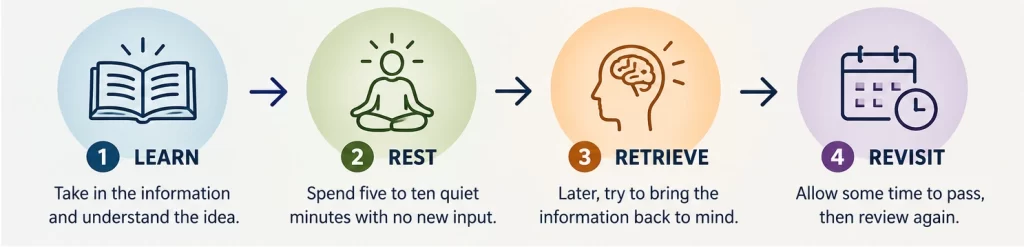
our-step memory strategy showing Learn, Rest, Retrieve, and Revisit.

You can turn the research into a very simple everyday routine.

Step 1: Learn

Read the important material.

Listen carefully during the explanation.

Understand the idea.

If possible, connect it to something you already know.

That last step matters because, as we discussed in Why New Information Sticks Better When You Connect It to What You Already Know, meaningful associations give the brain additional ways to organize and later access information.

Step 2: Rest

Once you finish, don’t immediately reach for another information source.

Try five to ten quiet minutes.

Sit.

Look out the window.

Close your eyes if comfortable.

Or simply allow yourself a few minutes without another demanding task.

You do not need to force yourself to think about the material.

The objective is simply to reduce new cognitive input for a short period.

These five to ten minutes are a practical starting point, not a scientifically established ideal duration for everyone.

Step 3: Retrieve

Later, not necessarily immediately, try bringing the information back to mind.

Ask:

What were the main points?

What was that person’s name?

What were the three things I needed to remember?

This connects with another memory principle we recently explored: retrieval practice.

Trying to remember before looking something up gives the brain practice accessing the information.

Step 4: Revisit Later

Then allow some time to pass before trying again.

That introduces the spacing effect.

Put these ideas together and you get a surprisingly sensible sequence:

Learn → Rest → Retrieve → Revisit

Each stage does something different.

Learning gets information in.

Rest may give it a quieter period for early consolidation.

Retrieval practices finding it again.

Spacing gives the memory another opportunity to strengthen over time.

You do not need to use this system for everything.

Use it for information that actually matters.

What About Reading?

Reading provides an especially easy way to test wakeful rest.

Suppose you spend twenty minutes reading a chapter, research report, or important article.

Your normal habit might be:

Finish reading → grab phone → check email → read news.

Try something different.

Finish reading.

Close the document.

Spend five quiet minutes doing almost nothing.

Later, ask yourself:

What were the three most important ideas?

You may also combine this with the strategy from our article Why Do I Forget What I Read?.

Instead of measuring reading by pages completed, measure it by what you can explain afterward.

Reading more material is not automatically the same as learning more material.

Rest Is Not the Same as Repetition

There is another interesting distinction here.

When people want to remember something, their instinct is often to keep repeating it.

Read it again.

Say it again.

Study it again.

Sometimes that helps.

But repetition and consolidation are not exactly the same process.

Research has begun comparing wakeful rest directly with post-learning repetition because scientists are still working out when one approach may be more useful than another.

So you do not need to choose one memory technique forever.

Different strategies can serve different purposes.

Connect new information to something meaningful.

Try retrieving it later.

Space those retrieval attempts over time.

And after especially important learning, consider giving your brain a few quiet minutes before flooding it with something new.

The Bigger Lesson Isn’t Really About Rest

The deeper lesson is that memory is influenced by what happens around learning.

We tend to judge our memory only at the moment we cannot remember something.

But successful recall begins much earlier.

Were you paying attention?

Did you understand the information?

Did you connect it to anything meaningful?

What happened immediately afterward?

Did you give it another opportunity to be retrieved?

Did you revisit it later?

Memory performance is the product of an entire sequence.

That is also why cognitive performance should not be reduced to one isolated ability.

Focus supports learning.

Working memory helps you manipulate new information.

Mental clarity helps you distinguish what matters.

Processing speed affects how efficiently you deal with incoming information.

And memory allows useful information to remain available after the moment has passed.

Where Lumultra Fits

Memory techniques work best when the cognitive systems required to use them are functioning well.

You still need enough focus to receive the information.

Enough mental clarity to process it.

Enough working memory to connect ideas.

And enough cognitive consistency to return to the information later.

Lumultra is formulated to support cognitive functions including focus, memory, and mental clarity as part of a broader cognitive-performance routine.

It is not a substitute for sleep, learning strategies, physical activity, or good memory habits. Nor has wakeful-rest research established that Lumultra enhances the effects of quiet rest.

Think of those habits as the method.

Lumultra is designed to complement a routine focused on everyday cognitive performance.

The Takeaway

We spend much of modern life trying to make every minute productive.

Read something.

Answer something.

Watch something.

Listen to something.

Move immediately to the next thing.

But your brain may not require constant input.

Sometimes information needs an opportunity to settle.

The next time you learn something that genuinely matters, experiment with something surprisingly simple:

Learn it.

Then stop.

Give yourself five or ten quiet minutes before feeding your brain another stream of information.

Later, try retrieving what you learned.

You may discover that one of the simplest memory strategies is not doing more.

It’s knowing when to briefly do less.
Why Saying Something Out Loud Can Help You Remember It

Someone tells you a name.

You repeat it silently in your head.

Five minutes later, it is gone.

You read the time of an appointment. You are certain you will remember it. Later that afternoon, you find yourself checking again.

Or you read an important sentence in a report, understand it perfectly, and discover the next day that almost none of the wording comes back.

But sometimes something different happens.

You say the information out loud.

“Thursday at 10:30.”

“Robert from Denver.”

“Call the accountant before Friday.”

And somehow it seems easier to retrieve later.

That may not be your imagination.

Researchers have studied a phenomenon known as the production effect: information that you actively say aloud can sometimes be remembered better than information you only read silently.

The explanation is surprisingly useful for everyday memory.

Saying Something Creates Another Memory Cue

When you silently read a piece of information, your brain processes the words visually and mentally.

When you say those same words aloud, you add something else.

You see the information.

You form the words.

You hear yourself saying them.

And because you produced the information yourself, it may become more distinctive from everything else you were processing at the time.

Researchers studying the production effect have found that selected words spoken aloud can be remembered better later than words studied silently.

That does not mean you should walk around narrating everything you want to remember.

The benefit appears to come partly from distinctiveness.

If everything becomes special, nothing is especially distinctive.

That makes this technique most useful for the few pieces of information that actually matter.

Speaking is one way to make information more memorable, but another is to create a meaningful picture—here’s why drawing a simple sketch can help you remember more.

Why Important Information Disappears So Easily

Memory does not begin when you try to remember something later.

It begins when the information first enters your attention.

Imagine someone gives you three instructions while you are:

  • checking your phone,
  • thinking about another problem,
  • watching someone walk past,
  • and deciding what you need to do next.

You may technically hear all three instructions.

But hearing something is not the same as giving your brain a strong opportunity to encode it.

This is one reason people occasionally interpret an attention problem as a memory problem.

The information did not necessarily disappear from memory. It may never have been strongly established there in the first place.

That is also why reading the same sentence repeatedly does not always solve the problem.

Passive exposure can create familiarity without creating reliable recall.

Something can look very familiar and still be surprisingly difficult to retrieve when the page is no longer in front of you.

Saying It Out Loud Forces a Small Moment of Attention

Try this with a piece of information you actually need later.

Instead of simply looking at:

Dentist — Thursday — 3:00 PM

say:

“Dentist. Thursday at three.”

That tiny action forces you to interact with the information instead of merely noticing it.

You have to select the words, produce them, hear them, and briefly hold their meaning together.

This creates a stronger event around the information.

The point is not that your voice has magical memory-enhancing properties.

The benefit comes from what producing the information makes your brain do.

There Is an Important Difference Between Remembering and Understanding

Reading something aloud may make certain information more memorable.

That does not necessarily mean you understand it better.

Researchers examining longer passages have found that reading aloud can improve memory for material without producing the same advantage for comprehension.

This distinction matters.

Suppose you are trying to understand a complicated investment document.

Reading one important definition aloud may help you remember the wording.

But that does not automatically mean you understand the financial implications.

For understanding, you still need to:

  • connect ideas,
  • ask questions,
  • compare information,
  • and explain the concept in your own words.

Memory and comprehension work together, but they are not identical.

For more detail, see this research on reading text aloud, memory, and comprehension.

An Even Better Trick: Say It Without Looking

There is another important memory principle here.

After you encounter something important, stop looking at it for a moment and try to retrieve it.

Instead of reading:

“Meeting moved to Wednesday at 2:00.”

five times, look away and ask:

“When is the meeting?”

Then answer:

“Wednesday at two.”

That small act changes the task.

You are no longer simply exposing yourself to the information.

You are practicing finding it.

Research on retrieval practice has found that attempting to retrieve recently learned information can strengthen later retention more effectively than simply restudying it.

This is why quizzing yourself can sometimes be more useful than rereading.

You are practicing the exact ability you will need later: getting the information back when the answer is no longer sitting in front of you.

Try the Read → Say → Recall Method

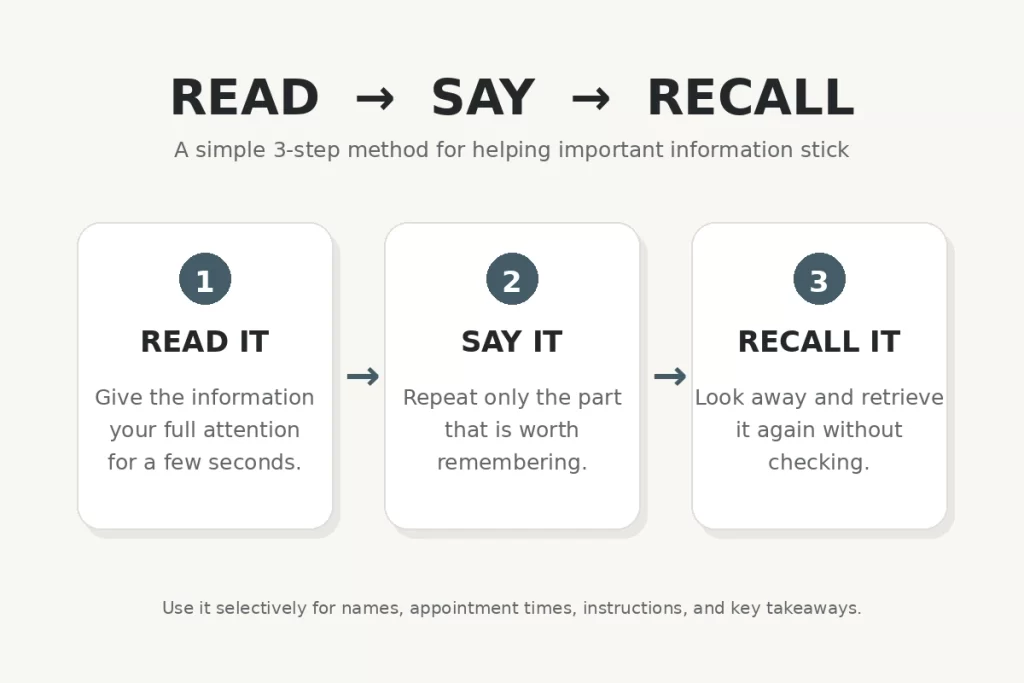
Read Say Recall three-step method for remembering important information

For information that really matters, use a simple three-step sequence.

1. Read It

Give the information your full attention for a few seconds.

2. Say It

Repeat the key information aloud in a simple form.

Not the entire paragraph. Just what you want to preserve.

3. Recall It

Look away.

Wait a few seconds.

Then say it again without checking.

READ → SAY → RECALL

For example:

You meet someone named Elizabeth who works with your accountant.

Instead of thinking:

“I need to remember her name.”

Try:

“Elizabeth. She works with David.”

Continue the conversation.

Thirty seconds later, mentally ask:

“What was her name?”

Elizabeth.

You have now done more than hear the name.

You have encoded it, produced it, and retrieved it.

What Kinds of Information Are Worth Saying Out Loud?

This technique works best when you are selective.

Good candidates include:

  • names you genuinely want to remember,
  • appointment times,
  • a short instruction,
  • an unfamiliar term,
  • a phone number you need temporarily,
  • a key takeaway from something you just read,
  • a next step you cannot act on immediately,
  • or one important detail from a conversation.

You probably do not need to vocalize your entire grocery list.

The purpose is to make selected information more distinctive.

Repeating a new name aloud can be especially useful when you meet someone you want to remember.

Saying something aloud can make it more distinctive, and revisiting it after a delay gives your brain another opportunity to retrieve it.

Combine Speaking With Writing When Something Really Matters

There is no rule saying you must choose between remembering something internally and using an external reminder.

Often, the smartest approach is both.

Suppose someone tells you:

“Bring the signed document Tuesday morning.”

You might say:

“Signed document, Tuesday morning.”

Then put a reminder next to your keys.

Writing things down gives you an external reminder, while saying the information gives your brain an additional encounter with it.

This is especially useful for responsibilities where forgetting has consequences.

Good memory systems do not require your brain to carry everything alone.

Why This Matters More Than Simply “Trying Harder”

When memory feels unreliable, the natural response is usually effort.

Concentrate harder.

Repeat something more times.

Force yourself to remember.

But better memory is often less about force and more about how information is processed.

Is the information receiving your attention?

Another useful strategy is to try retrieving the information before looking at it again, because the act of recall itself can help strengthen later memory.

Is it distinctive?

Did you actively retrieve it?

Did you create a useful cue for later?

These questions are often more productive than simply asking yourself to “remember better.”

Where Lumultra Fits

Memory techniques work best when the cognitive conditions around them are strong.

You still need enough attention to register information, enough working memory to hold it while using it, and enough mental clarity to separate what matters from everything competing for your attention.

Lumultra is formulated as daily cognitive support around those interconnected areas—focus, working memory, mental clarity, and overall cognitive performance.

It does not replace good sleep, useful memory systems, or habits such as retrieval practice.

Think of those behaviors as the strategy.

Lumultra is designed to support the cognitive foundation you are asking to carry out that strategy.

Because sometimes remembering more is not about forcing your brain harder.

It is about giving important information a better chance to stick.

Support clearer, more dependable cognitive performance with Lumultra.

Learn More About Lumultra

Why Does My Brain Work Better at Night?

If you’ve ever wondered, “Why does my brain work better at night?” you’re not alone. It happens to a lot of people.

All day, your brain feels crowded.

You answer emails.
Jump between tasks.
Handle conversations.
Remember appointments.
Check your phone.
Make decisions.

You sit down to do something that actually requires thought—and somehow everything feels harder than it should.

Then 10:00 p.m. arrives.

The messages slow down.

Nobody needs anything.

The house gets quiet.

And suddenly…

you can think.

The idea you’ve been struggling with all afternoon becomes obvious.

Writing gets easier.

Thoughts connect.

You can stay with one thing without constantly pulling yourself back.

And you start wondering:

Why does my brain work better at night?

It may be tempting to assume you’re simply a night person.

And for some people, biological timing absolutely matters.

But there may be another explanation hiding in plain sight:

Your brain didn’t suddenly become more powerful.

The competition for your attention disappeared.

This Shows Up More Than You Think

You may recognize the pattern:

  • You struggle to write during the workday but can write effortlessly late at night.
  • You spend hours avoiding a complicated task and suddenly solve it after dinner.
  • Your best ideas appear when everyone else has gone to bed.
  • You can read for an hour at night but struggle to finish three pages during the day.
  • You feel mentally scattered at 2:00 p.m. and strangely focused at 10:00 p.m.

That doesn’t necessarily mean something magical happens to your brain after sunset.

Two things may be changing simultaneously:

your internal biological rhythm

and

your external cognitive environment.

Understanding both helps explain why nighttime thinking can feel so different.

Your Brain Does Have a Daily Rhythm

The human brain doesn’t operate at exactly the same level of alertness throughout the entire day.

Your circadian rhythm helps regulate cycles of wakefulness and sleepiness over roughly 24 hours.

And those rhythms aren’t identical for everyone.

Some people naturally prefer waking and working earlier.

Others naturally shift later.

So yes—part of your nighttime clarity may reflect when your particular brain feels most alert.

But that’s only part of the story.

Because something else happens at night that has nothing to do with your internal clock.

The world gets quieter.

And cognitively, that matters.

During the Day, Your Brain Is Constantly Being Asked to Switch

Think about a normal afternoon.

You’re working on something.

An email appears.

You check it.

You return to your work.

Then your phone vibrates.

You answer a message.

You return again.

Someone asks a question.

Then you remember something you need to do later.

You add it to a list.

Then another notification appears.

None of these interruptions feels particularly significant.

But your brain pays for every one.

Research on task switching shows that the brain doesn’t seamlessly perform multiple demanding tasks at once. It repeatedly shifts its goals and rules as attention moves from one activity to another.

And when you return to the original task, you need to reconstruct where you were.

If this happens repeatedly during your day, it also helps to understand how long it can take to refocus after an interruption.

That’s why an interruption lasting 30 seconds can disrupt you for much longer than 30 seconds.

You’re not merely returning to your desk.

You’re returning to a mental state.

At Night, That Constant Reconstruction Often Stops

Now compare that with 10:30 p.m.

No meetings.

Fewer emails.

Fewer phone calls.

No coworkers asking questions.

No appointments waiting later in the day.

No constant expectation that something new might demand your attention.

You finally stay inside one thought long enough for it to develop.

And that creates an interesting sensation:

Your brain feels faster.

But perhaps it isn’t faster.

Perhaps it simply isn’t restarting every few minutes.

That distinction matters.

Because if you believe your brain only works at night, you may conclude that your biology is the problem.

If you recognize that your environment is contributing to the problem, you suddenly have much more control over it.

You’re Not Getting More Brainpower. You’re Losing Less of It.

This is one of the most useful ways to think about nighttime focus.

Throughout the day, your attention is constantly being divided among:

  • what you’re doing
  • what you were doing
  • what you need to do next
  • what someone just asked you
  • what you don’t want to forget
  • what’s happening on your phone
  • what might happen later

Each individual demand can be small.

Together, they create cognitive congestion.

That accumulating load may also help explain why your focus crashes halfway through the day, even when you still have plenty left to accomplish.

At night, much of that disappears.

You don’t necessarily gain additional mental capacity.

You stop spending so much of the capacity you already have.

That’s why complicated work can suddenly feel surprisingly easy.

The difference isn’t always motivation.

Sometimes it’s available mental bandwidth.

Why This Can Feel Like You’re “Finally Yourself” Again

The emotional part of this experience is easy to overlook.

When you’ve spent an entire day struggling to concentrate, it can create an uncomfortable question:

Am I getting slower?

Then nighttime comes and suddenly your old mental sharpness seems to reappear.

That’s reassuring—but also confusing.

Which version is the real you?

The answer may be both.

Your cognitive abilities don’t exist independently of the environment around you.

Attention is affected by interruptions, mental workload, stress, sleep, biological rhythms, and the number of competing demands you’re trying to hold at once.

That’s why your performance can feel dramatically different from one part of the day to another.

The capacity may still be there.

Access to it is inconsistent.

That’s also why understanding why your focus can feel inconsistent can be more useful than simply blaming yourself for having an “off” day.

But There’s an Important Catch: Don’t Sacrifice Sleep for Nighttime Clarity

Once people discover that they work well late at night, there’s a temptation to keep extending those hours.

That’s where this strategy can backfire.

Sleep deprivation has repeatedly been associated with poorer sustained attention and changes in working-memory and executive-function performance.

So if you’re routinely trading sleep for several hours of quiet work, you may eventually make your daytime cognition worse.

Which creates a vicious cycle:

You struggle during the day.

So you work at night.

You sleep less.

Then you struggle even more the next day.

So you depend even more on the quiet hours at night.

The goal shouldn’t be to become nocturnal.

It should be to understand what nighttime is giving your brain that daytime isn’t.

Then recreate more of that during the day.

Repeated context rebuilding is also one reason why your brain can feel slow at work, even when the work itself hasn’t become more difficult.

How to Recreate “Night Brain” During the Day

You probably can’t eliminate every interruption.

But you can create periods when your brain stops expecting them.

Try protecting one block of time for a cognitively demanding task.

During that period:

  • Silence notifications.
  • Close the inbox.
  • Put the phone somewhere you can’t see it.
  • Work on one clearly defined objective.

And perhaps most importantly:

Don’t use every moment of discomfort as a reason to switch tasks.

There is often a short period when your brain is settling into difficult work.

If you interrupt that process every time concentration feels slightly uncomfortable, you repeatedly prevent yourself from reaching the mental state you’re trying to create.

Nighttime sometimes solves this accidentally.

There simply isn’t as much else to switch to.

The Real Goal Is Mental Continuity

Most conversations about productivity revolve around energy.

More coffee.

More stimulation.

More motivation.

More urgency.

But if your best thinking happens when everything finally becomes quiet, energy may not be your primary limitation.

The missing ingredient may be continuity.

The ability to:

  • hold information in mind
  • remain inside the same thought
  • resist unnecessary switching
  • move from one mental step into the next
  • maintain clarity long enough to build momentum

Once continuity improves, thinking often feels different.

Not more intense.

Just smoother.

Where Lumultra Fits

This is where Lumultra makes the most natural connection.

The goal isn’t to artificially recreate the feeling of being awake at midnight.

And Lumultra isn’t a replacement for adequate sleep or good work habits.

The goal is to support the cognitive functions you rely on when you need to think clearly—focus, working memory, mental clarity, and the ability to stay engaged with what you’re doing.

Because the best mental-performance strategy isn’t forcing yourself to work only during the few hours when the world leaves you alone.

It’s building conditions that make clear, sustained thinking easier to access when you actually need it.

Your nighttime brain may already be showing you something important.

You’re probably capable of more focus than you think.

The challenge is giving that focus enough stability to show up consistently.

The Bottom Line

If your brain seems to work better at night, don’t immediately assume you were simply born to work after midnight.

Your natural circadian rhythm may play a role.

But so can something far simpler:

There is finally less competing for your attention.

Less switching.

Less incoming information.

Less anticipation of the next interruption.

Less mental reconstruction.

And when those things disappear, the difference can feel dramatic.

Your brain didn’t necessarily become sharper.

It finally got the chance to stay sharp.

And that’s the lesson worth taking into the rest of your day.


Want to Support Clearer, More Consistent Focus?

Explore Lumultra and discover support for clearer, more consistent focus throughout your day.

Explore Lumultra

Why Is It Harder to Remember New Information After 50?

You may remember the address of the house you lived in 30 years ago.

You may remember lyrics to a song you haven’t heard since college.

You might even remember exactly what someone said to you during an important conversation years ago.

But then someone tells you a name, gives you a three-step instruction, or explains something at lunch—and ten minutes later, part of it is gone.

That can be unsettling.

It can make you wonder: Why can I remember things from decades ago but have trouble remembering something I just heard?

The answer is more complicated—and often more encouraging—than simply saying your memory is getting worse.

Memory isn’t one single ability. Remembering new information requires several cognitive systems to cooperate. Before information can become a memory, your brain first has to notice it, focus on it, hold it long enough to process it, and encode it.

And some of those abilities can become less efficient with age.

The National Institute on Aging notes that aging can affect memory, learning and other cognitive functions, while also emphasizing that cognitive aging varies substantially from person to person.

So when new information doesn’t seem to “stick,” the problem may begin before what we normally think of as memory even takes over.

Memory Starts Before You Remember Anything

It helps to think about memory as a process rather than a storage container.

In simplified terms, your brain has to:

Pay attention → encode the information → store it → retrieve it later

If the first step is weak, everything downstream becomes more difficult.

Imagine someone introducing themselves while you’re simultaneously thinking about where you parked, looking at your phone and listening to another conversation.

Five minutes later, you can’t remember the person’s name.

It feels like a memory failure.

But there is another possibility: your brain never gave the name enough attention to create a strong memory in the first place.

Research has long demonstrated a close relationship between attention and memory. Attention helps determine which information receives priority, while working memory temporarily keeps relevant information accessible so the brain can work with it.

That’s why the question isn’t always:

“Why can’t I remember?”

Sometimes the better question is:

“How well was I paying attention when I first learned it?”

Working Memory Is Your Brain’s Temporary Workspace

Another important part of this process is working memory.

Working memory allows you to temporarily keep a small amount of information available while you’re doing something with it.

You use it when you:

Working memory has been described by researchers as the ability to keep a limited amount of information readily accessible for tasks such as comprehension, reasoning and problem-solving.

That temporary workspace is important because new information often passes through it before becoming something you can recall later.

If your attention is divided or your mental resources are already stretched, information can disappear from that temporary workspace before it has been processed deeply enough to become a stronger memory.

This connects directly to our recent article, Why Is It So Hard to Focus on One Thing?

Focus isn’t separate from memory.

Focus is part of the memory process.

Why New Information Can Feel Harder After 50

Healthy aging does not mean that everything about memory suddenly deteriorates.

In fact, many older adults retain extensive knowledge, vocabulary, expertise and memories accumulated over decades.

But certain aspects of cognition can become less efficient.

Research on normal cognitive aging has identified age-related differences in areas including processing speed, attention, working memory and episodic memory. Older adults can also find it more difficult to ignore irrelevant information competing for attention.

Even though some cognitive processes change with age, the brain retains an important capacity to adapt and learn. Read more in Can Your Brain Still Change After 50?.

That distinction helps explain a common experience:

Old information is already established. New information still has to get through the door.

A memory from 25 years ago may have been strengthened through repetition, emotion, associations and repeated retrieval.

Those long-established associations also help explain why certain smells bring back memories you thought you forgot. A familiar smell can provide a powerful retrieval cue for an older experience, even when recently learned information is more difficult to remember.

This contrast also helps explain why emotional memories can remain vivid for decades while important information from yesterday may be difficult to recall.

The name someone gave you 30 seconds ago has none of those advantages.

Your brain has to capture it while simultaneously filtering out everything else demanding your attention.

That can become particularly noticeable in busy environments.

Slower processing can also make new information feel harder to capture when several things are happening at once. See Why Your Brain Feels Slower After 50 for more on this connection.

That same filtering challenge helps explain why following conversations in noisy restaurants or crowded rooms can require noticeably more attention after 50.

You may find it harder to remember:

  • names during crowded social situations
  • verbal instructions given quickly
  • something your spouse tells you while you’re answering an email
  • details from meetings with several people speaking
  • information you read while notifications keep appearing
  • why you opened another browser tab
  • several items someone asks you to pick up later

Those situations don’t just test memory.

They test attention, filtering, processing speed and working memory at the same time.

Multitasking Makes Encoding Even Harder

Modern life isn’t exactly designed to make this easier.

We’re frequently trying to absorb information while checking messages, responding to notifications, watching television, navigating, listening to podcasts or thinking about the next task.

What we call multitasking often requires the brain to divide or rapidly redirect attention.

And that can interfere with memory formation.

In a study involving 252 adults ages 50 to 89, researchers found that performing competing tasks during memory encoding negatively affected performance, with age influencing some of the costs associated with that interference.

In everyday life, this means something very practical:

If you want to remember something, give your brain a real opportunity to receive it.

Listening while scrolling isn’t the same as listening.

Reading while checking email isn’t the same as reading.

Having a conversation while mentally rehearsing your next five tasks isn’t the same as being fully present for that conversation.

The brain can only remember what it successfully processes.

Sometimes the problem isn’t storing new information at all—it is retrieving information you already know, which helps explain why familiar names and words can suddenly feel just out of reach.

Mental Fatigue Can Make the Problem Worse

There’s another connection worth recognizing.

In our article Why Do I Feel Mentally Tired Even When I Haven’t Done Much?, we discussed how mental energy can be depleted by activities that don’t look physically demanding.

Decision-making, constant switching, information filtering and prolonged concentration all place demands on cognitive resources.

That matters for memory.

Think about how differently your brain functions at 9:00 in the morning compared with the end of a mentally demanding day.

A conversation that would have been easy to follow earlier may suddenly require more effort.

You reread the same paragraph.

Someone gives you three instructions and you retain two.

You walk away from a discussion remembering the general idea but not the details.

This same pattern can show up when you remember the big picture but forget the details, because general meaning and specific information are not always retained equally.

The issue may not be memory in isolation.

Your attention and working-memory systems may simply be operating under greater load.

That is why focus, mental stamina and memory should not always be treated as separate problems.

They are interconnected parts of cognitive performance.

Sometimes the issue is not memory alone—understanding the difference between brain fog and mental fatigue can help explain why thinking becomes less clear as cognitive demands build.

How to Help New Information “Stick”

You don’t have to memorize everything you encounter.

But when something genuinely matters, a few simple habits can give your brain a better chance to encode it.

1. Stop doing something else for a moment

When someone tells you something important, look away from the phone or computer.

Give the information a few seconds of undivided attention.

It sounds almost too simple, but attention is the entry point.

2. Repeat important information

If someone says:

“Dinner is at Marco’s at 7:15.”

Mentally repeat:

“Marco’s. 7:15.”

You’re giving the information another pass through your cognitive system instead of allowing it to disappear immediately.


3. Connect new information to something you already know

New information becomes easier to organize when it has context.

If you meet someone named Robert who lives in Austin, connect him mentally with another Robert you know or something memorable about Austin.

Instead of storing an isolated fact, you’re creating associations.

Another reason this can work is that connecting new information to knowledge you already have gives the brain more meaningful context for encoding and later retrieval.

4. Put information into your own words

After reading something important, stop and ask:

“What did that just say?”

Explaining the idea to yourself forces you to actively process it instead of simply looking at words.

5. Reduce unnecessary cognitive competition

If you’re learning something important, remove distractions when possible.

This can be especially useful when you’re already mentally tired.

You don’t need complete silence for every task. But there are times when giving one thing priority helps your brain do its job.

6. Use external memory strategically

Calendars, reminders and notes are not evidence that your memory has failed.

They’re tools that allow you to reserve mental resources for information that actually requires thinking.

You probably wouldn’t refuse to use a calculator because you believe your brain “should” handle every calculation.

Memory tools can serve the same purpose.

Supporting Memory May Start With Supporting Focus

People interested in cognitive supplements often begin with one goal:

“I want to improve my memory.”

But memory isn’t isolated from the rest of cognitive performance.

If your attention keeps drifting, information may never be encoded properly.

If your working memory is overloaded, you may lose details before you’ve had a chance to process them.

If mental fatigue makes sustained concentration difficult, learning new information becomes harder.

That is one reason Lumultra’s focus on cognitive performance goes beyond simply thinking about memory as storage.

Lumultra is designed to support areas such as focus, mental clarity and memory performance—cognitive functions that work together throughout the process of learning and remembering.

Think of it this way:

Better remembering begins with better receiving.

The goal isn’t to turn every passing detail into a permanent memory.

It’s to help create better conditions for your brain to engage with the information that actually matters.

For people whose bigger obstacle is mental energy or difficulty getting mentally engaged in the first place, Nova may address a somewhat different part of the cognitive-performance picture. But for this particular issue—attention, clarity and new-information processing—Lumultra is the more natural starting point.

What About Brain Health Overall?

No supplement replaces the fundamentals of cognitive health.

The National Institute on Aging recommends addressing broader factors associated with brain health, including physical health, sleep, physical activity, management of chronic conditions and social and intellectual engagement.

Lumultra should be viewed within that larger picture.

You want the fundamentals working in your favor while also supporting the specific cognitive functions you depend on every day.

When Memory Changes Deserve More Attention

Some forgetfulness is common.

But not every memory change should automatically be attributed to normal aging.

Forgetting a name and remembering it later is very different from becoming lost in familiar places, repeatedly asking the same questions or experiencing cognitive changes that interfere substantially with everyday activities.

The National Institute on Aging distinguishes ordinary age-related forgetfulness from patterns that may warrant medical evaluation.

If you or someone close to you notices a significant or rapidly progressing change in memory, reasoning or the ability to perform familiar tasks, discussing it with a healthcare professional is appropriate.

The Bigger Lesson: Memory Depends on More Than Memory

One of the most useful ways to think about cognitive aging is to stop treating focus, memory and mental stamina as three unrelated abilities.

They constantly influence one another.

Your brain needs enough attention to capture information.

It needs working memory to keep that information active.

It needs enough mental stamina to process it.

Then it needs to encode and eventually retrieve it.

That’s why you can remember something that happened decades ago yet forget what someone told you this morning.

The older memory has had years of reinforcement.

The new one had only a few seconds to compete for your attention.

So the next time something doesn’t stick, don’t immediately conclude:

“My memory is getting terrible.”

Ask a different question first:

“Did my brain really have a chance to take that information in?”

Supporting memory may begin much earlier than we think—with the quality of attention we bring to the moment in front of us.


Ready to Support Focus, Clarity and Memory?

If you’re noticing that information doesn’t seem to stick the way it once did, consider supporting the cognitive functions that come before recall.

Explore Lumultra →

Support clearer focus, stronger mental engagement and everyday cognitive performance.

Why You Read a Page and Remember Nothing

You finish a page, reach the bottom, and realize you cannot explain what you just read. Why do I forget what I read?

For information you especially want to retain, another simple strategy is to say it out loud, which can make selected information more distinctive than silent reading alone.

It’s a frustrating experience that sends many people back to the beginning of the page. You read it again—more slowly this time. The words look familiar. The sentences make sense. Yet a few minutes later, the main idea has already slipped away.

It is easy to interpret this as a memory problem. You may wonder whether your brain is getting slower, whether age is catching up with you, or whether you simply cannot concentrate the way you once could.

If you have ever asked, “Why do I forget what I read?” the answer may be more reassuring than you expect.

Often, the problem begins before memory is even asked to do its job.

To remember something, your brain first has to fully receive it. And that depends on attention.

Reading Is Not the Same as Encoding

Your eyes can move across every word on a page while your attention is somewhere else.

You may be thinking about an unfinished task, replaying a conversation, anticipating a notification, or mentally jumping ahead to what you need to do next.

From the outside, you are reading.

Inside the brain, however, only part of the information may be processed deeply enough to become memorable.

Memory begins with encoding—the process of turning incoming information into a form the brain can store and later retrieve.

If attention is weak or divided during that first stage, the memory trace may be incomplete. A systematic review examining mind wandering and memory encoding found that attention drifting away during learning is generally associated with poorer later memory.

This is why “I forgot what I read” often really means:

“My brain never fully captured it.”

The Quiet Role of Mind Wandering

Mind wandering is not always obvious.

Sometimes you notice that you have drifted away. Other times, your thoughts shift so subtly that you continue reading for several paragraphs before realizing you have lost the thread.

A meta-analysis of mind wandering and reading comprehension found a consistent negative relationship between the two.

When attention moves away from the text, the brain performs less of the processing needed to build a coherent understanding of what the words mean.

Comprehension requires more than recognizing words.

Your brain must:

  • Connect each new sentence to the one before it
  • Maintain the topic
  • Identify what matters
  • Interpret the author’s meaning
  • Update its understanding as the passage develops

When your attention drifts, that chain breaks.

You may understand each sentence individually without forming a clear picture of what the entire passage was trying to say.

Working Memory Has to Hold the Story Together

Working memory is the temporary mental workspace you use while thinking.

During reading, it helps you hold the beginning of a sentence long enough to understand the end. It connects a new point to an earlier one. It keeps the author’s argument active while you evaluate what comes next.

But working memory is limited.

If part of that workspace is already occupied by a meeting you need to prepare for, an email you have not answered, background noise, incoming messages, or low-level stress, less capacity remains for the page in front of you.

You may still decode the words correctly.

What becomes harder is integrating them.

This can make reading feel strangely effortful. You reread sentences, lose track of references, or reach the end of a section without a clear sense of what it said.

The same overload can explain why you keep losing your train of thought during conversations or work.

That feeling does not necessarily mean your intelligence has changed.

It may mean your mental workspace is overcrowded.

Why Rereading Can Create False Confidence

Rereading feels productive because the material becomes more familiar.

On the second pass, the words are easier to recognize. The paragraph flows more smoothly. You may think:

“Yes, I know this.”

But recognition and recall are not the same.

Recognition means the information looks familiar when it is in front of you.

Recall means you can bring the information back when the page is no longer there.

That difference matters.

Research on retrieval practice has repeatedly found that trying to recall information can strengthen long-term retention more effectively than simply restudying it.

The small effort involved in pulling an idea from memory helps make that idea more accessible later.

So the best question after reading a section is not:

“Did that make sense?”

It is:

“Can I explain it without looking?”

Why This Happens More Often Now

Age can influence attention and memory, but the modern information environment also matters.

Most of us rarely approach reading with an empty mind.

We read between emails, while monitoring messages, with multiple browser tabs open, or after hours of making decisions.

Even when the phone is silent, part of the brain may remain alert for the next interruption.

The result is fragmented attention.

The brain becomes practiced at scanning, switching, and reacting—but less practiced at staying with one idea long enough to encode it deeply.

That can also contribute to inconsistent focus, where your concentration feels strong one moment and unreliable the next.

This is especially noticeable with material that is complex, unfamiliar, or not immediately stimulating.

Short, fast-moving content trains the brain to expect frequent novelty. A long article, book, or detailed report asks for a different kind of attention:

Steady.

Patient.

Internally directed.

If that mode feels harder than it used to, it does not mean it is gone.

It may simply need to be protected and practiced.

“Mental fatigue can also make it harder to hold and encode new information, which may help explain why recent conversations or details don’t always stick.

How to Remember More of What You Read

1. Read in Sections, Not in Marathons

Do not wait until the end of a long chapter to test your understanding.

Pause after a meaningful section. Look away from the page and state the main point in your own words.

This keeps information from piling up faster than working memory can organize it.

Research also shows that information buried in the middle of a sequence can be harder to recall than information at the beginning or end, another reason to break longer material into manageable sections.

2. Use the One-Sentence Test

For a useful next step, explore how learning by teaching can help you organize what you’ve read into an explanation you can share with someone else.

After a page or section, ask:

“What was the author trying to tell me?”

Answer in one sentence.

If you cannot, reread with a purpose. You are no longer passively looking at the same words. You are searching for the central idea.

3. Remove Competing Inputs

Put the phone out of reach. Close unrelated tabs. Turn off alerts.

Even a brief glance at a message can replace the information you were holding in working memory.

A quieter environment gives the brain a better chance to maintain continuity.

4. Retrieve Before You Review

Before reopening the page, write down or say what you remember.

That pause is a form of retrieval practice for memory, giving your brain a chance to produce the idea before seeing it again.

Then compare your recollection with the original material.

This reveals what was actually encoded and what merely felt familiar.

5. Connect New Information to Something You Know

Memory becomes stronger when new information has somewhere to attach.

Ask how the idea relates to your work, an experience, a person, or something you previously learned.

The more meaningful the connection, the easier the information may be to retrieve later.

6. Notice When Mental Energy Is the Real Problem

Sometimes the issue is not your reading strategy.

It is timing.

If your focus crashes halfway through the day, schedule important reading for a sharper window whenever possible.

A depleted brain may need recovery more than another productivity technique.

Where Lumultra Fits

Better reading habits can improve how information enters memory.

But those habits are easier to use when your brain feels clear enough to sustain attention in the first place.

Lumultra is designed to support cognitive functions involved in mental clarity, focus, memory, and processing.

It is not a replacement for sleep, quiet, or active learning.

Rather, it can be part of a broader approach to helping your brain stay engaged long enough to process information more effectively.

For people whose difficulty is compounded by low mental energy, the Lumultra + Nova combination provides a complementary approach:

Lumultra for cognitive support.

Nova for a smoother lift in energy and drive.

The goal is not to force your brain through more pages.

It is to create the conditions in which the pages have a better chance of staying with you.

The Bottom Line

When you read a page and remember nothing, do not immediately assume your memory is failing.

The breakdown may have happened earlier—when attention drifted, working memory became overloaded, or the material was recognized without ever being actively retrieved.

Reading becomes memorable when the brain does more than see the words.

It must stay with them, organize them, connect them, and practice bringing them back.

Protecting that process can help you retain more—not by reading harder, but by reading in a way the brain can actually store.

Why Can’t I Remember Names Anymore? The Real Reason Recall Feels Slower

Why can’t I remember names the way I used to?

If you’ve been asking yourself why can’t I remember names, you’re experiencing one of the most common memory complaints among adults.

You meet someone, shake their hand, hear their name, and then five minutes later it is gone.

You know the face. The conversation is still clear in your mind. You might even remember where they work, what they were wearing, or the story they told you. But the name itself feels locked behind a mental door.

If you’ve found yourself wondering, “Why can’t I remember names anymore?”, you’re not alone. Name recall is one of the most common memory frustrations, especially for adults who still feel intelligent, capable, and high-functioning in every other area.

The good news is that forgetting names does not automatically mean your memory is failing. In many cases, it has less to do with “storage” and more to do with attention, mental load, stress, sleep, and the way your brain retrieves information under pressure.

The frustrating part is that name recall feels personal. Forgetting a task is annoying. Forgetting where you put your keys is inconvenient. But forgetting someone’s name can feel embarrassing, awkward, or even alarming.

So let’s break down what is really happening.

Remembering a Name Is Harder Than It Seems

Understanding why can’t I remember names starts with understanding how the brain stores and retrieves information.

A name feels like a simple piece of information. But to your brain, it is actually surprisingly difficult.

When someone tells you their name, your brain has to do several things almost instantly. It has to hear the sound clearly, pay attention to it, attach it to the person’s face, connect it to the context of the meeting, and store it long enough to retrieve later.

That is a lot of mental coordination for something that often happens during a distracted social moment.

You may be thinking about what to say next. Perhaps your attention is on the room around you. Many people are also trying to make a good impression. Sometimes you’re simply tired, overstimulated, or mentally juggling ten other things. By the time the person says, “Hi, I’m Sarah,” your brain may technically hear the name but never fully encode it.

The problem is not always that your memory lost the name. Sometimes your brain never properly filed it in the first place.

One reason people often say, “I’m terrible with names,” even though they remember faces, stories, appointments, and complicated work details just fine.

Names are arbitrary. A face may give you visual clues. A conversation may have meaning. A story has context. But a name often has no built-in logic unless you deliberately attach it to something.

That makes name recall more fragile than other kinds of memory.

Why Name Recall Can Feel Slower With Age

As people get older, many notice that recall feels less instant than it used to. The information may still be there, but it takes longer to access.

Name-recall problems are especially common with names, specific words, and small details. You know what you mean. The person’s face may be easy to picture. You may even remember the first letter of their name. But the full name does not appear when you want it.

This is sometimes described as a “tip-of-the-tongue” moment. It feels like the information is close, but not reachable.

The National Institute on Aging explains that some forgetfulness can be a normal part of aging, while memory problems that interfere with everyday life deserve more attention.

The key distinction is function.

Occasionally forgetting a name, misplacing glasses, or needing a moment to recall a word can be normal. But repeatedly getting lost in familiar places, struggling to follow directions, forgetting how to do everyday tasks, or experiencing major personality or judgment changes should be discussed with a medical professional.

For most people reading this, though, the issue is more subtle.

You’re not losing your life skills. Most people still know exactly who others are. Everyday functioning remains intact. You simply feel like recall is slower, less reliable, and more effortful than before.

That is exactly the type of mental performance gap many adults notice before they ever think of it as “memory decline.”

Attention Comes Before Memory

When people ask why can’t I remember names, attention problems during introductions are often a major part of the answer.

One of the biggest reasons people forget names is not poor memory. It is poor attention at the moment of introduction.

Memory does not begin when you try to recall something. Memory begins when you first take information in.

If your attention is scattered, your memory has less to work with.

Think about how often introductions happen when your mind is already busy. You are walking into a meeting, entering a party, joining a call, or being introduced to several people at once. In those moments, attention is often focused on the situation rather than the name itself.
You may hear the name but not register it deeply.

That matters because recall depends on encoding. Encoding is the process of turning new information into something your brain can store and retrieve later. If the name was weakly encoded, recall will feel difficult later.

This is why you might remember the name of someone you had a meaningful one-on-one conversation with, but forget the names of three people introduced to you quickly in a group.

Those names were not impossible to remember. Instead, your brain didn’t have enough attention available to attach each name to a strong mental cue.

Harvard Health notes that memory retrieval involves areas of the brain connected to attention and focus.

That is an important point for Lumultra’s audience: sharper memory is not just about “remembering better.” It often starts with focusing better.

Mental Load Makes Recall Worse

Another reason people wonder why can’t I remember names is that mental overload reduces the brain’s ability to encode and retrieve details efficiently.

Name recall also suffers when your brain is overloaded.

If you’ve ever felt like your brain feels busy all day but somehow accomplishes less than expected, you’re not imagining it. Mental overload can make even simple information like names harder to store and retrieve.

That mental load affects recall.

This may also explain why everything takes more effort during particularly demanding periods of life, even when your responsibilities haven’t dramatically changed.

When your brain is busy managing unfinished tasks, emotional stress, or constant stimulation, it has less capacity for small details. A person’s name may not seem important enough for the brain to prioritize in the moment.

Later, when you try to retrieve it, the name feels missing.

This does not mean your brain is broken. It means your cognitive bandwidth is being consumed.

Many people notice this pattern during especially demanding seasons of life. You may forget more names when you are sleeping poorly, traveling, managing stress, working long hours, or constantly switching between responsibilities.

The brain does not separate memory from the rest of your mental state. Recall is affected by energy, attention, emotional load, and recovery.

That is why the same person can feel sharp one week and mentally scattered the next.

Stress Can Block the Name You Know

There is another frustrating part of name recall: the harder you try, the more blocked it can feel.

Someone approaches. You know you should remember their name. A small wave of panic can follow. Then your mind goes blank.

That pressure can make recall worse.

When stress rises, your brain shifts away from relaxed retrieval and toward threat management. Even mild social anxiety can interfere with recall. The name may still be stored, but the mental state you are in makes it harder to access.

This is why the name often comes back later when you are no longer trying. You are driving home, taking a shower, or doing something unrelated, and suddenly the name appears.

That delayed recall is a clue. The information was probably not gone. It was temporarily blocked.

For many people, the issue is not memory loss. It is retrieval under pressure.

Sleep Plays a Bigger Role Than People Realize

If you’ve noticed yourself asking why can’t I remember names after a poor night’s sleep, there may be a direct connection between sleep quality and recall.

Sleep is one of the most overlooked factors in memory and recall.

Many people who struggle with brain fog after poor sleep notice that remembering names, words, and small details becomes noticeably more difficult the next day.

When you do not sleep well, your brain has a harder time encoding new information and retrieving stored information. You may still push through the day, but your recall becomes less clean.

Names, words, and small details are often the first things to feel affected.

Poor sleep can also make attention worse. That creates a double problem: you do not encode the name well when you hear it, and you have a harder time retrieving it later.

Harvard Health has noted that lack of sleep is a common contributor to forgetfulness. Dan can link the phrase “lack of sleep” to the Harvard forgetfulness source.

This is why someone may say, “My memory is getting worse,” when the real issue is that their brain is under-recovered.

Memory is not just a storage system. It is an energy-dependent process.

Why Faces Are Easier Than Names

Many people say, “I never forget a face, but I always forget a name.”

That makes sense.

Faces contain visual information. Your brain is naturally strong at recognizing facial patterns, expressions, and familiarity. Names are different. A name is usually an abstract sound with no obvious connection to the person.

Unless you create that connection, the name has less to attach to.

That is why memory techniques often involve making the name more vivid. You repeat it. You connect it to another person you know. You associate it with a visual image. You use it naturally in conversation.

For example, if you meet someone named Lily, you might briefly picture a lily flower. If you meet someone named Mark, you might connect him to another Mark you know. The point is not to make a perfect association. The point is to give your brain more hooks.

The more hooks a memory has, the easier it is to retrieve.

How to Improve Name Recall

Once you understand why can’t I remember names, the next step is learning strategies that strengthen attention and memory formation.

You do not need complicated memory tricks to get better at remembering names. You need a better system for attention and encoding.

Start by slowing down during the introduction. When someone says their name, give it one full second of attention. That sounds simple, but most people do not do it.

Repeat the name naturally: “Nice to meet you, Sarah.”

Then use the name once more soon after, if it feels natural. Repetition helps your brain register the information instead of letting it disappear into the noise.

Harvard Health recommends repetition as a practical memory strategy, including repeating a new person’s name because repetition helps strengthen memory formation and retrieval.

You can also attach the name to context. Instead of trying to remember “Sarah” by itself, remember “Sarah from the design team,” “Sarah who has two kids,” or “Sarah who talked about Italy.”

Context gives the memory a place to live.

Another helpful strategy is to say the name silently to yourself after the introduction. Not obsessively, just once or twice. This strengthens the first mental imprint.

Finally, reduce the pressure. If you forget a name, be normal about it. A simple “Remind me of your name again?” is usually fine. Most people understand because most people have the same problem.

The less shame you attach to forgetting, the easier recall becomes.

What Name Forgetting Can Tell You About Your Brain

Forgetting names can be annoying, but it can also be useful feedback.

t may be telling you that your brain is overloaded. Poor sleep may also be contributing to the problem. Multitasking through social situations can make recall harder. Fragmented attention is another common factor.

In other words, name recall is often a signal of your overall mental state.

That is why improving recall is not only about memory exercises. It is also about supporting the conditions that make clear thinking possible: attention, mental energy, recovery, and calm focus.

This is where Lumultra fits naturally.

Lumultra is designed to support mental clarity and focus while helping adults maintain cognitive performance when they want their minds to feel sharper and more reliable. It is not about forcing your brain into overdrive. It is about helping support the mental conditions that make better focus and recall possible.

When your attention is clearer, you encode information better. More stable mental energy can make recall feel less effortful. Without constant brain fog, small details become easier to hold onto.

That does not mean one supplement replaces sleep, stress management, or good memory habits. But for many people, supporting focus and clarity is one practical piece of the bigger picture.

The Bottom Line

So, if you’ve been wondering why can’t I remember names like I used to, the answer is often more related to attention, stress, sleep, and mental overload than true memory loss.

Often, the name hasn’t disappeared forever.
Instead, your brain was distracted when you heard it, overloaded when you tried to store it, or under pressure when you tried to retrieve it.

Name recall sits at the intersection of attention, memory, stress, sleep, and mental energy.

The next time you forget a name, do not immediately assume your memory is failing. Ask a better question: was I fully paying attention when I heard it? Was mental overload getting in the way? Could fatigue have been a factor? Or was I trying too hard under pressure?

Those answers are often more useful than self-criticism.

A sharper memory starts with a clearer mind. And for many adults, the goal is not to become perfect at remembering every detail. The goal is to feel mentally present, quick, and confident again.

That starts with giving your brain the support it needs to focus, encode, and recall more clearly.

Cognitive Resilience: The Hidden Skill That Determines How Sharp You Stay Under Pressure

Why Some People Stay Mentally Strong While Others Feel Constantly Drained

There was a time when being tired meant you needed more sleep.

Today, many people get plenty of sleep and still feel mentally exhausted.

They wake up tired. They lose focus faster. They forget simple things. Their attention feels fragmented. By afternoon, even routine decisions seem to require more effort than they should.

The strange part is that most of these people are not lazy, unmotivated, or unintelligent.

In fact, many are highly capable professionals, business owners, executives, parents, and lifelong learners.

They haven’t lost their intelligence.

Instead, many have lost something else.

Cognitive resilience has gradually eroded.

And in today’s world, that may be one of the most important mental abilities you can possess.

What Is Cognitive Resilience?

Most people think cognitive performance is about how smart you are.

But real-world performance is often determined by something different:

How well your brain continues functioning when life becomes stressful, demanding, distracting, or mentally overwhelming.

That ability is cognitive resilience.

It is the capacity to:

  • Maintain focus during pressure
  • Think clearly during uncertainty
  • Recover quickly from mental fatigue
  • Resist cognitive overload
  • Stay emotionally regulated under stress
  • Continue making good decisions when others mentally unravel

In other words, cognitive resilience isn’t about performing at your best on your easiest day.

It’s about how much of your mental capability remains available on your hardest day.

The Modern Brain Is Under Constant Attack

Humans evolved for occasional stress.

Today’s environment creates continuous stress.

Your brain is processing:

  • Emails
  • Text messages
  • News alerts
  • Social media feeds
  • Financial concerns
  • Work deadlines
  • Family responsibilities
  • Endless digital stimulation

The result is something neuroscientists increasingly recognize as cognitive overload.

Your brain rarely gets a chance to fully recover before the next demand arrives.

Many people assume their memory is declining.

Others assume they’re aging faster than expected.

But often the issue is simpler.

Their cognitive resources are being consumed faster than they can replenish them.

Why Brain Fog Is Often a Resilience Problem

When people describe brain fog, they usually say things like:

“I know the information is in my head.”

“I can’t think as quickly as I used to.”

“I keep losing my train of thought.”

“My brain feels tired all the time.”

These symptoms are frequently blamed on memory.

However, memory is often not the primary problem.

The deeper issue is that stress and mental fatigue are interfering with the brain systems responsible for accessing information efficiently.

Think of it this way:

Your knowledge may still be there.

Your brain simply doesn’t have enough available bandwidth to retrieve it smoothly.

That distinction matters.

Because it means many people are not experiencing a loss of intelligence.

They’re experiencing a loss of mental resilience.

The Working Memory Bottleneck

One of the most overlooked aspects of cognitive performance is working memory.

Working memory acts like the brain’s mental workspace.

It’s where you:

  • Hold information temporarily
  • Solve problems
  • Make decisions
  • Follow conversations
  • Organize thoughts
  • Learn new information

When working memory becomes overloaded, performance suffers quickly.

You may notice:

  • Increased distraction
  • Reduced attention span
  • Slower thinking
  • Difficulty multitasking
  • Frequent forgetfulness
  • Mental fatigue

Stress is particularly damaging because it consumes working memory resources.

The more mental energy spent managing stress, the less remains available for thinking clearly.

Dopamine Overstimulation Is Quietly Weakening Attention

Many people believe they have a focus problem.

What they often have is an overstimulation problem.

Every notification, scroll, click, and novelty hit triggers small dopamine responses.

Dopamine itself is not bad.

It’s essential for motivation, learning, and goal pursuit.

The problem occurs when the brain becomes conditioned to constant stimulation.

Suddenly:

  • Deep work feels uncomfortable.
  • Reading feels harder.
  • Long conversations require more effort.
  • Concentration weakens.
  • Boredom becomes intolerable.

This creates a dangerous cycle.

The more distracted we become, the more stimulation we seek.

The more stimulation we seek, the weaker sustained attention becomes.

Over time, attention starts behaving like an untrained muscle.

The Insight Most People Miss

Here’s a framing worth remembering:

Mental sharpness is not the absence of stress.

Mental sharpness is the ability to remain functional despite stress.

Many people spend years trying to eliminate every source of pressure from their lives.

But resilience develops differently.

The goal is not to create a stress-free life.

The goal is to build a brain that can absorb stress without losing access to its highest capabilities.

That distinction changes everything.

Because stress is inevitable.

Cognitive collapse is not.

Why Resilient Minds Age Better

One of the most interesting findings emerging from neuroscience is that chronic stress doesn’t simply affect mood.

It affects cognition.

Long-term stress has been associated with:

  • Reduced attention control
  • Impaired memory performance
  • Slower information processing
  • Increased mental fatigue
  • Greater susceptibility to cognitive decline

Meanwhile, individuals who maintain strong cognitive resilience often demonstrate:

  • Better focus
  • Faster recovery from setbacks
  • Greater emotional stability
  • More consistent productivity
  • Stronger long-term cognitive performance

In practical terms, resilient brains tend to remain usable for longer periods throughout the day—and throughout life.

Building Cognitive Resilience in a World That Constantly Drains It

The challenge facing modern adults isn’t a lack of information.

It’s a lack of recovery.

Most people are feeding their brains more data than ever before while giving them less time than ever to process it.

Cognitive resilience grows when the brain has opportunities to:

  • Recover
  • Adapt
  • Consolidate information
  • Restore attention
  • Rebuild mental energy

This is why sleep, movement, meaningful work, social connection, intellectual engagement, and proper cognitive support continue to matter so much.

Not because they make life perfect.

Because they help preserve the mental resources required to navigate an increasingly demanding world.

Final Thoughts

Many people worry they’re becoming less sharp.

Less focused.

Less capable.

Less mentally resilient than they once were.

In reality, the modern environment places extraordinary demands on the human brain.

The problem is often not a lack of intelligence.

It’s an accumulation of cognitive load.

Understanding this distinction is empowering.

Because cognitive resilience is not something you’re born with or without.

It is something that can be strengthened.

The people who remain mentally sharp for decades are not necessarily the smartest people in the room.

More often, they’re the ones who learned how to protect, preserve, and replenish the cognitive resources that matter most.

And in a world overflowing with distraction, that may become one of the greatest competitive advantages of all.


Why Do I Feel Tired Before Starting Work? (The Real Reason Your Brain Feels Drained)

why do I feel tired before starting work

Why do I feel tired before starting work even when the task is simple, the day just started, and nothing has actually drained me yet?

It’s the kind of tired that shows up before the work even has a chance to be hard.

You sit down to work.

Laptop open.
Task in front of you.

And within seconds… something feels off.

Not sleepy.

Not physically tired.

Just… mentally heavy.

So you don’t start.

Instead, you do small things that feel like movement but aren’t progress.

You move your cursor around.

You open a tab.

Close it.

Open another.

Then pause for a second… wondering what you were about to do.

You reread the same sentence — and it still doesn’t stick. 


This happens within seconds.

Before your first click.

Before your first sentence.

There’s a small pause — just a second longer than it should be.

That’s where it starts. 

You tell yourself: “I’ll start in a second.”

You’re not resting. You’re circling the start.

If you’ve ever caught yourself wondering:

  • Why do I feel tired before starting work?
  • Why does my brain feel drained before I even begin?
  • Why does everything feel harder than it should?

You’re not imagining it.

But you are misreading what’s happening.


Why Do I Feel Tired Before Starting Work Even When I Haven’t Done Anything?

Because your brain already started — just not in a way you can see.

Before you take action, your brain runs a rapid internal check — the same pattern behind why your brain feels slow at work:

  • How hard is this going to feel?
  • How long will this drag on?
  • What if I lose focus again?
  • What if I waste another hour?

You don’t consciously choose to think this. But your brain runs it anyway.

Each of those micro-calculations costs energy.

So by the time you’re about to begin, you already feel like you’ve spent something — a pattern strongly linked to mental fatigue.

You didn’t do the work.

Your brain already paid the cost of starting.

And this is where it starts to feel confusing. 


Why Your Brain Feels Tired Before Work (It’s Not About Energy)

This is where most people go wrong.

They assume:

“I just need more energy.”

So they reach for:

  • coffee
  • motivation
  • discipline

But none of that touches the real issue.

Because this isn’t an energy problem.

It’s a pre-load problem — and it’s closely tied to what’s actually distracting your focus.

Your brain is loading the weight of the task before the task begins. And that weight feels like fatigue.

You’re not tired from work. You’re tired from trying to start it before you start it.

So when you ask, “why do I feel tired before starting work?” the answer usually isn’t that you lack energy. It’s that your brain is already bracing for the task before you begin.


Why does it feel hard to start even simple tasks?

Because your brain doesn’t see the task the way you do.
It doesn’t see “simple.”
It sees uncertain effort.

Before you even begin, your brain is trying to predict:
How long this will take
How focused you’ll need to be
How likely you are to get stuck

And if that prediction feels even slightly off…
it slows you down.

Not because the task is hard —
but because your brain isn’t sure what it’s walking into.


Signs Your Brain Is Mentally Drained Before You Even Start

This doesn’t look dramatic. It looks subtle — and familiar.

brain feels drained before starting work

You might notice:

  • You open your laptop… then sit there a few seconds too long.
  • You click into a task… then hesitate before typing.
  • You switch tabs… then forget why you switched.
  • You check your phone — not because you want to, but because you need relief.

And then the quieter behaviors:

  • resizing windows like it somehow helps
  • organizing things that don’t matter
  • “getting ready” instead of actually beginning

And then the part you don’t say out loud:

“I should’ve started by now.”

“I’ll start after this.”

You’re not stuck.

You’re delaying in a way that feels just productive enough to avoid guilt.

Over time, that builds something deeper.

You don’t feel lazy.

You feel unreliable to yourself.


Why Do I Feel Tired Before Starting Work but Feel Better Once I Begin?

Because the hardest part is not always the work. Sometimes, it’s the transition into the work.

Once you begin, your brain has clearer signals. It can respond to what is actually happening instead of guessing how hard the task might feel.

That’s why the resistance often feels strongest before the first real action.

When you can focus on enjoyable activities but resist important work, the issue may involve how your brain evaluates cognitive effort and immediate reward.


Why You Feel Drained Before Doing Anything (The Hidden Mental Loop)

What you’re experiencing isn’t random. It’s a loop  — and the same pattern behind how interruptions destroy your ability to refocus.

You anticipate effort → You feel resistance → So you hesitate.

You hesitate → You feel pressure → So the task feels heavier.

So next time?

The loop starts earlier — until starting itself feels like the task.


Why do simple tasks feel heavy even when they’re not?

Because you’re not just feeling the task.
You’re feeling everything that happened before it.

The hesitation.
The delay.
The pressure of “I should’ve started already.”

That weight stacks quietly.
So by the time you finally try to begin…
even a small task feels like something you have to push into.

It’s not the task that’s heavy.
It’s the buildup around it.


How This Quietly Destroys Your Day

You don’t start fresh. You start behind.

Your day begins to follow a pattern:

Delay → rush → lose focus → feel guilty → repeat.

That small guilt doesn’t go away. It builds.

By the time you’re actually working, you’re already mentally taxed — not from output, but from resistance.

The real drain isn’t the task. It’s the hesitation before it.


Why Coffee, Discipline, and Productivity Hacks Don’t Fix It

Let’s break this down clearly.

Coffee

  • increases stimulation
  • helps you feel alert
  • but doesn’t change how your brain interprets the task

Discipline

  • forces action
  • helps you push through
  • but keeps the resistance loop intact

Productivity systems

  • organize execution
  • make you more efficient
  • but don’t reduce pre-action load

So yes, you might perform better.

But the starting point?

It never actually changes.


Is this laziness or something else?

It doesn’t feel like laziness.
Because it isn’t.

Laziness is passive.
This isn’t.

This feels like pressure.
Like something you should be doing… but can’t fully get into.

That tension — that internal resistance —
isn’t a lack of discipline.

It’s your brain reacting to how the task is being processed before you even start.


What Actually Causes Mental Fatigue Before Starting Work

Your brain is wired to minimize uncertainty through your stress response system.

Work = unknown experience
Unknown = potential discomfort
Discomfort = slow down

So your brain creates resistance before you begin.

But here’s the deeper layer most people miss:

This isn’t just psychological.

Your brain is trying to predict how much effort this task will take — before you even start.

And that prediction alone creates resistance.


That hesitation loop is tied to how your brain regulates cognitive load — the amount of mental effort your brain can handle at once — along with your stress response and focus signaling.

When that signal is unstable, your brain treats even simple tasks like something to brace for.

You’re not avoiding work.

You’re reacting to how your brain is signaling it— before you even get a chance to start.


How to Stop Feeling Tired Before Work (Without Forcing Yourself)

You don’t fix this by pushing harder.

You fix it by stabilizing what happens before the push.

Because that’s where the problem starts.

When your brain stops overloading the signal…

Starting stops feeling like effort.


Why Most Solutions Never Fix This Layer

They focus on output, not input.

So you end up adding:

  • more structure
  • more pressure
  • more effort

But the signal stays the same.

And if the signal stays the same, the loop keeps running.


The Only Way This Actually Changes

You need to stabilize the system that’s creating the signal.

Not override it.

Not fight it.

Stabilize it.

Because if the problem starts before you begin, no solution that works after you begin can fix it.


A Different Kind of Solution (This Targets the Root Mechanism)

This only changes if that signal changes.

Not after you start.

But before you start.

That’s the layer most solutions never touch.

They try to push you into action — which is exactly what most people get wrong about brain supplements.

They force the output… without fixing what your brain is experiencing going into the task.

This works earlier than that.

The hesitation you feel is the result of unstable signaling between:

  • focus
  • stress
  • cognitive load

And if that layer doesn’t change, this pattern doesn’t change — no matter what you try.


And it’s the only place something like Lumultra actually works.

Not by forcing stimulation, but by helping regulate:

  • mental clarity going into tasks
  • how your brain processes effort
  • how smoothly you transition into focus

So instead of fighting resistance…

you remove the condition that creates it in the first place.


What Happens When That Loop Is Broken

Things don’t become intense. They become simple.

You stop:

  • hovering over tasks
  • stalling in fake productivity
  • negotiating with yourself

You sit down.

And you start.

Not perfectly. Not forcefully.

Just… clean.

And the biggest shift?

You trust yourself to begin.


Quick Reality Check

Be honest for a second.

How often does this happen?

  • You open your laptop… and don’t start immediately
  • You switch tabs before doing anything meaningful
  • You feel resistance before simple tasks
  • You “prepare” instead of actually beginning
  • You feel mentally tired before doing real work

If your answer is:

“Yeah… that’s basically every day.”

Then this isn’t random.

It’s a loop.


If You Leave This Unfixed

Nothing dramatic happens.

That’s the danger.

Your days just stay slightly heavier than they should be.

You keep starting later than you want.

You keep thinking:

“I could’ve done more… if I just got going earlier.”

Not failure.

Just constant drag.


What Fixing This Actually Feels Like

This isn’t about becoming more disciplined.

It’s about removing the friction that makes starting feel heavy.

Because once that friction is gone…

you don’t negotiate with yourself anymore.

You don’t stall.

You don’t hover.

You sit down —

and you begin. 


Where to Start

If this pattern feels familiar, this isn’t something you fix by trying harder.

It’s something you fix by changing what your brain experiences before you begin.

Because when starting feels heavy, you’ll keep avoiding it — no matter how disciplined you are.

That’s the exact layer Lumultra is built to affect.

Not by forcing focus.
Not by pushing you through resistance.

But by helping your brain feel clear enough to start without that internal weight.

And once that changes…

Starting doesn’t feel like something you have to convince yourself to do.

It just happens.

If you’re tired of fighting the same start every day, fix it at the source.

Explore Lumultra here.

How Long Does It Really Take to Refocus After an Interruption

Frustrated man sitting at a laptop struggling to refocus after losing concentration

If you’ve ever wondered how long it takes to refocus after interruption —
or why it always feels longer than it should —

this is probably why your day feels slower than it should.

You sit down to work.
Nothing complicated.
Nothing you haven’t done before.

But for a few seconds…
you feel slower than you should.

Like you forgot how to do something you’ve done a hundred times…

and for a second, something feels off…

like your brain lagged for a second
like you suddenly don’t trust your own thinking


You start… then pause.

Your cursor moves…
then stops halfway

because something feels off
even though you don’t know what.

Then you reread.

and it still doesn’t click the first time

And suddenly, you hesitate longer than you should.

So you check something first.
Slack.
Your inbox.
A notification.

Phone showing multiple app notifications distracting a person and breaking their focus while working

Then you come back.

But now it feels like you’re easing into something
that should’ve been easy to continue.

You’re not continuing your work —
you’re becoming a beginner again…

but with the pressure of someone who’s supposed to already be good at this.


What’s actually happening (and why it feels off)

What’s actually happening is easy to miss.

You’re not picking up where you left off.

You’re rebuilding it — from scratch.

The version of you that knew exactly what to do?
It’s gone.

That means reconstructing:

  • what you were doing
  • where you were in it
  • what mattered in that moment

That takes time.

Not seconds.
Minutes.

And if you get pulled away again before it fully locks in—

you reset again.

This is the part nobody says out loud:

it’s not just frustrating —
it makes you question your own sharpness.

like you’re slower than you used to be — even if you’re not


Why does it feel so hard to focus again after being interrupted?

Because your brain doesn’t pause tasks.

It deletes the active version of them.

And when you come back—

you’re not resuming…

That’s why this keeps happening:

you reread the same line… again
not because it’s hard — but because it doesn’t register

you pause mid-thought
and for a second… your mind goes blank

you remember the task…
but not the next step

so you sit there longer than you should

you were about to do something
and now you’re just staring
trying to remember what that was

Not because you lack discipline.

Because nothing had time to fully stick.


The part nobody tells you about interruptions

Interruptions don’t just slow you down in the moment.

This is also one reason interruptions can leave you reading the same sentence over and over: you’re rebuilding the mental context needed to understand it.

They train your brain to stop trusting momentum.

So even when nothing interrupts you…

you still hesitate.

You still feel that slight delay
before getting into anything.

That’s why your day feels slow
even when you’re “not that distracted.”


Why interruptions ruin focus more than you think (it’s not what you expect)

The reason why interruptions ruin focus isn’t just the distraction itself —
it’s the reset that happens after.

The interruption itself isn’t the real problem.

It’s what it breaks.

You open a task…
check Slack “for a second”…
reply quickly…
then come back…

…and now you’re staring at your screen longer than you should.

Trying to reload:

  • what you were doing
  • what your next step was
  • how everything connected

That’s where the time goes.

Not in the interruption—

but in the recovery.

You’re not slow.

You’re just constantly becoming a beginner again.

Not because you’re bad at focusing —
but because you never stay the same version of yourself long enough to get good at it.

This is why you can be busy all day…
and still feel like you barely got anything done.


The hidden cost of task switching on productivity

Most people think task switching costs seconds.

But it doesn’t.

It costs mental continuity.

You’re writing something.

Then you switch tabs to look something up.

You open one page… then another… then another.

A few seconds pass.

Then you stop.

And you realize you don’t remember why you opened any of them.

so you click around for a bit…
hoping it comes back

until you eventually give up
and switch tasks again

so your day fills up with started things… but barely anything actually finished


Now you go back.

And instead of writing—

you sit there, trying to reconstruct your train of thought.

This is the real cost of task switching on productivity — not lost time, but lost mental state.


So how long does it take to refocus after an interruption in real life?

Task switching doesn’t just slow your work.

It deletes the version of you
that knew exactly what to do next.

This hidden cost of task switching on productivity is why your day feels slower even when you’re constantly busy.


How long does it take to refocus after interruption

In most cases, how long does it take to refocus after an interruption isn’t just a few seconds —
it can take several minutes to fully rebuild your mental state, based on studies on how long it takes to refocus after an interruption.

Because refocusing isn’t one step.

It’s a sequence.

First, you reorient: what am I doing?

Then you reload context: where was I?

Then you rebuild momentum: okay… continue…

That process takes minutes — which is why how long it takes to get back into focus after distraction is almost always longer than people expect.

And if you get interrupted again before that process finishes—

you reset again.


Why your brain feels slower after switching tasks

It’s not one interruption.

It’s dozens of small ones.

Each one forces your brain to:

  • drop context
  • rebuild context
  • regain momentum

So by the end of the day:

  • things take longer than they should
  • simple tasks feel heavier
  • you never fully get into flow

Not because you’re tired.

But because you never stay in one version of yourself

long enough to build speed.

This may also explain why some people focus better at night, when the constant cycle of interruption and refocusing finally slows down

How to reduce the cost of interruptions (without forcing discipline)

Most advice tells you to eliminate distractions.

But that’s not always realistic.

Interruptions happen.

So the real question is:

how much do they cost you?

What matters is your brain’s ability to:

  • hold context longer
  • return to tasks faster
  • rebuild focus with less effort

So you don’t keep starting over.


Where Lumultra fits in

Most tools try to force focus.

Short bursts. Timers. Quick spikes.

Coffee doesn’t fix this.

It might wake you up —

but it doesn’t stop your focus from breaking.

Willpower doesn’t fix it either.

You can force yourself to sit there…

but you can’t force your brain to hold momentum.

But that’s not the real problem.


The real problem is this:

your focus doesn’t last long enough to build momentum.

That’s why everything feels like a restart.

Lumultra is built for something different.

Not getting you into focus—

but keeping you there.

So instead of constantly dropping out
and having to rebuild your mental state…

you stay in it longer.

Long enough for things to click.
Long enough to build speed.
Long enough for work to feel smooth again.

So when interruptions happen—

they don’t hit as hard.

Because you’re not operating on fragile focus anymore.

You’re operating on sustained momentum.

You’re not trying to get into focus over and over again.

You’re staying in it.


Final thought

If your day feels slower than it should—

it’s not your effort.

It’s the constant restarting.

Imagine going through your work…

without that feeling.

No “what was I doing?”
No slow ramp-up.
No hesitation.

Just… continuity.

The kind where you forget what it felt like
to constantly start over.

If you’re tired of constantly starting over —

this is where you fix it.


Lumultra is where you stop starting over.


Explore Lumultra here.

Why You Feel Tired Before Starting Work (And How to Fix It)

checking phone notifications before starting work distraction

If you’ve ever asked yourself, “why do I feel tired before starting work,” — or why it takes longer than it should to get into something simple — you’re not alone.

You sit down to work.
Nothing complicated. 
Nothing you can’t handle.

But something feels off.

You’re not fully in it.
It takes longer than it should to get started.
Simple tasks feel heavier.
Your focus doesn’t click the way it used to.

So you check something first.

Your inbox. 
Slack. 
Notifications.

Then you try to begin again.

But it still feels like you’re easing into something
that should’ve been easy to start in the first place.


You’re not starting your work — you’re recovering first

What’s actually happening is more subtle.

You’re not starting from a clear mental state.
You’re trying to recover one first.

That’s why starting feels harder than it should.

Before you even begin, your brain is already partially engaged —
anticipating messages, expecting updates, staying ready to respond.

Like having multiple tabs open in the background.

You’re not actively using them…
but they’re still taking up space.


Why do you feel tired before starting work?

Most people assume this is just fatigue.

“I’m just tired.”
“I didn’t sleep well.”
“I need more time to wake up.”

So they try:

  • more caffeine
  • more time
  • or just pushing through

But the issue isn’t energy.

It’s that your brain isn’t starting from neutral.

It’s already carrying a layer of mental activity —
a kind of cognitive pre-load.

So instead of starting fresh,
you’re already slightly pulled in multiple directions.


The hidden cost of checking messages and notifications

person distracted by notifications while working

This is where things start to break down.

You open a task…
check Slack “for a second”…
come back…

…and suddenly you’re trying to remember where you were.


At first, that moment doesn’t feel like much.

But it adds up.

Because:

Checking something for 10 seconds doesn’t cost you 10 seconds —

it costs the mental state you were just in.

Every time your attention shifts, your brain has to rebuild:

  • what you were focusing on
  • where you were going
  • your thinking feels less sharp what mattered in that moment

And that reset takes longer than you think.


How long does it take to refocus after interruption?

Most people think it’s a few seconds.

In reality, it’s not.

Even brief interruptions can cost minutes of mental recovery.

Not because the work is hard —
but because your brain has to reconstruct the state you were just in.

So instead of continuing…

you keep restarting.

Start → pause → reset → try again.

And over time, those resets quietly consume your day.


Why you keep losing your train of thought

This isn’t just about distraction.

You can focus.

You can start.

But you can’t always stay in it long enough to build momentum.

That’s why you:

  • reread the same line
  • pause mid-task
  • switch tabs without thinking
  • lose your train of thought

Not because you lack discipline —

but because your mental state keeps getting disrupted.


Why You Feel Tired Before Starting Work (Even When It’s Easy)


At first, it’s subtle.

You take slightly longer to start.
You hesitate more.
You need more effort to think things through.

But over time, it compounds.

Tasks stretch out longer than they should.
Your thinking feels less sharp.
Your output doesn’t match your effort.

And if you’re honest…

you don’t feel as sharp as you used to.

Not dramatically.
Just enough to notice.


This isn’t a discipline problem

Most people try to fix this by pushing harder.

Focus more.
Be more disciplined.
Eliminate distractions.

But that misses the point.

You can’t force performance
if your mental state keeps dropping.

The real issue isn’t effort.

It’s stability.


How to stay focused longer without constantly restarting

What your brain actually needs isn’t more stimulation.

Not more spikes.
Not more forcing.

It needs the ability to:

  • reduce background mental noise
  • come out of constant “ready mode”
  • and stay in a stable, clear mental state

So when you start something—

you don’t have to keep restarting.

You just continue.


How to support a more stable, focused mental state

If the real issue is your ability to stay in one mental state,

then the solution isn’t pushing harder —

it’s making that state easier to maintain.

Because when your brain can stay clear and engaged:

  • work feels smoother
  • thinking feels sharper
  • effort actually translates into output

You don’t need to force focus.

You don’t need to keep resetting.

You just stay in it. 


Where Lumultra fits in

Most solutions try to push short bursts of focus.

But that’s not the real problem.

The real issue is whether your brain can stay there.

Lumultra was designed around this —
to support how consistently your brain can stay clear, stable, and engaged.

So instead of constantly starting over…

you continue.


If this feels familiar

This isn’t about discipline.

It’s not that you’ve lost your ability to focus.

It’s that your brain hasn’t been able to stay in one state long enough
to perform the way you know it can.

And that gap —
between effort and output —
is what’s costing you time, energy, and clarity every day.

Once that changes…
everything else follows.


👉 Explore Lumultra here